Five electric-car faults that get answered with a battery
The traction battery is the most expensive part of an electric car and the thing owners expect to fail. That combination makes it the default answer to a long list of faults that are not the battery at all.
Here are five, with what each actually is, and the question that separates it.
1. A section of the pack reading low
Could be a weak cell group. Could equally be the thin sense wire measuring it, gone high-resistance somewhere inside the pack. The car cannot tell them apart.
Ask: does the reading change in ways a battery physically can — slowly, with load and temperature — or does it jump? Jumping is wiring. See P0B14.
2. A 12 V battery that keeps going flat
An electric car has no alternator. The DC/DC converter charges the 12 V system from the traction pack, and when it stops doing that the symptom is a dead 12 V battery — twice.
Ask for the 12 V charging voltage with the car powered on. Around 13.5 to 14.5 volts means it is charging; twelve-point-something means it is not. See P0C38.
3. Range that has collapsed
State of charge is not measured, it is counted — current integrated over time. A drifting current sensor changes what the car believes about its own battery while nothing is wrong with the battery.
Ask whether the pack's current sensors were checked before the pack was. Two are usually fitted precisely so they can be compared. See P0B0E and P0B13.
4. Charging that has become slow
Temperature sets charging speed, and no car will rapid-charge a cold pack at full rate — that part is by design. But a cooling fault does the same thing on a warm day: a blocked pack intake, a failed coolant pump, or air trapped in the circuit after a repair.
Ask whether the pack's cooling was actually verified, and look at the intake — on air-cooled packs it is usually inside the cabin and blocks with dust and whatever has been left on the back seat. See P0C32.
5. Power that fades on a long climb and comes back afterwards
That is thermal derating, and it can be the motor, the inverter or the pack. It is also exactly what one faulty temperature sensor produces on completely healthy hardware.
Ask which sensor, and whether it disagrees with its neighbours. Sensors sitting near each other cannot be at very different temperatures, because heat moves. See P0C11.
The pattern worth taking away
In every one of these the battery is downstream of the thing that is actually wrong — a wire, a converter, a sensor, a pump. None of those is exotic and none is expensive. The battery is simply the most visible thing in the system and the first thing a quote reaches for.
Ask what was measured. A pack replacement is a reasonable answer to some of these and the wrong answer to most of them.
يُنشر هذا الدليل بموجب رخصة CC BY-SA 4.0 — حرٌّ في الاتّباع وإعادة الاستخدام والتحسين، مع نسب العمل إلى صاحبه والمشاركة بالترخيص نفسه.
المرفقات
-
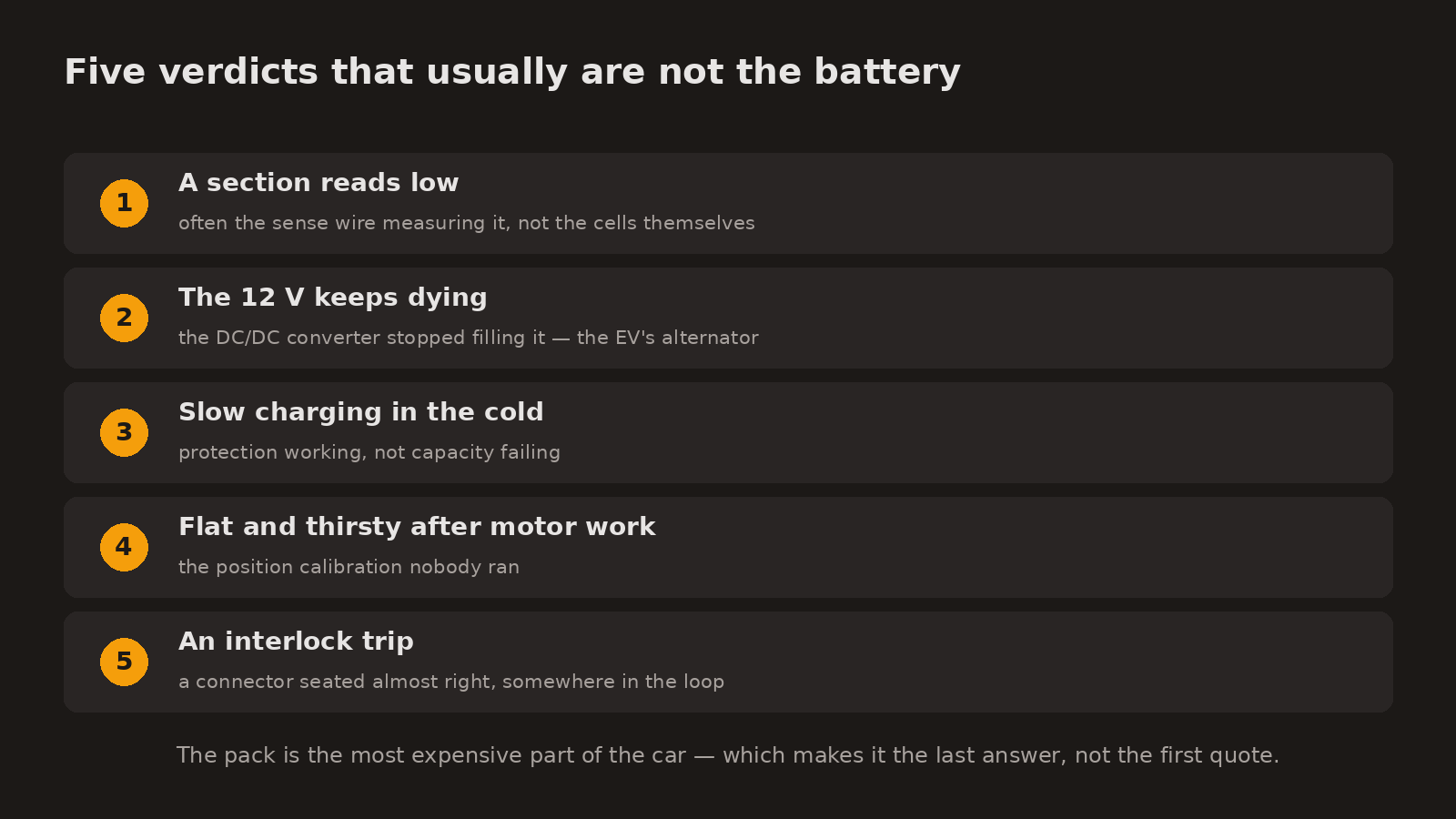
Diagram: five electric-car faults commonly blamed on the traction battery, and what each usually is instead.
معلومات لا تعليمات
موقع CarGeek مرجع وليس دليل صيانة. تُكتب صفحاته من مصادر عامة ومما توصّل إليه آخرون، لا من وثائق الصيانة الخاصة بالشركة الصانعة، ولذلك قد تكون خاطئة أو ناقصة بالنسبة لمركبتك تحديدًا. وبعض ما تصفه ينطوي على خطر حقيقي: جهد عالٍ، ووقود تحت ضغط، وطاقة مخزَّنة، وأجزاء ساخنة أو متحركة.
قبل العمل بأي مما هنا، اطلب من شخص مدرَّب التحقق منه وفق الإجراء المعتمد من الشركة الصانعة لمركبتك. ولا شيء هنا يغني عن ذلك الإجراء.