P0A80 before you buy a battery: what the block voltages actually say
P0A80 — "replace hybrid battery pack" — is the most expensively misread code in the hybrid world. It reports that the pack's blocks are drifting apart in performance, and it is routinely quoted straight into a whole-pack replacement when the data often describes one weak module in an otherwise serviceable pack.
Safety first, and not as a formality: hybrid packs run at lethal voltage. Reading live data through the diagnostic port is safe; anything beyond that — opening the pack, touching the service disconnect, module work — needs HV training, insulated gloves rated and tested for it, and the discipline to treat orange cables as what they are. If that is not you, use this guide to understand the quote, not to open the battery.
What to look at, scanner only
- Find the battery block voltages in live data (a Toyota/Lexus-capable app shows 14 blocks on most packs).
- Watch them under load — hard acceleration, then regen braking.
- A healthy pack moves as a family: blocks within roughly 0.3 V of each other. A pack failing P0A80's test shows one or two blocks sagging hard under load and spiking high on charge while the rest hold together — that is the signature of a weak module, not fourteen dead ones.
What it means
- One or two outlier blocks, rest tight: module-level repair is a real option, and a reconditioned-pack quote should be weighed against it.
- All blocks sagging together, high mileage, poor state of charge swing: the pack genuinely is tired; P0A80 means what the quote says.
- Also check the pack cooling fan and its intake vent — a fan choked with dust or pet hair cooks packs into early P0A80s, and it costs nothing to clean at service.
The corpus's hybrid block (P0Axx) covers the neighbouring codes this one often arrives with; read them together before deciding anything expensive.
This guide is published under CC BY-SA 4.0 — free to follow, reuse and improve with attribution, share-alike.
Attachments
-
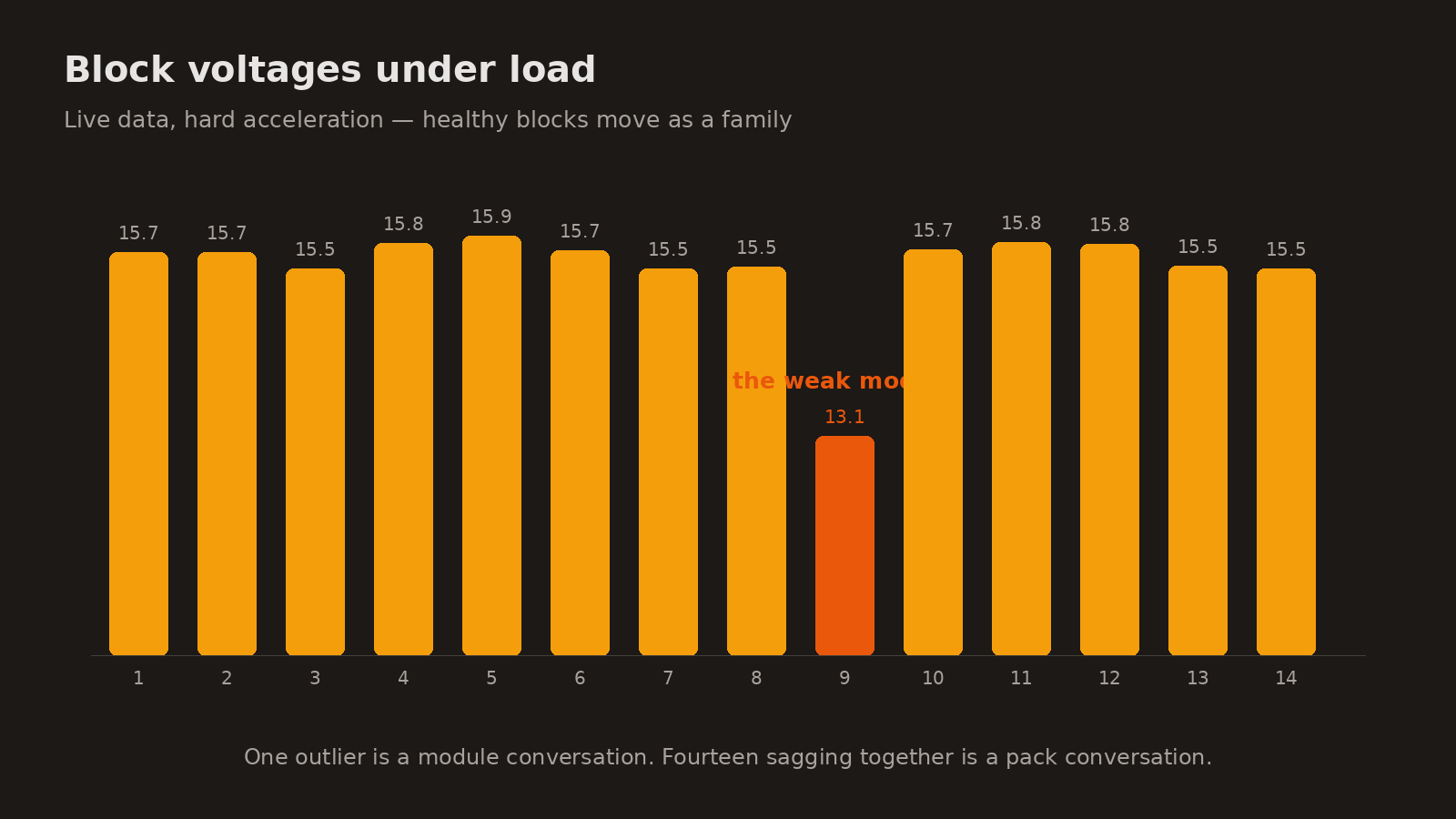
Diagram: fourteen hybrid battery block voltages under load. Thirteen blocks hold together near sixteen volts; block nine sags visibly low — the signature of one weak module, not a dead pack.
Information, not instruction
CarGeek is a reference, not a service manual. Its pages are written from public sources and from what other people have found, never from a manufacturer's own service information, so they can be wrong or incomplete for your particular vehicle. Some of what they describe carries real risk: high voltage, fuel under pressure, stored energy, hot and moving parts.
Have anything you intend to act on checked by a trained person against the manufacturer's own procedure for your vehicle. Nothing here replaces that procedure.