Civic 1.5T oil dilution: what it looks like on a scanner before you smell it
The tenth-generation Civic's 1.5 turbo has a documented cold-climate habit: on short trips in cold weather, fuel washes past the rings faster than the oil gets hot enough to boil it back off. The oil level rises, the oil thins, and the first symptoms are easy to misread as ignition problems.
The pattern, in the order owners meet it
- Cold-morning misfire counts — P0300-family codes or pending misfires on the first minutes of frosty drives, smoothing out once warm. The diluted oil and cold-start fuelling gang up on the plugs.
- The dipstick reads over full and the oil smells of petrol. An engine that "makes oil" is diluting, not defying physics.
- Rough idle after the third short school-run of the day, fine after a motorway hour.
What to check
- Dipstick honestly: level and smell, engine cold, on level ground.
- Plugs at half their scheduled life if the car lives on short cold trips — dilution fouls them early.
- Software: Honda issued updates for affected model years that adjust cold-weather fuelling and warm-up. Confirm yours is applied before deeper diagnosis.
What actually helps
Longer runs. The condition is largely self-inflicted by duty cycle — an engine that regularly gets twenty warm minutes boils the fuel back out of its oil. Where the duty cycle cannot change, shorten the oil interval instead; oil is cheaper than the parts diluted oil wears.
A 1.5T with cold misfire codes deserves this check before any coil or injector spending — the codes are downstream of the oil more often than this engine gets credit for.
Это руководство опубликовано на условиях лицензии CC BY-SA 4.0 — его можно свободно применять, повторно использовать и улучшать при указании авторства и на тех же условиях.
Вложения
-
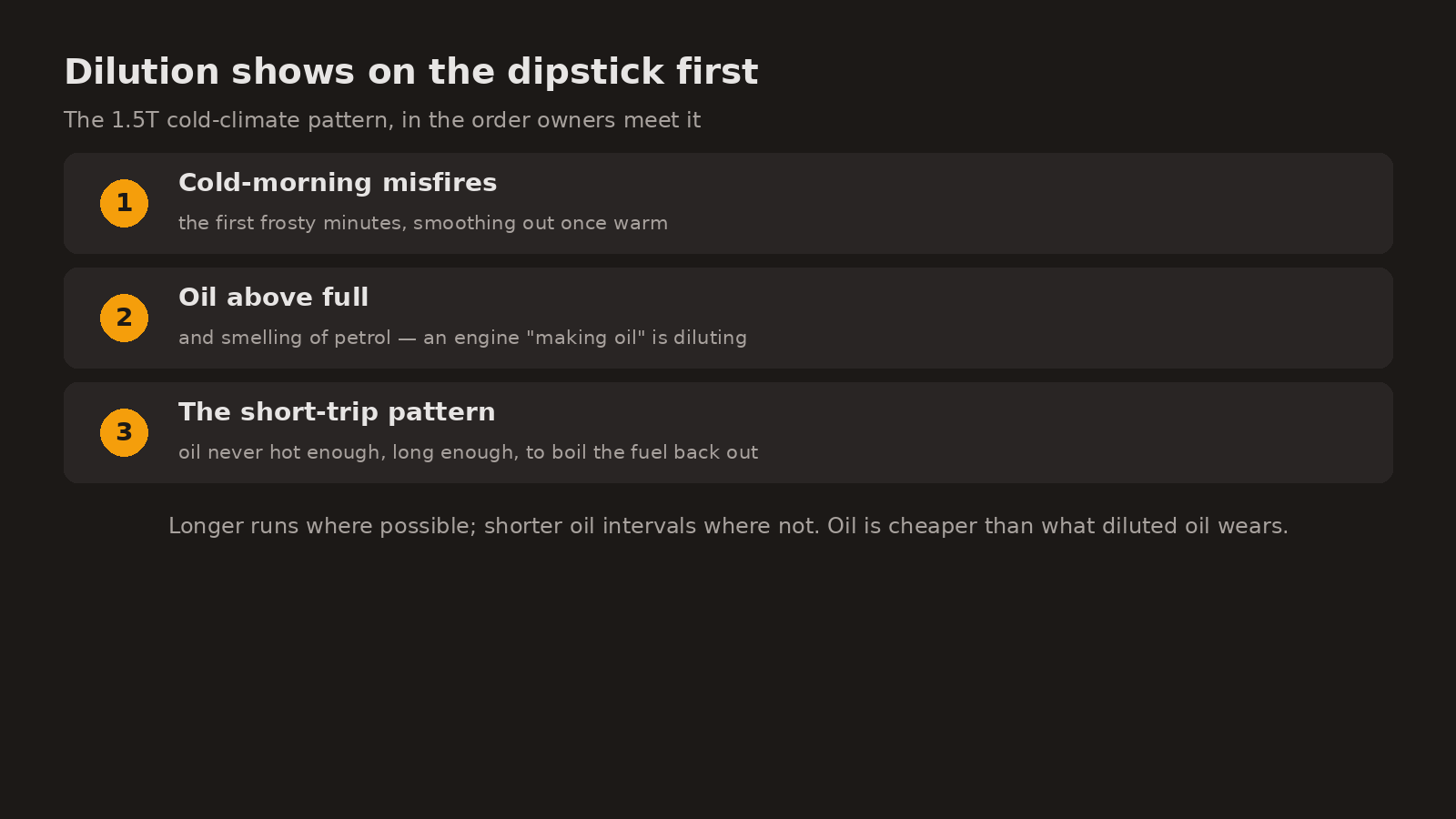
Diagram: the three signs of fuel dilution on the 1.5-litre turbo — cold misfires, a rising oil level that smells of petrol, and a short-trip duty cycle.
Информация, а не инструкция
CarGeek — это справочник, а не руководство по ремонту. Его страницы составлены по открытым источникам и по опыту других людей, но не по сервисной документации производителя, поэтому для вашего конкретного автомобиля они могут быть неверными или неполными. Часть описанного связана с реальной опасностью: высокое напряжение, топливо под давлением, накопленная энергия, горячие и движущиеся детали.
Всё, по чему вы собираетесь действовать, сначала проверьте с человеком, имеющим техническую подготовку, по собственной процедуре производителя для вашего автомобиля. Ничто здесь не заменяет эту процедуру.