Vehicle
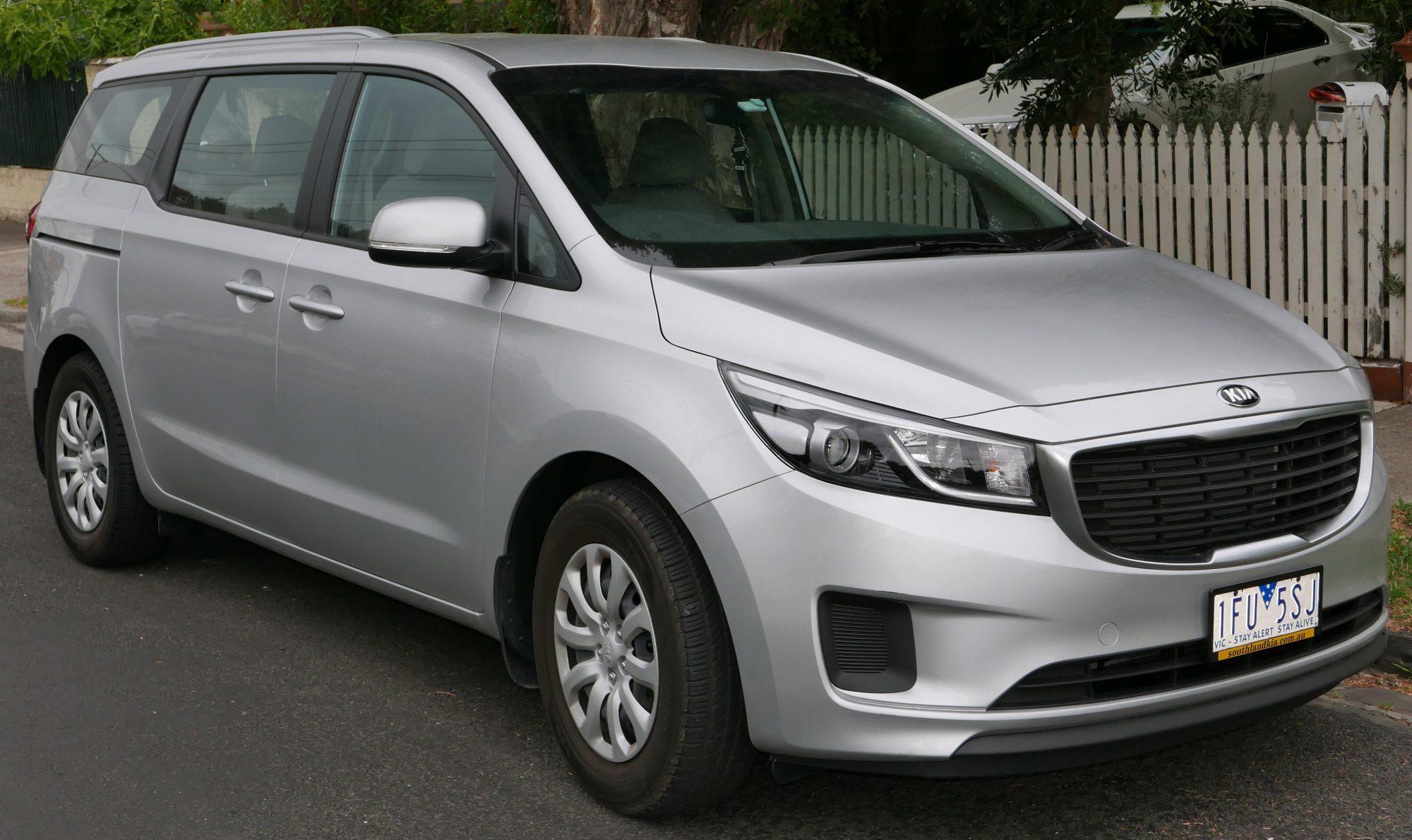
Kia Carnival
The full-size minivan, sold as the Sedona in several markets — search both, because the written diagnosis is split across the two names. The 2.2 CRDi at family and taxi mileage is the European and Korean population, and its timing chain and the balance-shaft assembly behind it are the two items worth establishing before believing a rattle or a correlation code. Powered sliding doors and a powered tailgate account for a large share of what actually gets scanned.
_S_van_(2016-01-04)_01.jpg)
Generations
-
First generation 1998–2005
Sold as the Sedona in North America and the United Kingdom, and facelifted in 2001 as the Carnival II. Its 2.5 V6 is not a Hyundai engine at all but a Rover KV6 built under licence in Korea, which is where the documentation for it lives; the 2.9 diesel is Kia's own J3, turbocharged at first and common-rail from the facelift.
- Body styles
- MPV
- Platform
- Kia Carnival
- Engines
-
- 2.5 V6 — petrol · 110–121 kW (148–162 hp) · 222 Nm (164 lb-ft) · Rover KV6 built under licence, internally K5
- 3.5 V6 — G6AU · petrol · Sigma, from 2001
- 2.9 CRDi — J3 · diesel · 93–106 kW (125–142 hp) · turbodiesel to 2001, common rail after
- Transmissions
- 5-speed manual · 4-speed automatic · 5-speed automatic
- Drivetrain
- Front-wheel drive
-
Second generation 2005–2014
The VQ, also sold as the Grand Carnival, the Sedona and, for three years, the Hyundai Entourage. Two different diesels wear the CRDi badge here — the carried-over 2.9 J3 to 2009 and the chain-driven 2.2 R from 2010 — and they share almost nothing, so establish which one is in front of you before reading any fault pattern.
- Body styles
- MPV
- Platform
- Hyundai-Kia Y5
- Engines
-
- 2.7 V6 — G6EA · petrol · 139 kW (186 hp) · 246 Nm (181 lb-ft) · Mu
- 2.7 LPi V6 — L6EA · LPG bi-fuel · 245 Nm (181 lb-ft) · Korea
- 3.5 V6 — G6DC · petrol · 204 kW (274 hp) · 335 Nm (247 lb-ft) · Lambda II, from 2010
- 3.8 V6 — G6DA · petrol · 344 Nm (254 lb-ft) · Lambda
- 2.9 CRDi — J3 · diesel · 136 kW (182 hp) · 343 Nm (253 lb-ft) · to 2009
- 2.2 CRDi — D4HB · diesel · R II, from 2010
- Transmissions
- 5-speed manual · 6-speed manual · 4-speed automatic · 5-speed automatic · 6-speed automatic
- Drivetrain
- Front-wheel drive
-
YP 2014–2020
Sold as the Sedona in several markets; the 2.2 CRDi's timing chain is the fault a cold rattle is announcing.
- Body styles
- MPV
- Platform
- Hyundai YP
- Engines
-
- 3.3 V6 — LAMBDA · petrol · 318–336 Nm (235–248 lb-ft)
- 2.2 CRDi — diesel
- Transmissions
- 6-speed automatic · 8-speed automatic
- Drivetrain
- Front-wheel drive
-
KA4 2020–present
N3 platform with a hybrid added late; the sliding-door and tailgate modules remain most of its real fault traffic.
- Body styles
- MPV
- Platform
- Hyundai N3
- Engines
-
- 3.5 V6 — SMARTSTREAM · petrol
- 2.2 CRDi — diesel · 146–149 kW (196–200 hp) · 441 Nm (325 lb-ft)
- 1.6 turbo GDi hybrid — hybrid · 180 kW (241 hp) · 367 Nm (271 lb-ft)
- 3.3 — petrol · 6-cylinder, US market 2020-2021
- Transmissions
- 8-speed automatic · 6-speed automatic
- Drivetrain
- Front-wheel drive
Service information
Information, not instruction
CarGeek is a reference, not a service manual. Its pages are written from public sources and from what other people have found, never from a manufacturer's own service information, so they can be wrong or incomplete for your particular vehicle. Some of what they describe carries real risk: high voltage, fuel under pressure, stored energy, hot and moving parts.
Have anything you intend to act on checked by a trained person against the manufacturer's own procedure for your vehicle. Nothing here replaces that procedure.
Posted about the Kia Carnival
Be the first to write this up
Nothing posted about this yet. Whatever you found is worth writing down — even a dead end saves someone the same afternoon.
What makes one worth reading:
- The car — make, model, year and engine. The same fault behaves differently on each.
- What you measured, not only what you replaced.
- What actually fixed it — or that nothing did, which is worth knowing too.
Sign in or create an account to add what you found about Kia Carnival.