Vehicle
Nissan Sentra
The compact sedan, overlapping with the Sunny/Sylphy names across markets and eras. Huge taxi and fleet populations in the Middle East and Latin America.
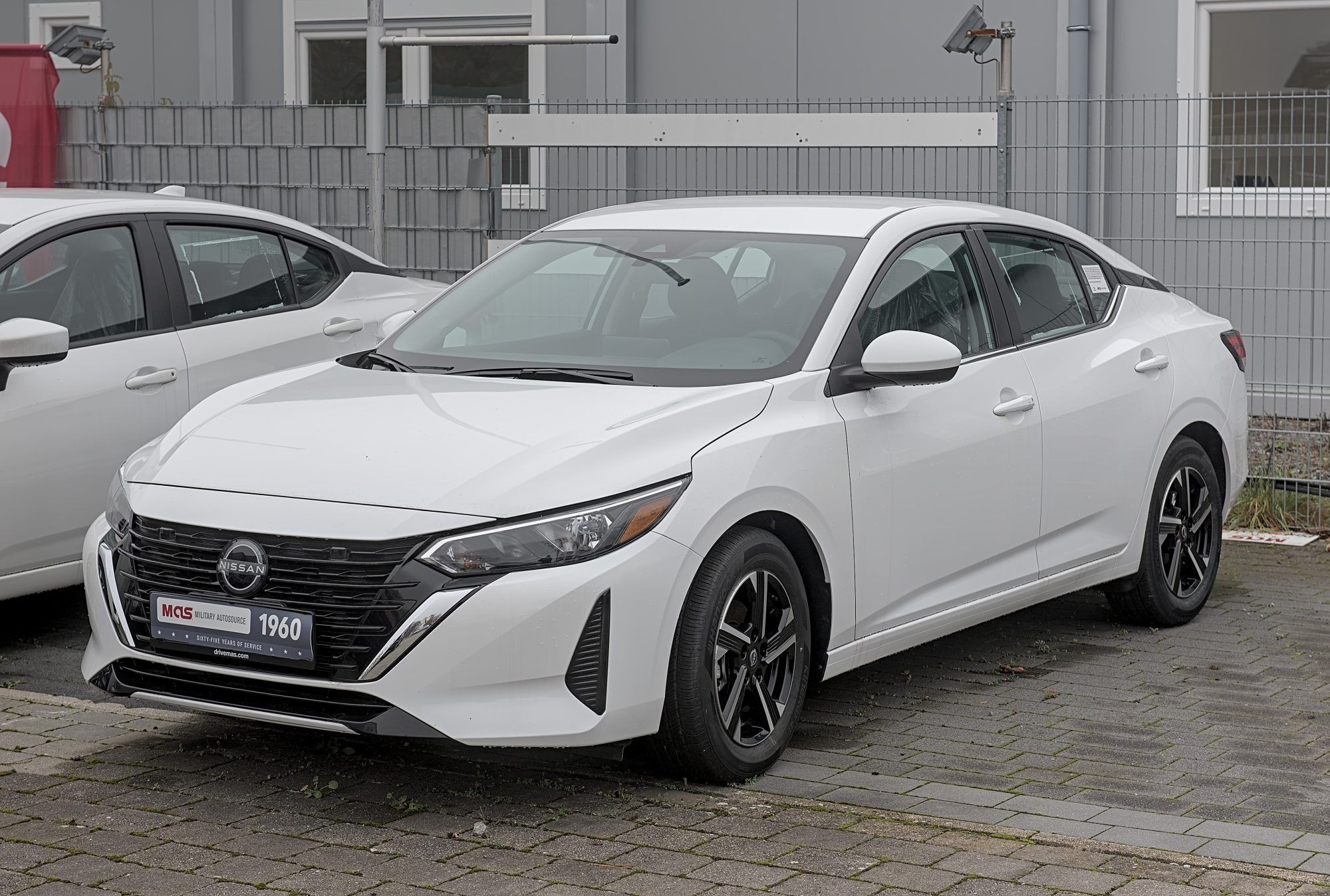
_DSC_3754.jpg)
Generations
-
B11 1982–1986
The first front-drive Sentra, sold as a saloon, a coupé and a wagon, with the E-series petrol fours and a CD17 diesel.
- Body styles
- Sedan · Coupé · Hatchback · Estate
- Engines
-
- 1.5 petrol — E15 · petrol · 50 kW (67 hp)
- 1.6 petrol — E16 · petrol · 51 kW (69 hp)
- 1.7 diesel — CD17 · diesel
- Transmissions
- 4-speed manual · 5-speed manual · 3-speed automatic
- Drivetrain
- Front-wheel drive
-
B12 1986–1990
The generation that offered a four-wheel-drive wagon and a turbocharged E16, and where the GA family begins to replace the E.
- Body styles
- Sedan · Coupé · Hatchback · Estate
- Engines
-
- 1.4 petrol — GA14DE · petrol
- 1.5 petrol — E15 · petrol
- 1.6 petrol — E16 · petrol
- 1.6 turbo — E16ET · petrol
- 1.6 petrol — GA16i · petrol
- 1.7 diesel — CD17 · diesel
- Transmissions
- 4-speed manual · 5-speed manual · 3-speed automatic
- Drivetrain
- Front-wheel drive · Four-wheel drive
-
B13 1990–1994
The SE-R and its SR20DE — the generation this car is remembered for. Built in Mexico as the Tsuru until 2017.
- Body styles
- Sedan · Coupé
- Engines
-
- 1.3 petrol — GA13DS · petrol
- 1.4 petrol — GA14DS · petrol
- 1.4 petrol — GA14DE · petrol
- 1.6 petrol — E16 · petrol
- 1.6 petrol — GA16DE · petrol · 82–94 kW (110–126 hp) · 127–147 Nm (94–108 lb-ft)
- 2.0 petrol SE-R — SR20DE · petrol · 104 kW (140 hp) · 172–214 Nm (127–158 lb-ft)
- Transmissions
- 4-speed manual · 5-speed manual · 3-speed automatic · 4-speed RE4F03B automatic
- Drivetrain
- Front-wheel drive
-
B14 1994–1999
Saloon only, and down to two engines — the GA16DE and the SE-R's SR20DE. The simplest Sentra range of the era.
- Body styles
- Sedan
- Engines
-
- 1.6 petrol — GA16DE · petrol · 86 kW (115 hp) · 127–147 Nm (94–108 lb-ft)
- 2.0 petrol SE-R — SR20DE · petrol · 104 kW (140 hp) · 172–214 Nm (127–158 lb-ft)
- Transmissions
- 4-speed RE4F03B automatic · 5-speed RS5F51A manual
- Drivetrain
- Front-wheel drive
-
B15 1999–2006
The QG and QR fours replace the GA and SR, and the SE-R Spec V gets a 2.5 and a six-speed. The last Sentra before the CVT era.
- QG18DE (QG family, 1.6 and 1.8) 1.8 L
- QR25 (QR family, 2.0 and 2.5) 2.5 L
- SR20 (SR family, 1.8 and 2.0) 2.0 L
- RE4F02A / RE4F03A / RE4F04A 4-speed automatic
- RS5F32 / RS5F50 / RS5F91 5-speed manual
- RS6F51A / RS6F51H 6-speed manual
- Body styles
- Sedan
- Engines
-
- 1.8 petrol — QG18DE · petrol · 94 kW (126 hp) · 158–176 Nm (117–130 lb-ft)
- 2.0 petrol — SR20DE · petrol · 108 kW (145 hp) · 172–214 Nm (127–158 lb-ft)
- 2.5 petrol SE-R — QR25DE · petrol · 123–130 kW (165–175 hp) · 213–251 Nm (157–185 lb-ft)
- Transmissions
- 4-speed RE4F04B automatic · 5-speed RS5F70A manual · 6-speed RS6F51H manual
- Drivetrain
- Front-wheel drive
-
B16 2006–2012
The CVT arrives at volume — the transmission most of its stored codes concern.
- Body styles
- Sedan
- Platform
- Renault–Nissan C
- Engines
-
- 2.0 — MR20DE · petrol · 199 Nm (147 lb-ft)
- 2.5 — QR25DE · petrol · SE-R Spec V
- Transmissions
- 6-speed manual · CVT
- Drivetrain
- Front-wheel drive
-
B17 2012–2019
Continued CVT; conventional port injection keeps intake carbon out of the picture.
- Body styles
- Sedan
- Platform
- Renault–Nissan V
- Engines
-
- 1.8 — MRA8DE · petrol
- 1.6 turbo — MR16DDT · petrol · 210–285 Nm (155–210 lb-ft) · Nismo and SR Turbo
- 1.6 — HR16DE · petrol · 80–103 kW (107–138 hp) · 150–163 Nm (111–120 lb-ft)
- 2.0 — MR20DE · petrol · 187–200 Nm (138–148 lb-ft) · gasoline/ethanol; Brazil
- Transmissions
- 6-speed manual · CVT · 5-speed manual · 5-speed automatic · 6-speed automatic
- Drivetrain
- Front-wheel drive
-
B18 2019–present
Direct injection arrives, and with it the carbon question.
- Body styles
- Sedan
- Platform
- Renault–Nissan CMF-C/D
- Engines
-
- 2.0 PR20DD — PR20DD · petrol
- 1.6 — HR16DE · petrol · 80–103 kW (107–138 hp) · 150–163 Nm (111–120 lb-ft)
- 2.0 — MR20DD · petrol · 160–210 Nm (118–155 lb-ft)
- 1.2 — HR12DE · petrol · 85 kW (114 hp) · 103–108 Nm (76–80 lb-ft) · China
- Transmissions
- 6-speed manual · CVT
- Drivetrain
- Front-wheel drive
Service information
Information, not instruction
CarGeek is a reference, not a service manual. Its pages are written from public sources and from what other people have found, never from a manufacturer's own service information, so they can be wrong or incomplete for your particular vehicle. Some of what they describe carries real risk: high voltage, fuel under pressure, stored energy, hot and moving parts.
Have anything you intend to act on checked by a trained person against the manufacturer's own procedure for your vehicle. Nothing here replaces that procedure.
Posted about the Nissan Sentra
Be the first to write this up
Nothing posted about this yet. Whatever you found is worth writing down — even a dead end saves someone the same afternoon.
What makes one worth reading:
- The car — make, model, year and engine. The same fault behaves differently on each.
- What you measured, not only what you replaced.
- What actually fixed it — or that nothing did, which is worth knowing too.
Sign in or create an account to add what you found about Nissan Sentra.