Corolla hybrid 12 V battery: the five-minute October test
The hybrid's traction battery gets the attention, but the small 12 V battery is what actually strands Corolla hybrid owners — it boots the computers that start the hybrid system, and it lives a gentler-but-sneakier life than a normal car battery: never hard-cranked, so it never announces its aging with slow cranking. It just fails.
What you need: a multimeter. Five minutes. Ideally October, not the first −10° morning of December.
- Rest voltage. Car fully off, locked, left for ten minutes. Measure across the 12 V terminals (in the boot on most): 12.4 V or better is healthy. Below 12.2 V, it is living on borrowed time.
- Charging voltage. Press the start button to READY. The DC-DC converter now feeds the 12 V system: expect 13.5–14.5 V at the same terminals. Seeing that means the charging side is fine and any weakness is the battery's own.
- Recovery. Switch off, wait ten minutes, measure again. A battery that was healthy at rest but is now noticeably down is not holding what it is given.
Why this matters more on a hybrid: a weak 12 V produces a festival of nonsense before it produces a no-start — warning lights across unrelated systems, brake-system messages, modules logging communication codes. If a hybrid ever shows ten unrelated warnings at once, test this battery before believing any single one of them. It is the cheapest component on the car that can imitate all the expensive ones.
This guide is published under CC BY-SA 4.0 — free to follow, reuse and improve with attribution, share-alike.
Attachments
-
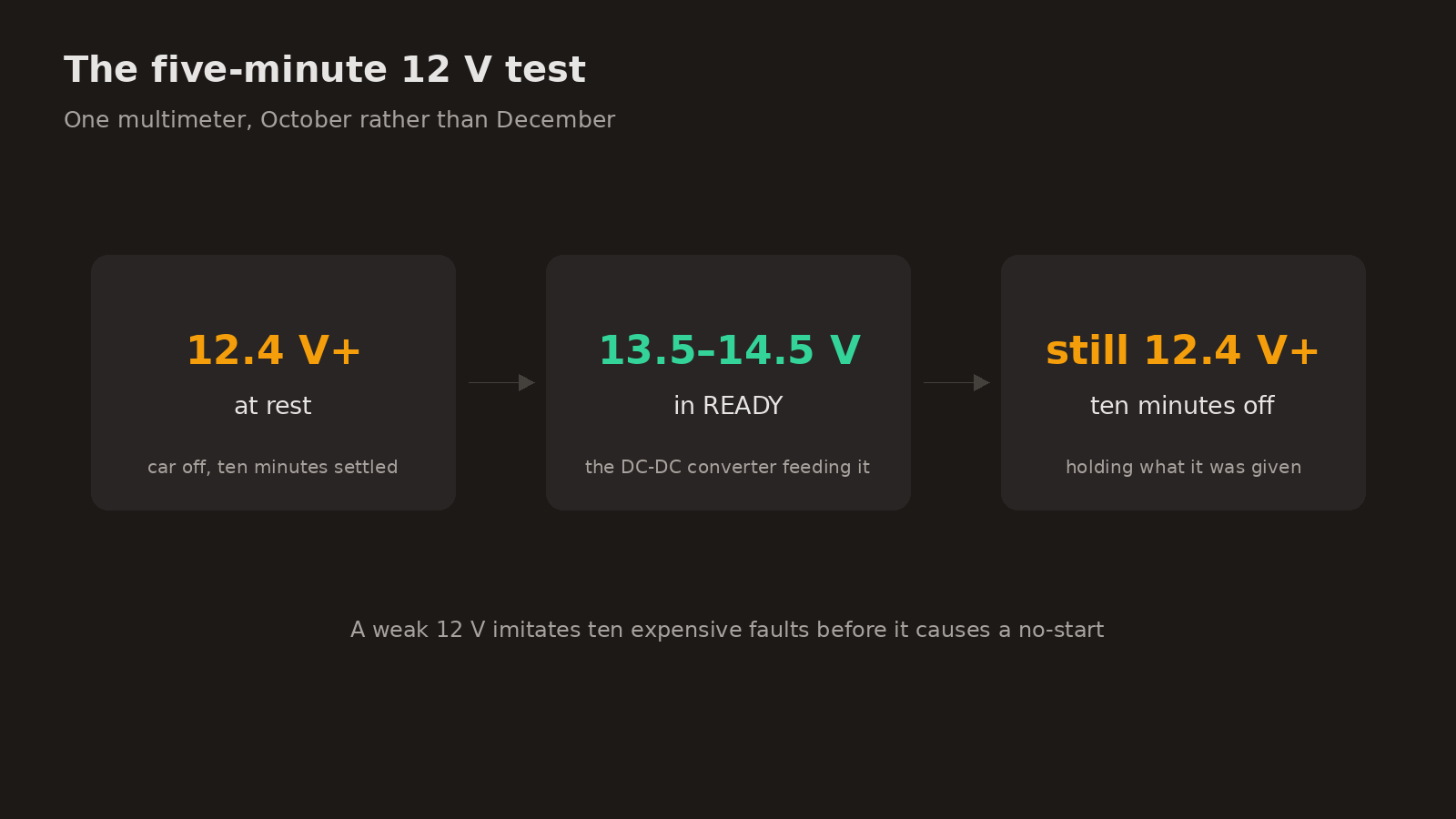
Diagram: the three multimeter readings of the hybrid 12-volt test — 12.4 volts or better at rest, 13.5 to 14.5 volts in READY, and holding its value ten minutes after switching off.
Information, not instruction
CarGeek is a reference, not a service manual. Its pages are written from public sources and from what other people have found, never from a manufacturer's own service information, so they can be wrong or incomplete for your particular vehicle. Some of what they describe carries real risk: high voltage, fuel under pressure, stored energy, hot and moving parts.
Have anything you intend to act on checked by a trained person against the manufacturer's own procedure for your vehicle. Nothing here replaces that procedure.