Live data: the eight readings that solve most engine codes
Codes name symptoms; live data names causes. These eight PIDs, available on nearly any scanner or dongle app, are the working set this site's write-ups reach for again and again.
- Short + long term fuel trim (per bank) — the ECU's running confession of how wrong its fuel model is. Combined within ±8% is healthy. High positive: unmetered air or starved fuel. The idle-versus-2,500 rpm comparison splits those two — see the P0171 guide.
- Coolant temperature — should climb steadily from cold and hold near the thermostat's rating (~90 °C). Plateauing low is a stuck-open thermostat wasting fuel; implausible-at-cold readings are sensor lies.
- Intake air temperature — cross-check against coolant and ambient after an overnight soak; all three within a couple of degrees or someone is lying.
- MAF grams/second — rough health check: about 1 g/s per litre of displacement at hot idle, rising sharply and smoothly with revs. Low everywhere with an oiled filter history: film on the element.
- Front O2 sensor voltage — should switch busily between roughly 0.1 and 0.9 V at cruise. Stuck lean, stuck rich, or lazy switching each tell their own story, and trims give the context.
- Rear O2 sensor voltage — flat and boring near 0.6–0.7 V is a healthy catalyst; mirroring the front one is P0420 forming in real time.
- Engine load + rpm together — the context stamp for everything else, and the pair to match against a freeze frame when reproducing a fault on a road test.
- Fuel system status — open loop when warm at cruise means the ECU has stopped trusting a sensor; find out which before chasing anything downstream of it.
The habit that makes these useful: record a short log of your car healthy. The day something breaks, "compared to last month" beats every generic specification on the internet.
Это руководство опубликовано на условиях лицензии CC BY-SA 4.0 — его можно свободно применять, повторно использовать и улучшать при указании авторства и на тех же условиях.
Вложения
-
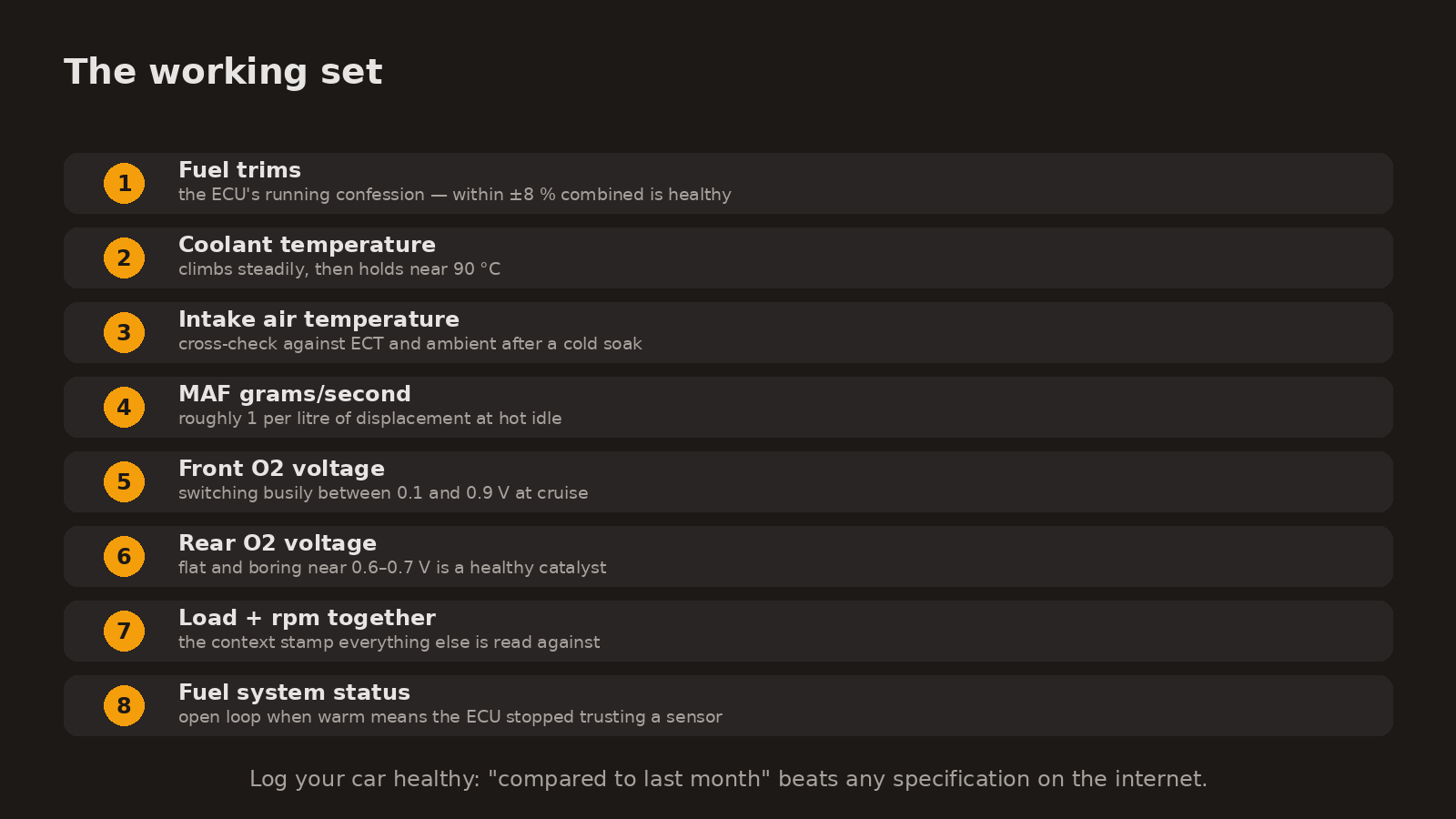
Diagram: the eight live-data readings that solve most engine codes — trims, temperatures, MAF, both oxygen sensors, load with rpm, and fuel system status.
Информация, а не инструкция
CarGeek — это справочник, а не руководство по ремонту. Его страницы составлены по открытым источникам и по опыту других людей, но не по сервисной документации производителя, поэтому для вашего конкретного автомобиля они могут быть неверными или неполными. Часть описанного связана с реальной опасностью: высокое напряжение, топливо под давлением, накопленная энергия, горячие и движущиеся детали.
Всё, по чему вы собираетесь действовать, сначала проверьте с человеком, имеющим техническую подготовку, по собственной процедуре производителя для вашего автомобиля. Ничто здесь не заменяет эту процедуру.