Live data: the eight readings that solve most engine codes
Codes name symptoms; live data names causes. These eight PIDs, available on nearly any scanner or dongle app, are the working set this site's write-ups reach for again and again.
- Short + long term fuel trim (per bank) — the ECU's running confession of how wrong its fuel model is. Combined within ±8% is healthy. High positive: unmetered air or starved fuel. The idle-versus-2,500 rpm comparison splits those two — see the P0171 guide.
- Coolant temperature — should climb steadily from cold and hold near the thermostat's rating (~90 °C). Plateauing low is a stuck-open thermostat wasting fuel; implausible-at-cold readings are sensor lies.
- Intake air temperature — cross-check against coolant and ambient after an overnight soak; all three within a couple of degrees or someone is lying.
- MAF grams/second — rough health check: about 1 g/s per litre of displacement at hot idle, rising sharply and smoothly with revs. Low everywhere with an oiled filter history: film on the element.
- Front O2 sensor voltage — should switch busily between roughly 0.1 and 0.9 V at cruise. Stuck lean, stuck rich, or lazy switching each tell their own story, and trims give the context.
- Rear O2 sensor voltage — flat and boring near 0.6–0.7 V is a healthy catalyst; mirroring the front one is P0420 forming in real time.
- Engine load + rpm together — the context stamp for everything else, and the pair to match against a freeze frame when reproducing a fault on a road test.
- Fuel system status — open loop when warm at cruise means the ECU has stopped trusting a sensor; find out which before chasing anything downstream of it.
The habit that makes these useful: record a short log of your car healthy. The day something breaks, "compared to last month" beats every generic specification on the internet.
این راهنما منتشر شده است با مجوز CC BY-SA 4.0 — آزاد برای اجرا، بازنشر و بهبود، با ذکر منبع و اشتراکگذاری همسان.
پیوستها
-
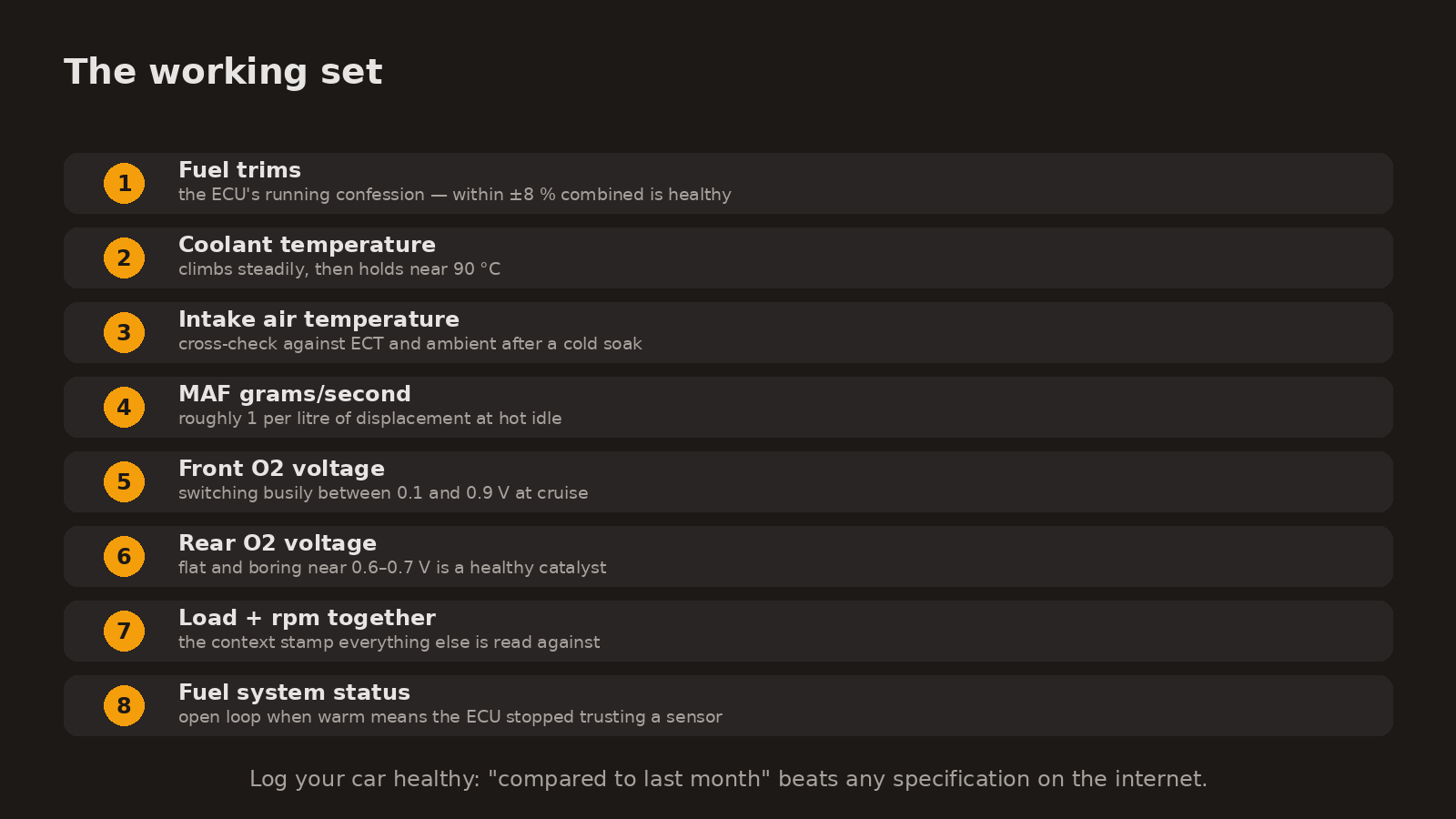
Diagram: the eight live-data readings that solve most engine codes — trims, temperatures, MAF, both oxygen sensors, load with rpm, and fuel system status.
اطلاعات است، نه دستورالعمل
سایت CarGeek یک مرجع است، نه دفترچه تعمیرگاهی. صفحههای آن از منابع عمومی و از آنچه دیگران تجربه کردهاند نوشته میشود، نه از مستندات سرویس خودِ سازنده؛ بنابراین ممکن است برای خودروی خاص شما نادرست یا ناقص باشد. بخشی از آنچه شرح داده میشود خطر واقعی دارد: ولتاژ بالا، سوخت تحت فشار، انرژی ذخیرهشده و قطعات داغ یا متحرک.
هر چیزی را که میخواهید بر اساس آن اقدام کنید، نخست فردی آموزشدیده بر پایه دستورالعمل خودِ سازنده برای خودروی شما بررسی کند. هیچچیز در اینجا جایگزین آن دستورالعمل نیست.