Freeze frame: read the moment the code set before touching anything
Every stored trouble code comes with a photograph nobody looks at: the freeze frame, a snapshot of the engine's data at the instant the fault was recorded. Any scan tool that reads codes can read it, and it answers the first diagnostic question — what was the engine doing when this happened? — with data instead of guesswork.
How to pull it
On most tools it sits one menu below the code itself ("freeze frame", "FF", or a snowflake icon). Read it before clearing anything — clearing codes erases the freeze frame with them, and with it the only record of the conditions you are trying to reproduce.
The five values that carry the story
- Coolant temperature — was the engine cold or warm? A fault only at −5 °C coolant is a cold-start story (choke-phase fuelling, cracked boots that close when warm) and no amount of warm-idle testing will show it.
- Engine speed and load — idle, cruise, or wide open? A misfire logged at 4,200 rpm and 85% load will never appear in the workshop at idle, and that is information, not bad luck.
- Vehicle speed — moving or stationary separates driveline-influenced faults from engine-only ones.
- Fuel trims at the moment — a code logged with +23% trim is a lean event whatever the code's own name says; the trim tells you what the ECU was fighting.
- Fuel system status — open loop when it should be closed points at a sensor the ECU stopped trusting.
Using it
Reproduce the freeze-frame conditions, not workshop conditions: same temperature band, same load. A road test at the recorded rpm and load with live data running is worth three hours of stationary revving.
The honest caveat
Most systems store one frame per code — usually the first or the worst occurrence — so an intermittent fault's frame may describe one bad morning, not the pattern. It is a witness statement, not the whole trial. But it is the only witness that was actually there, and it is free.
Bu rehber şu lisansla yayımlanmıştır: CC BY-SA 4.0 — kaynak göstermek ve aynı lisansla paylaşmak koşuluyla uygulanabilir, yeniden kullanılabilir ve geliştirilebilir.
Ekler
-
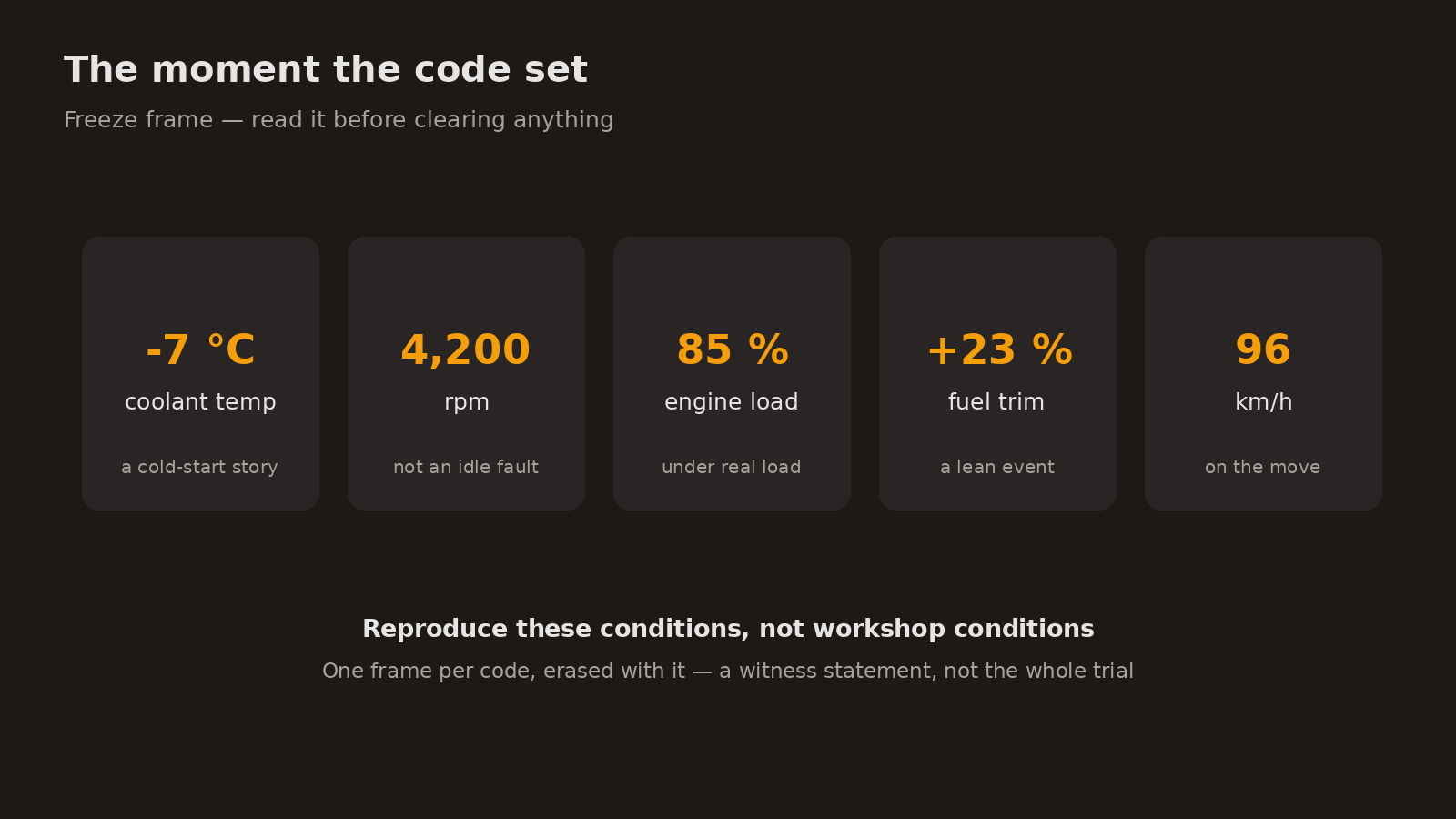
Diagram: the five freeze-frame values to read first — coolant temperature, engine speed, load, fuel trim and vehicle speed — shown as the moment the code set.
Bilgi amaçlıdır, talimat değildir
CarGeek bir başvuru kaynağıdır, servis el kitabı değildir. Sayfaları kamuya açık kaynaklardan ve başkalarının tespit ettiklerinden yazılır; hiçbir zaman üreticinin kendi servis belgelerinden yazılmaz. Bu nedenle sizin aracınız için yanlış veya eksik olabilir. Anlatılanların bir kısmı gerçek risk taşır: yüksek gerilim, basınç altındaki yakıt, depolanmış enerji, sıcak ve hareketli parçalar.
Uygulamayı düşündüğünüz her şeyi, aracınız için üreticinin kendi prosedürüne göre eğitimli bir kişiye doğrulatın. Buradaki hiçbir şey o prosedürün yerini tutmaz.