Freeze frame: read the moment the code set before touching anything
Every stored trouble code comes with a photograph nobody looks at: the freeze frame, a snapshot of the engine's data at the instant the fault was recorded. Any scan tool that reads codes can read it, and it answers the first diagnostic question — what was the engine doing when this happened? — with data instead of guesswork.
How to pull it
On most tools it sits one menu below the code itself ("freeze frame", "FF", or a snowflake icon). Read it before clearing anything — clearing codes erases the freeze frame with them, and with it the only record of the conditions you are trying to reproduce.
The five values that carry the story
- Coolant temperature — was the engine cold or warm? A fault only at −5 °C coolant is a cold-start story (choke-phase fuelling, cracked boots that close when warm) and no amount of warm-idle testing will show it.
- Engine speed and load — idle, cruise, or wide open? A misfire logged at 4,200 rpm and 85% load will never appear in the workshop at idle, and that is information, not bad luck.
- Vehicle speed — moving or stationary separates driveline-influenced faults from engine-only ones.
- Fuel trims at the moment — a code logged with +23% trim is a lean event whatever the code's own name says; the trim tells you what the ECU was fighting.
- Fuel system status — open loop when it should be closed points at a sensor the ECU stopped trusting.
Using it
Reproduce the freeze-frame conditions, not workshop conditions: same temperature band, same load. A road test at the recorded rpm and load with live data running is worth three hours of stationary revving.
The honest caveat
Most systems store one frame per code — usually the first or the worst occurrence — so an intermittent fault's frame may describe one bad morning, not the pattern. It is a witness statement, not the whole trial. But it is the only witness that was actually there, and it is free.
Diese Anleitung erscheint unter CC BY-SA 4.0 — frei zum Nachmachen, Weiterverwenden und Verbessern, mit Namensnennung und Weitergabe unter gleichen Bedingungen.
Anhänge
-
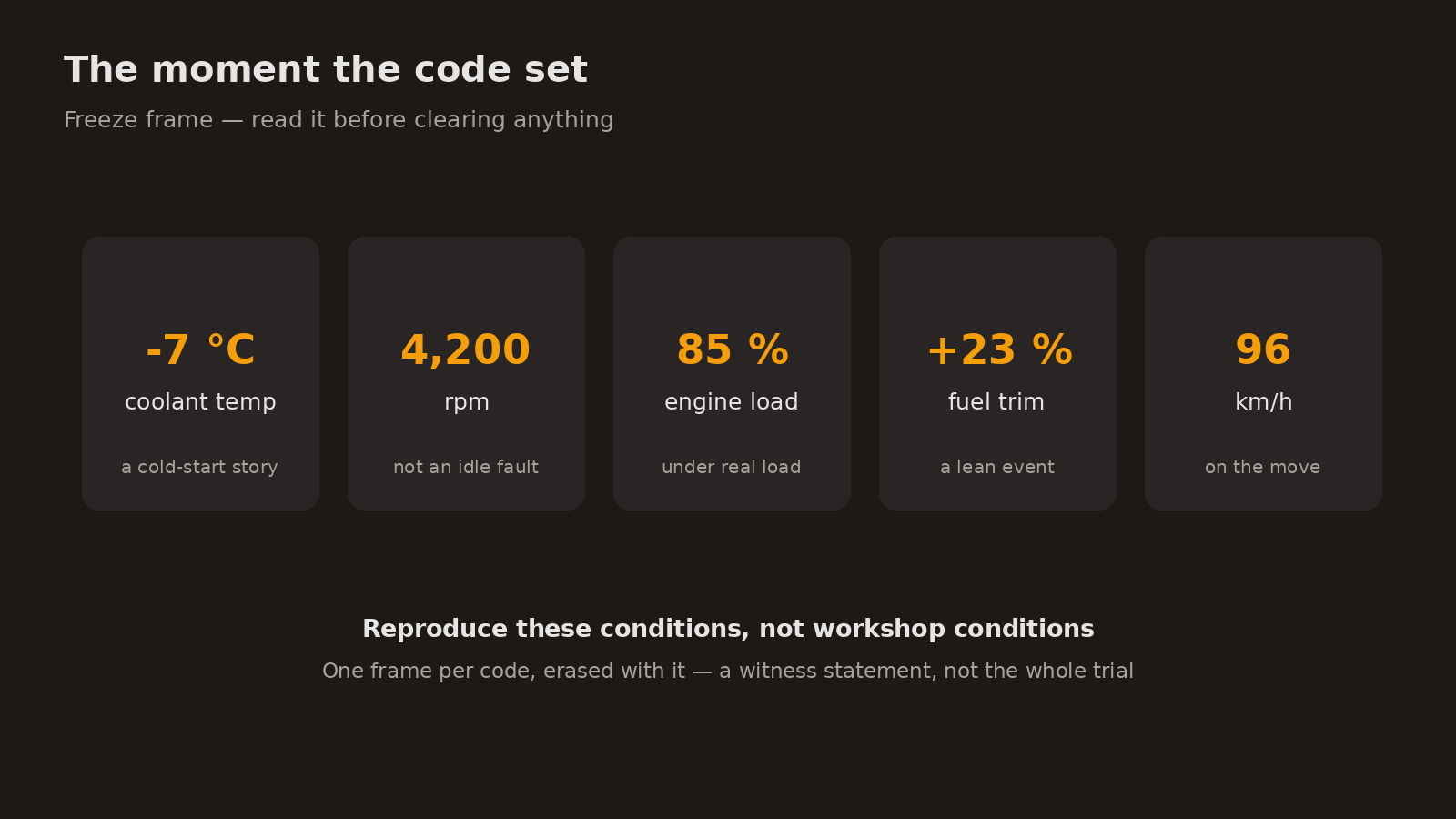
Diagram: the five freeze-frame values to read first — coolant temperature, engine speed, load, fuel trim and vehicle speed — shown as the moment the code set.
Information, keine Handlungsanweisung
CarGeek ist ein Nachschlagewerk, kein Werkstatthandbuch. Die Seiten entstehen aus öffentlichen Quellen und aus dem, was andere festgestellt haben, nie aus den Serviceunterlagen des Herstellers; für Ihr konkretes Fahrzeug können sie daher falsch oder unvollständig sein. Ein Teil des Beschriebenen birgt echte Gefahren: Hochspannung, Kraftstoff unter Druck, gespeicherte Energie sowie heiße oder bewegte Teile.
Lassen Sie alles, wonach Sie handeln wollen, von einer fachlich geschulten Person anhand der herstellereigenen Vorgehensweise für Ihr Fahrzeug prüfen. Nichts hiervon ersetzt diese Vorgehensweise.