Vehicle
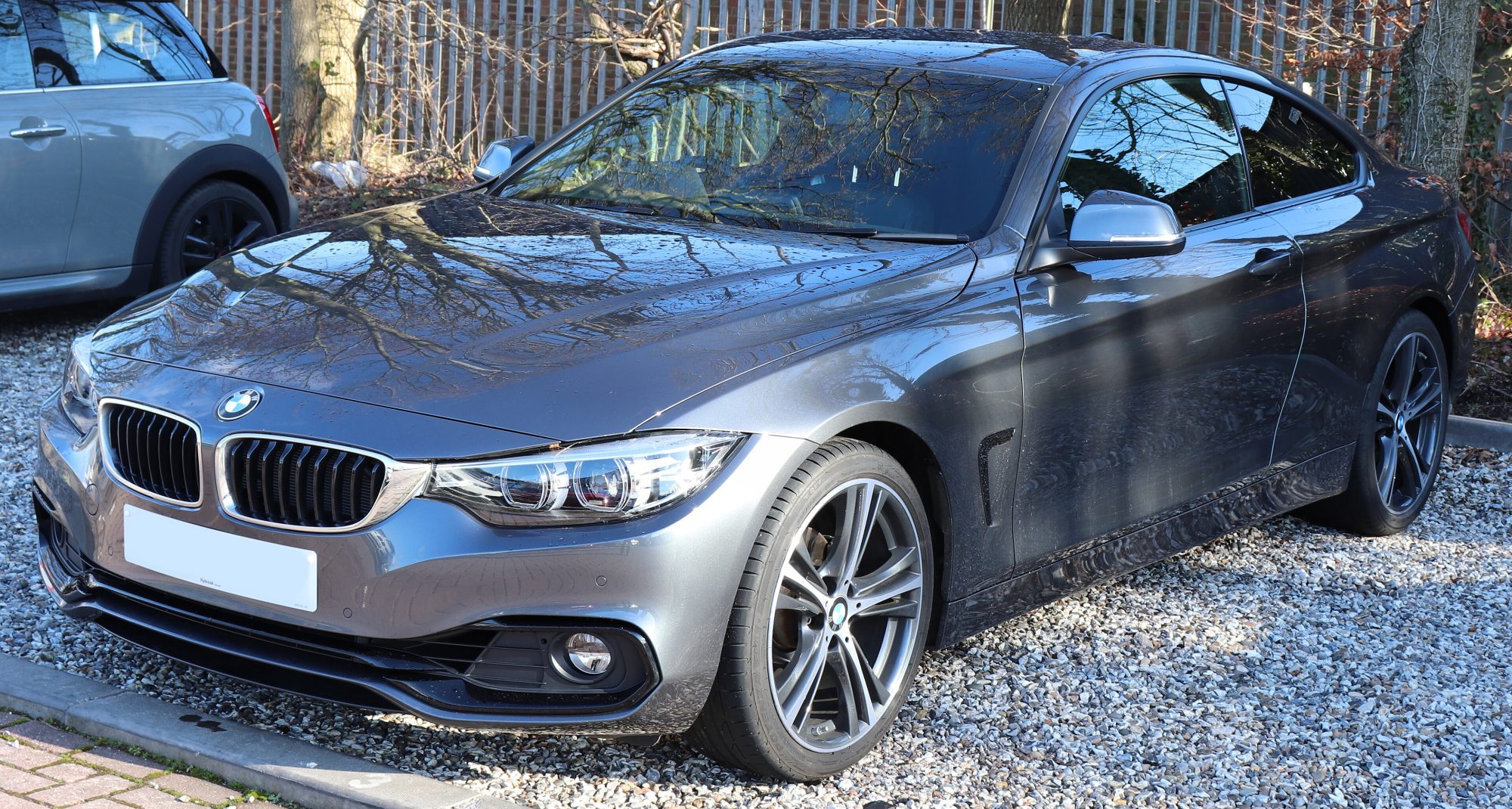
BMW 4 Series
The 3 Series coupé, convertible and Gran Coupé given their own badge from 2013 — so 3 Series information applies to the powertrain in full, and what differs is the body, the wider track and the convertible's folding roof. That roof is worth naming: on the F33 it is a retractable hardtop with its own hydraulic pump, microswitches and control unit, and a roof that will not cycle is almost always a switch or a pressure fault rather than a body-module one.

Generations
-
F32 2013–2020
The F30 3 Series under a different badge; the convertible's retractable hardtop has its own hydraulics and its own fault set.
- B38 (1.2 and 1.5) 1.5 L
- B47 2.0 L
- B48 2.0 L
- B58 3.0 L
- N20 2.0 L
- N47 (1.6 and 2.0)
- N55 3.0 L
- N57 3.0 L
- Body styles
- Coupé · Convertible · Liftback
- Platform
- BMW F30
- Engines
-
- 2.0 turbo four-cylinder — N20 · petrol · 115–180 kW (154–241 hp) · 240–350 Nm (177–258 lb-ft) · N20 and B48
- 3.0 turbo straight-six — N55 · petrol · 225–331 kW (302–444 hp) · 400–500 Nm (295–369 lb-ft) · N55 and B58
- 3.0 twin-turbo straight-six — petrol · 317–331 kW (425–444 hp) · 550 Nm (406 lb-ft) · M4, S55
- 2.0d — N47 · diesel · 105–165 kW (141–221 hp) · 320–450 Nm (236–332 lb-ft) · N47 and B47
- 3.0d — N57 · diesel · 190–230 kW (255–308 hp) · 560–630 Nm (413–465 lb-ft) · N57 and B57
- 1.5 — B38 · petrol · 104–170 kW (139–228 hp) · 220–320 Nm (162–236 lb-ft)
- Transmissions
- 6-speed manual · 7-speed dual-clutch · 8-speed automatic
- Drivetrain
- Rear-wheel drive · xDrive four-wheel drive
-
G22 2020–present
CLAR with the G20 3 Series; mild hybrid across most of the range, and the convertible reverts to a fabric roof.
- Body styles
- Coupé · Convertible · Liftback
- Platform
- BMW CLAR
- Engines
-
- 2.0 turbo four-cylinder — B48 · mild hybrid · 135–190 kW (181–255 hp) · 300–400 Nm (221–295 lb-ft)
- 3.0 turbo straight-six — B58 · mild hybrid · 275 kW (369 hp) · 500 Nm (369 lb-ft)
- 3.0 twin-turbo straight-six — petrol · 353–375 kW (473–503 hp) · 550–650 Nm (406–479 lb-ft) · M4, S58
- 2.0d — B47 · mild hybrid · 140 kW (188 hp) · 400 Nm (295 lb-ft)
- 3.0d — B57 · mild hybrid · 210–250 kW (282–335 hp) · 650–700 Nm (479–516 lb-ft)
- Transmissions
- 6-speed manual · 8-speed ZF 8HP automatic
- Drivetrain
- Rear-wheel drive · xDrive four-wheel drive
Service information
Information, not instruction
CarGeek is a reference, not a service manual. Its pages are written from public sources and from what other people have found, never from a manufacturer's own service information, so they can be wrong or incomplete for your particular vehicle. Some of what they describe carries real risk: high voltage, fuel under pressure, stored energy, hot and moving parts.
Have anything you intend to act on checked by a trained person against the manufacturer's own procedure for your vehicle. Nothing here replaces that procedure.
Posted about the BMW 4 Series
Be the first to write this up
Nothing posted about this yet. Whatever you found is worth writing down — even a dead end saves someone the same afternoon.
What makes one worth reading:
- The car — make, model, year and engine. The same fault behaves differently on each.
- What you measured, not only what you replaced.
- What actually fixed it — or that nothing did, which is worth knowing too.
Sign in or create an account to add what you found about BMW 4 Series.