نصيحة
رمز العطل P0C17
Flat and thirsty after motor work: the calibration nobody ran
HO
@hhh
منذ شهر
A specific and very fixable complaint. An electric or hybrid car comes back from having its motor, inverter or rotor position sensor replaced. It drives — but it feels flat, it uses more battery than it used to, and it runs warmer. Nothing is obviously broken. Everything is new.
**The likely answer is a procedure that was skipped rather than a part that is faulty.**
To make torque, an inverter places a rotating magnetic field just ahead of the rotor's magnets, so it must know exactly where the rotor is at every instant. The position sensor reports rotor angle — but **the sensor's own zero is not the rotor's magnetic zero.** The offset between them depends on how that particular sensor ended up mounted on that particular machine, a fraction of a degree of assembly tolerance. It cannot be assumed and it is not built in. **It is measured once, on the vehicle, with a scan tool routine, and stored.**
Replace the motor, the inverter or the sensor and that stored number describes an arrangement that no longer exists. Until the routine is run the field is placed approximately rather than exactly — which is not a breakdown. It is a car that works and is quietly wrong: **less torque for more current, more heat, worse range.**
**The trap is what happens next.** The obvious conclusion is that the new part is faulty, so it gets replaced again — which changes nothing and invalidates the calibration a second time.
P0C17 is the code for the calibration not having been done. **P0C4E is the worse sibling**: the routine ran and returned a value the car will not accept, which points at how the sensor is physically fitted rather than at software. Do not simply re-run that one until it passes — the number is implausible for a reason.
**The likely answer is a procedure that was skipped rather than a part that is faulty.**
To make torque, an inverter places a rotating magnetic field just ahead of the rotor's magnets, so it must know exactly where the rotor is at every instant. The position sensor reports rotor angle — but **the sensor's own zero is not the rotor's magnetic zero.** The offset between them depends on how that particular sensor ended up mounted on that particular machine, a fraction of a degree of assembly tolerance. It cannot be assumed and it is not built in. **It is measured once, on the vehicle, with a scan tool routine, and stored.**
Replace the motor, the inverter or the sensor and that stored number describes an arrangement that no longer exists. Until the routine is run the field is placed approximately rather than exactly — which is not a breakdown. It is a car that works and is quietly wrong: **less torque for more current, more heat, worse range.**
**The trap is what happens next.** The obvious conclusion is that the new part is faulty, so it gets replaced again — which changes nothing and invalidates the calibration a second time.
P0C17 is the code for the calibration not having been done. **P0C4E is the worse sibling**: the routine ran and returned a value the car will not accept, which points at how the sensor is physically fitted rather than at software. Do not simply re-run that one until it passes — the number is implausible for a reason.
المرفقات
-
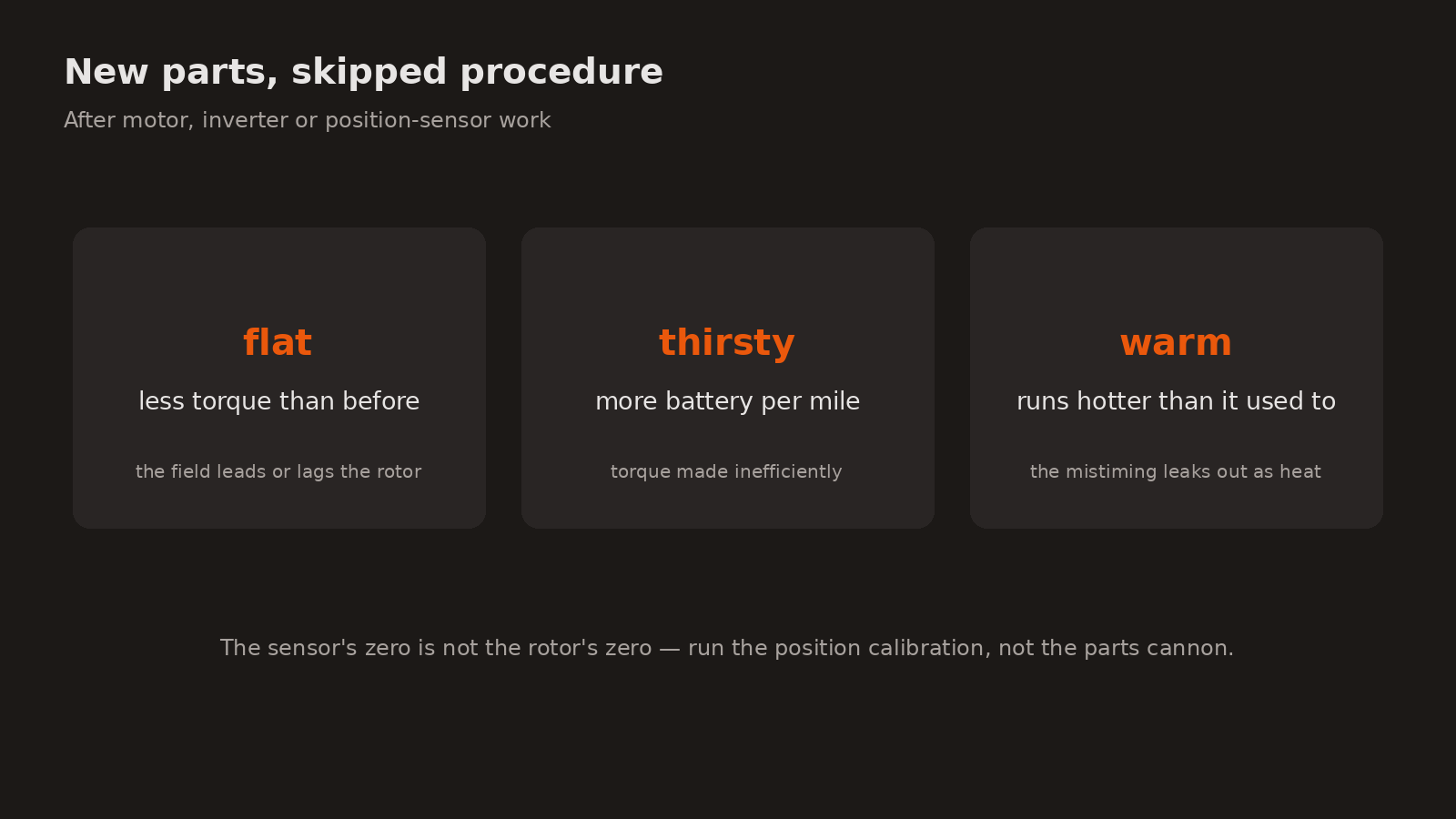
Diagram: the three symptoms of a skipped rotor-position calibration after drive-motor work — reduced torque, higher consumption, and extra heat.
معلومات لا تعليمات
موقع CarGeek مرجع وليس دليل صيانة. تُكتب صفحاته من مصادر عامة ومما توصّل إليه آخرون، لا من وثائق الصيانة الخاصة بالشركة الصانعة، ولذلك قد تكون خاطئة أو ناقصة بالنسبة لمركبتك تحديدًا. وبعض ما تصفه ينطوي على خطر حقيقي: جهد عالٍ، ووقود تحت ضغط، وطاقة مخزَّنة، وأجزاء ساخنة أو متحركة.
قبل العمل بأي مما هنا، اطلب من شخص مدرَّب التحقق منه وفق الإجراء المعتمد من الشركة الصانعة لمركبتك. ولا شيء هنا يغني عن ذلك الإجراء.