Flat and thirsty after motor work: the calibration nobody ran
**The likely answer is a procedure that was skipped rather than a part that is faulty.**
To make torque, an inverter places a rotating magnetic field just ahead of the rotor's magnets, so it must know exactly where the rotor is at every instant. The position sensor reports rotor angle — but **the sensor's own zero is not the rotor's magnetic zero.** The offset between them depends on how that particular sensor ended up mounted on that particular machine, a fraction of a degree of assembly tolerance. It cannot be assumed and it is not built in. **It is measured once, on the vehicle, with a scan tool routine, and stored.**
Replace the motor, the inverter or the sensor and that stored number describes an arrangement that no longer exists. Until the routine is run the field is placed approximately rather than exactly — which is not a breakdown. It is a car that works and is quietly wrong: **less torque for more current, more heat, worse range.**
**The trap is what happens next.** The obvious conclusion is that the new part is faulty, so it gets replaced again — which changes nothing and invalidates the calibration a second time.
P0C17 is the code for the calibration not having been done. **P0C4E is the worse sibling**: the routine ran and returned a value the car will not accept, which points at how the sensor is physically fitted rather than at software. Do not simply re-run that one until it passes — the number is implausible for a reason.
Ekler
-
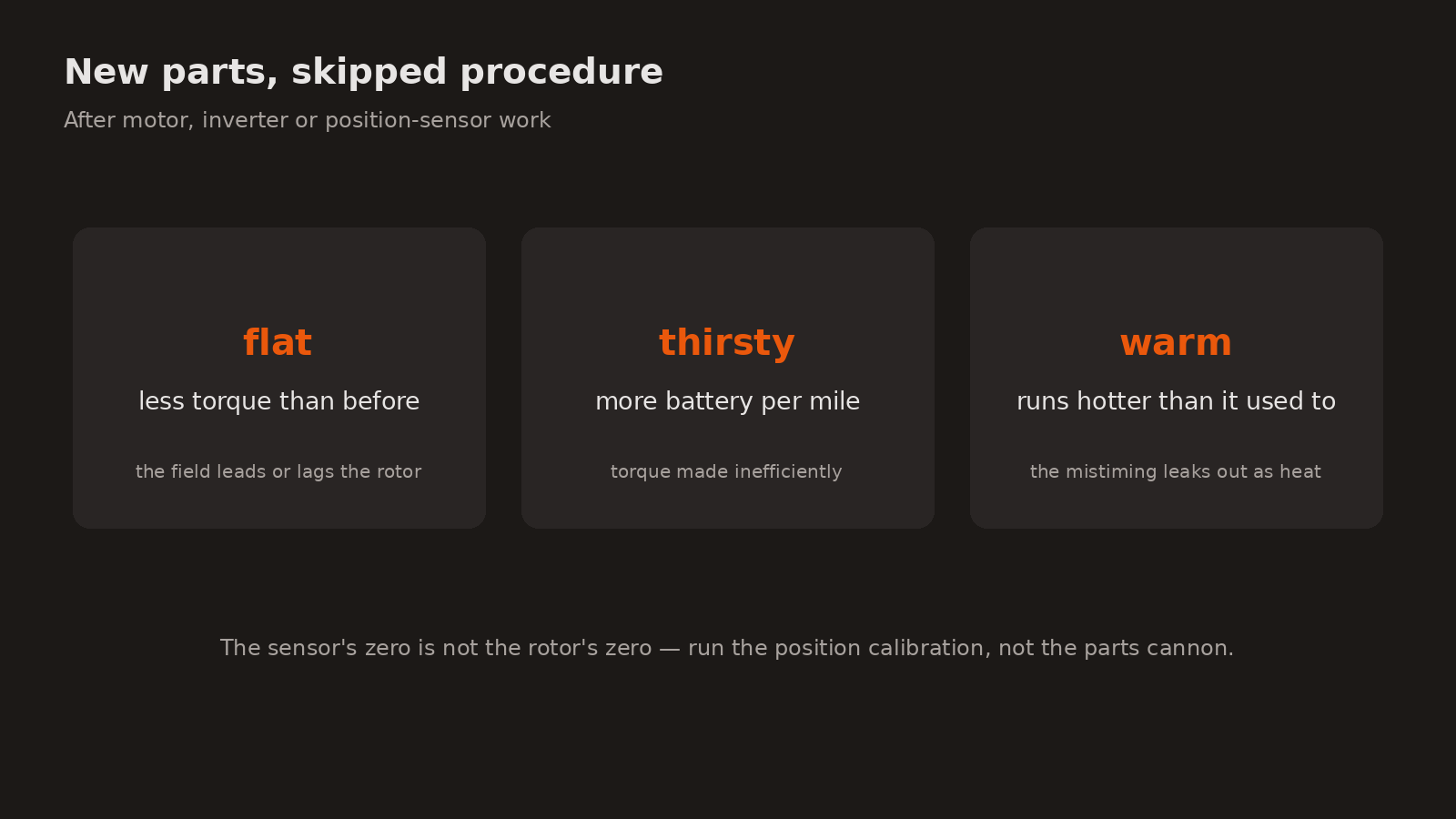
Diagram: the three symptoms of a skipped rotor-position calibration after drive-motor work — reduced torque, higher consumption, and extra heat.
Bilgi amaçlıdır, talimat değildir
CarGeek bir başvuru kaynağıdır, servis el kitabı değildir. Sayfaları kamuya açık kaynaklardan ve başkalarının tespit ettiklerinden yazılır; hiçbir zaman üreticinin kendi servis belgelerinden yazılmaz. Bu nedenle sizin aracınız için yanlış veya eksik olabilir. Anlatılanların bir kısmı gerçek risk taşır: yüksek gerilim, basınç altındaki yakıt, depolanmış enerji, sıcak ve hareketli parçalar.
Uygulamayı düşündüğünüz her şeyi, aracınız için üreticinin kendi prosedürüne göre eğitimli bir kişiye doğrulatın. Buradaki hiçbir şey o prosedürün yerini tutmaz.