How to write a write-up people can confirm
On CarGeek, a confirmed reaction means another person had the same fault and your fix worked for them. That is the strongest signal on the site — it ranks posts, it feeds badges, and it is only possible when a write-up carries enough detail to be followed. Here is the shape that earns it.
The car, exactly. Model, engine (the engine code if you know it), year, rough mileage. The same trouble code behaves differently across engines, and "Golf" helps nobody where "Golf 1.4 TSI CZCA, 2015, 168k km" lets the right reader recognise their own car.
The complaint and the conditions. What the driver actually experienced, and when: cold mornings only, under load only, after refuelling. Conditions are half the diagnosis.
What you measured, with numbers. "Trims were +19% at idle, +4% at 2,500" beats "it was running lean" forever. Freeze frame values, pressures, voltages — the numbers are what let the next person compare their car to yours.
What you ruled out, and how. The tests that came back clean are as valuable as the fix. They are the hours you are saving the next owner.
The fix, specifically. The part (a part number if you have it), roughly what it cost, and — the part everyone forgets — what the readings looked like after. "Trims within ±4% two drive cycles later" is what turns your story into evidence.
A photo, if you have one. The split in the boot, the corroded pin, the oil in the connector. One picture of the actual fault outranks three paragraphs, and every image here is stripped of location data on upload.
Write-ups in this shape are the site working as designed: the next person with your fault finds your page, follows your steps, clicks confirmed — and the fix that cost you a weekend costs them an hour.
Esta guía se publica bajo la licencia CC BY-SA 4.0 — libre para seguir, reutilizar y mejorar con atribución y bajo la misma licencia.
Archivos adjuntos
-
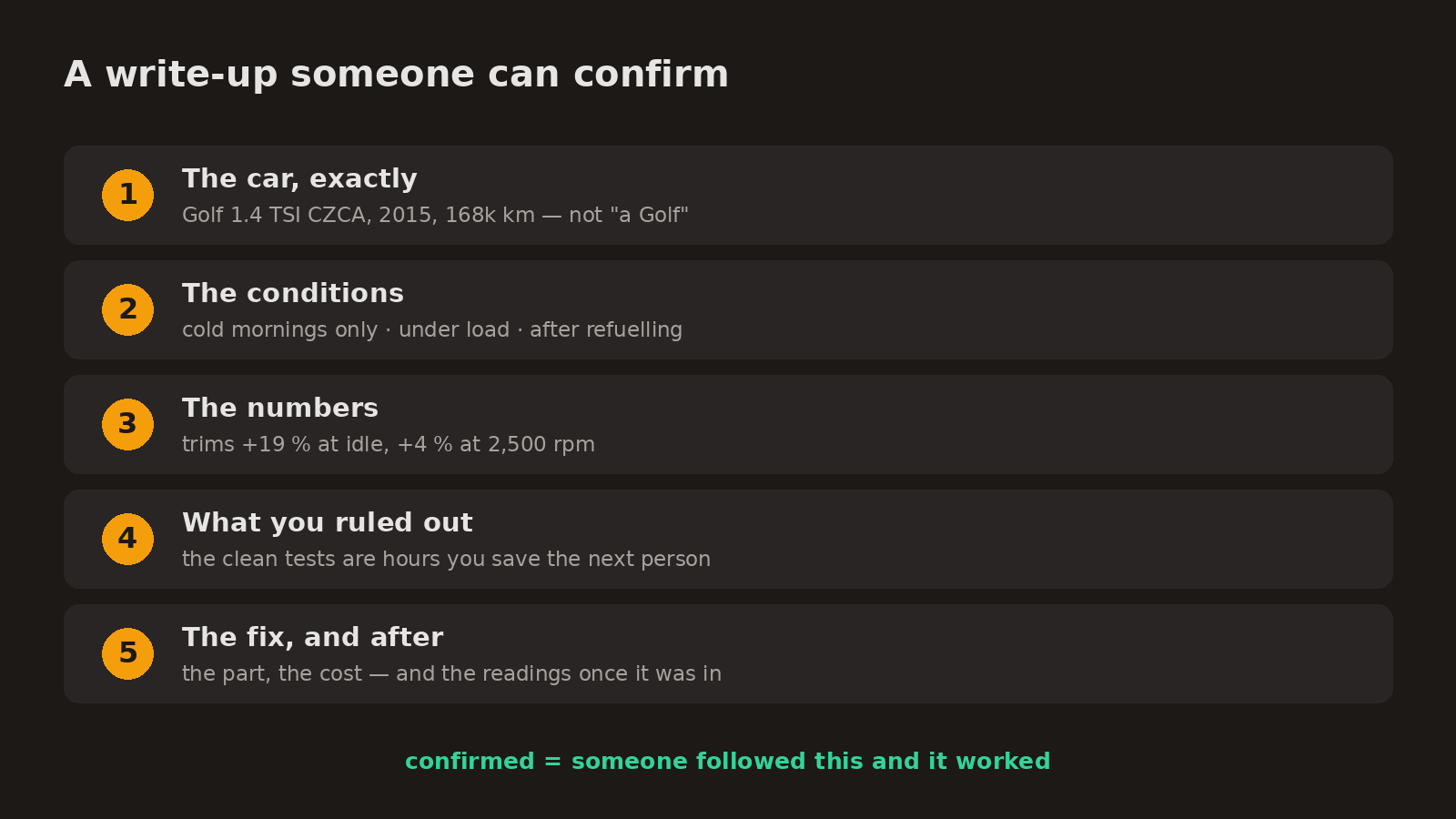
Diagram: the five parts of a confirmable write-up — the exact car, the conditions, the measured numbers, what was ruled out, and the fix with its after-readings.
Información, no instrucciones
CarGeek es una obra de referencia, no un manual de taller. Sus páginas se escriben a partir de fuentes públicas y de lo que otras personas han comprobado, nunca a partir de la documentación de servicio del fabricante, de modo que pueden ser incorrectas o incompletas para su vehículo concreto. Parte de lo que describen entraña un riesgo real: alta tensión, combustible a presión, energía acumulada y piezas calientes o en movimiento.
Antes de actuar sobre cualquier indicación, hágala verificar por una persona con formación técnica siguiendo el procedimiento propio del fabricante para su vehículo. Nada de lo que hay aquí sustituye ese procedimiento.