Read the fuel trims before you replace anything for P0171
P0171 says bank 1 is running lean and the ECU has run out of authority to correct it. The code names the symptom. The fuel trims name the cause — and reading them takes ten minutes with any scan tool that shows live data.
What you are looking at
Short-term fuel trim (STFT) is the correction being applied right now; long-term (LTFT) is the correction the ECU has learned over time. Add them together for bank 1. A healthy engine sits within about ±8% combined. P0171 usually sets somewhere past +20%.
The test
- Engine fully warm, in Park, everything electrical off. Note STFT + LTFT for bank 1 at idle.
- Hold a steady 2,500 rpm for thirty seconds. Note the combined trim again.
- Compare the two numbers.
Reading the result
- High at idle, near normal at 2,500 rpm — unmetered air. A vacuum or intake leak is a fixed-size hole, so it is proportionally huge against idle airflow and almost irrelevant at higher airflow. Look at everything between the MAF and the head: the intake boot (flex it — cracks that gape under engine torque close up at rest), vacuum hoses, PCV plumbing, intake manifold gaskets, the brake booster line.
- High at both, or climbing with load — the engine is not getting the fuel it asks for, or the MAF is underreporting all of it. Check fuel pressure at the rail against spec, then the filter and pump. On the MAF: at hot idle a healthy reading is roughly 1 g/s per litre of displacement; a reading clearly below that with a clean air filter is telling you something.
Confirming a leak
A smoke machine is the honest tool. Short of one, small amounts of brake cleaner or an unlit propane wand around suspect joints will lift the idle the moment they find the hole — keep either well away from the exhaust manifold.
Why this order matters
The parts-cannon order for this code is MAF, then O2 sensor, then plugs — and none of those is the common cause. The trims point at the right third of the engine before you have spent anything.
Deze handleiding verschijnt onder CC BY-SA 4.0 — vrij te volgen, te hergebruiken en te verbeteren, met naamsvermelding en gelijk delen.
Bijlagen
-
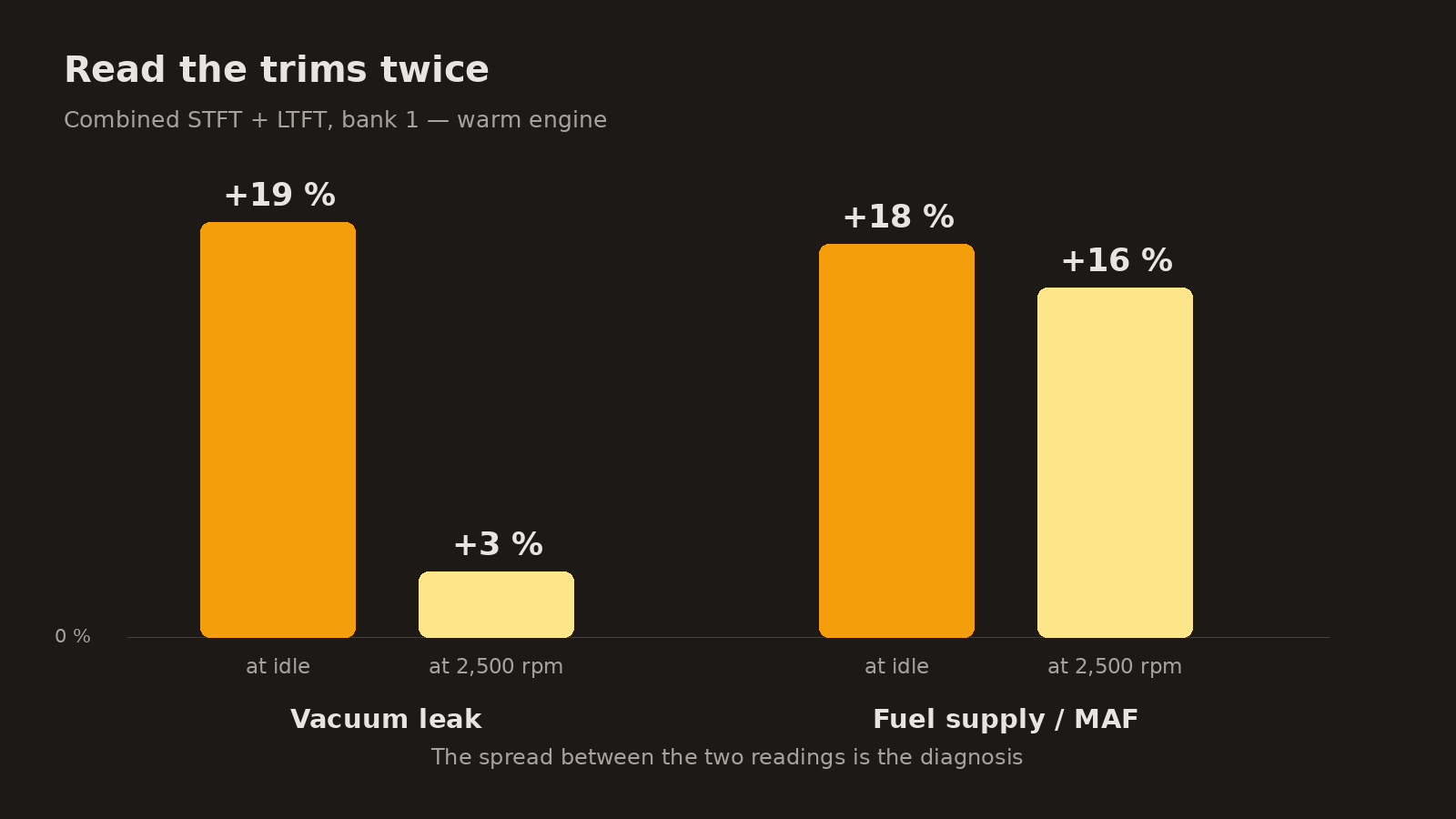
Diagram: combined fuel trim at idle versus 2,500 rpm. A vacuum leak reads high at idle and near normal at revs; a fuel-supply or MAF problem reads high at both.
Informatie, geen instructie
CarGeek is een naslagwerk, geen werkplaatshandboek. De pagina's zijn geschreven op basis van openbare bronnen en van wat anderen hebben ondervonden, nooit op basis van de servicedocumentatie van de fabrikant zelf, dus ze kunnen onjuist of onvolledig zijn voor jouw specifieke voertuig. Een deel van wat erin staat brengt echt gevaar met zich mee: hoogspanning, brandstof onder druk, opgeslagen energie en hete of bewegende delen.
Laat alles waarnaar je wilt handelen eerst controleren door iemand met een technische opleiding, aan de hand van de eigen procedure van de fabrikant voor jouw voertuig. Niets hier vervangt die procedure.