P0113 usually means a connector, and the scanner proves it in one reading
HO
@hhh
1 month ago
P0113 says the intake air temperature signal went above its plausible range — which, because the sensor is a thermistor whose voltage rises as it gets colder, is the electrical signature of an open circuit. The ECU is not seeing "hot air"; it is seeing nothing, and logging the coldest value it can represent.
One live reading settles it: look at IAT on the scanner. A sensor showing −40° is not measuring anything on Earth — that is the open-circuit default, and your problem is a connector, a broken wire, or the sensor's own element, in that order of likelihood.
Check when it started. This sensor lives in or near the air filter housing on most cars, and a huge share of these codes appear right after an air filter service — the connector left unplugged, or its locking tab cracked with age and the plug walked out. Unplug, inspect the pins for corrosion, replug until it clicks.
Why it matters beyond the light: the ECU falls back to a default temperature and richens cold-start fuelling. The car mostly drives, economy quietly suffers, and on cold mornings it can run rough enough to collect misfire codes that are really this one wearing a disguise.
The plausibility cross-check, free with any scanner: after a full overnight cold soak, IAT, coolant temperature and ambient should all read within a couple of degrees. The one that disagrees is the liar.
One live reading settles it: look at IAT on the scanner. A sensor showing −40° is not measuring anything on Earth — that is the open-circuit default, and your problem is a connector, a broken wire, or the sensor's own element, in that order of likelihood.
Check when it started. This sensor lives in or near the air filter housing on most cars, and a huge share of these codes appear right after an air filter service — the connector left unplugged, or its locking tab cracked with age and the plug walked out. Unplug, inspect the pins for corrosion, replug until it clicks.
Why it matters beyond the light: the ECU falls back to a default temperature and richens cold-start fuelling. The car mostly drives, economy quietly suffers, and on cold mornings it can run rough enough to collect misfire codes that are really this one wearing a disguise.
The plausibility cross-check, free with any scanner: after a full overnight cold soak, IAT, coolant temperature and ambient should all read within a couple of degrees. The one that disagrees is the liar.
Attachments
-
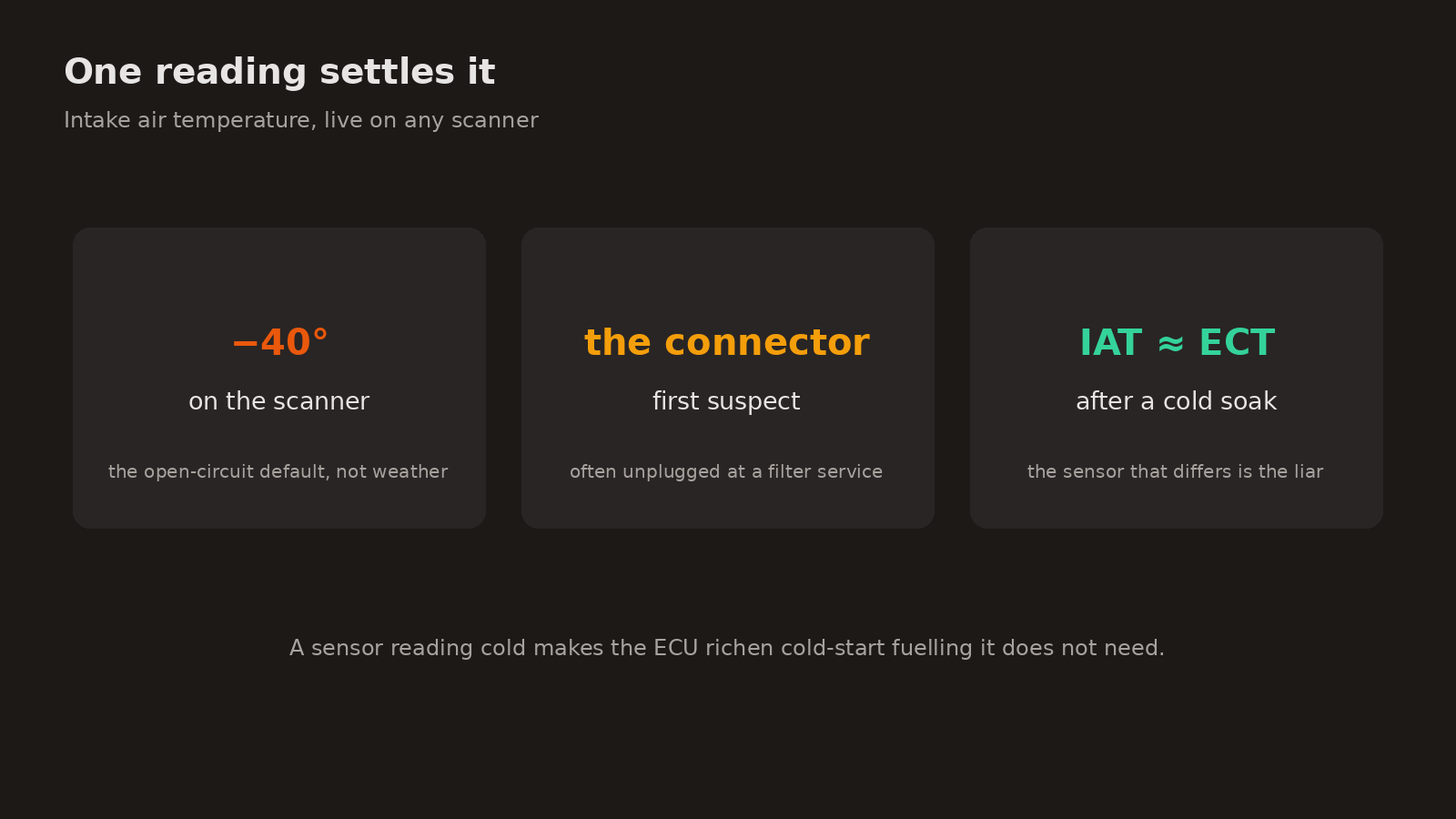
Diagram: the three checks for an intake air temperature circuit code — the minus-forty open-circuit reading, the connector, and the cold-soak plausibility cross-check.
Information, not instruction
CarGeek is a reference, not a service manual. Its pages are written from public sources and from what other people have found, never from a manufacturer's own service information, so they can be wrong or incomplete for your particular vehicle. Some of what they describe carries real risk: high voltage, fuel under pressure, stored energy, hot and moving parts.
Have anything you intend to act on checked by a trained person against the manufacturer's own procedure for your vehicle. Nothing here replaces that procedure.