P0113 usually means a connector, and the scanner proves it in one reading
One live reading settles it: look at IAT on the scanner. A sensor showing −40° is not measuring anything on Earth — that is the open-circuit default, and your problem is a connector, a broken wire, or the sensor's own element, in that order of likelihood.
Check when it started. This sensor lives in or near the air filter housing on most cars, and a huge share of these codes appear right after an air filter service — the connector left unplugged, or its locking tab cracked with age and the plug walked out. Unplug, inspect the pins for corrosion, replug until it clicks.
Why it matters beyond the light: the ECU falls back to a default temperature and richens cold-start fuelling. The car mostly drives, economy quietly suffers, and on cold mornings it can run rough enough to collect misfire codes that are really this one wearing a disguise.
The plausibility cross-check, free with any scanner: after a full overnight cold soak, IAT, coolant temperature and ambient should all read within a couple of degrees. The one that disagrees is the liar.
Pièces jointes
-
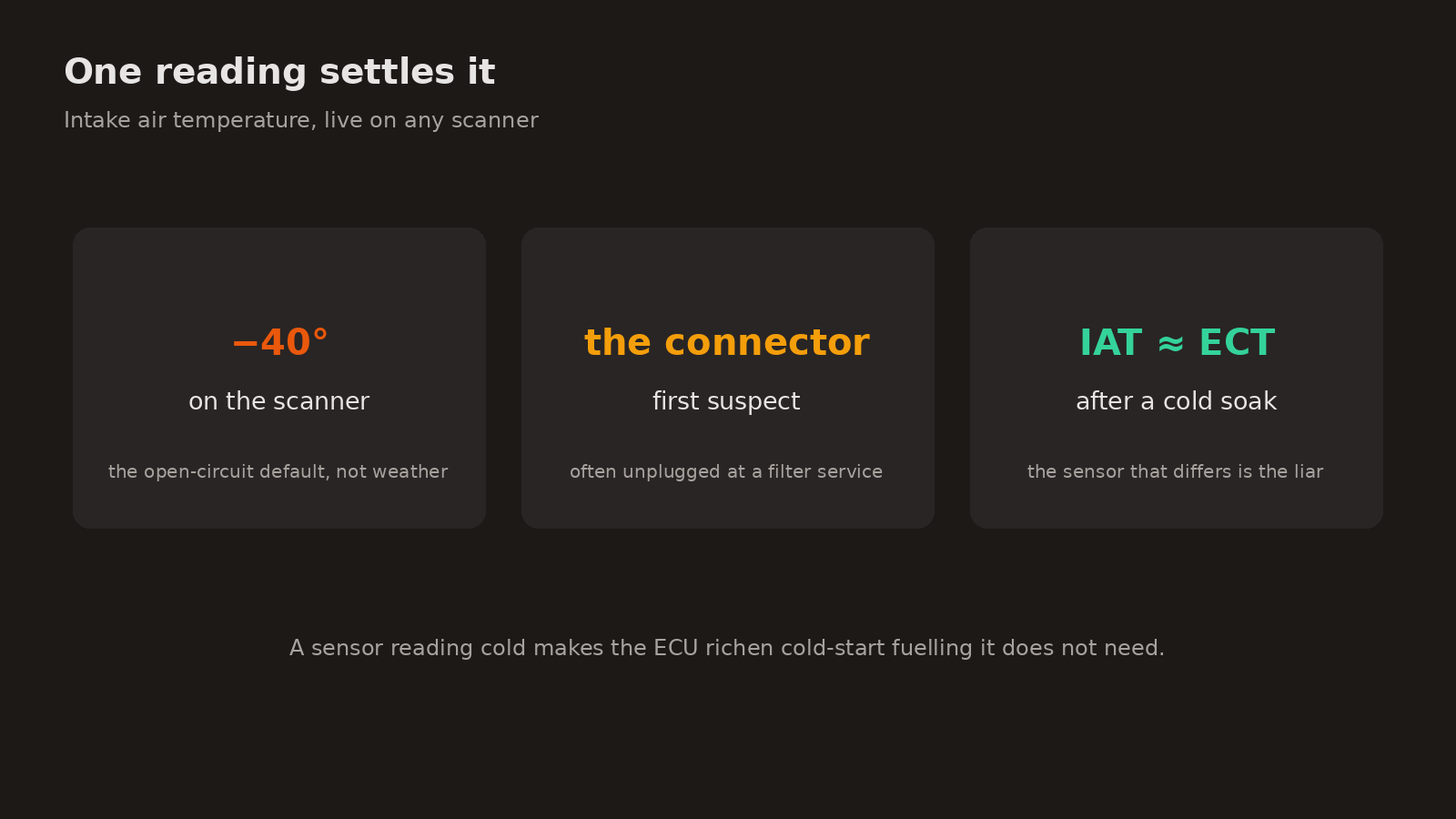
Diagram: the three checks for an intake air temperature circuit code — the minus-forty open-circuit reading, the connector, and the cold-soak plausibility cross-check.
Des informations, pas des instructions
CarGeek est un ouvrage de référence, pas un manuel d'atelier. Ses pages sont rédigées à partir de sources publiques et de ce que d'autres ont constaté, jamais à partir de la documentation technique du constructeur ; elles peuvent donc être erronées ou incomplètes pour votre véhicule précis. Une partie de ce qu'elles décrivent présente un risque réel : haute tension, carburant sous pression, énergie accumulée, pièces chaudes ou en mouvement.
Avant d'agir sur quoi que ce soit, faites-le vérifier par une personne formée, en suivant la procédure du constructeur pour votre véhicule. Rien ici ne remplace cette procédure.