P0113 usually means a connector, and the scanner proves it in one reading
One live reading settles it: look at IAT on the scanner. A sensor showing −40° is not measuring anything on Earth — that is the open-circuit default, and your problem is a connector, a broken wire, or the sensor's own element, in that order of likelihood.
Check when it started. This sensor lives in or near the air filter housing on most cars, and a huge share of these codes appear right after an air filter service — the connector left unplugged, or its locking tab cracked with age and the plug walked out. Unplug, inspect the pins for corrosion, replug until it clicks.
Why it matters beyond the light: the ECU falls back to a default temperature and richens cold-start fuelling. The car mostly drives, economy quietly suffers, and on cold mornings it can run rough enough to collect misfire codes that are really this one wearing a disguise.
The plausibility cross-check, free with any scanner: after a full overnight cold soak, IAT, coolant temperature and ambient should all read within a couple of degrees. The one that disagrees is the liar.
Anhänge
-
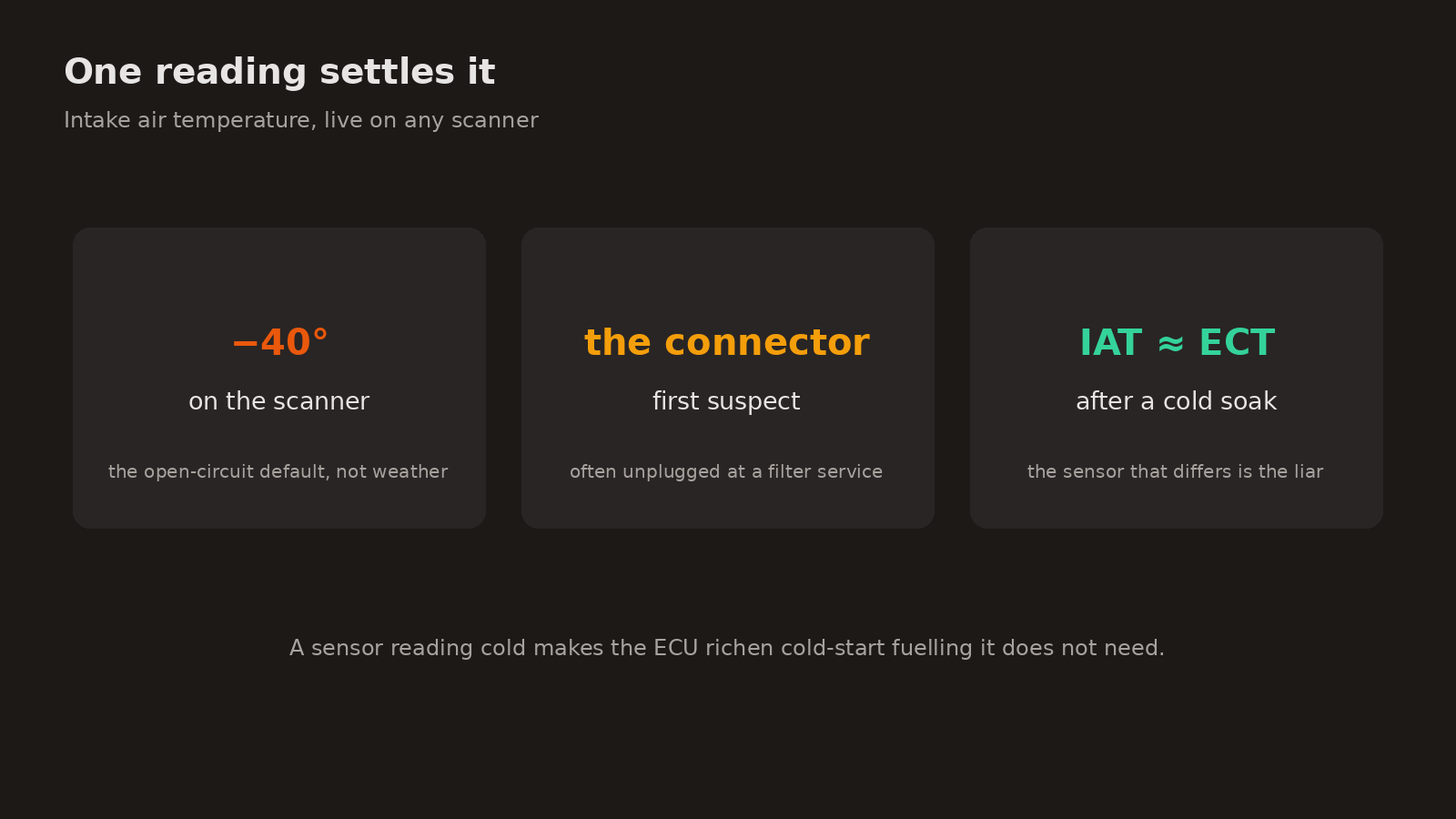
Diagram: the three checks for an intake air temperature circuit code — the minus-forty open-circuit reading, the connector, and the cold-soak plausibility cross-check.
Information, keine Handlungsanweisung
CarGeek ist ein Nachschlagewerk, kein Werkstatthandbuch. Die Seiten entstehen aus öffentlichen Quellen und aus dem, was andere festgestellt haben, nie aus den Serviceunterlagen des Herstellers; für Ihr konkretes Fahrzeug können sie daher falsch oder unvollständig sein. Ein Teil des Beschriebenen birgt echte Gefahren: Hochspannung, Kraftstoff unter Druck, gespeicherte Energie sowie heiße oder bewegte Teile.
Lassen Sie alles, wonach Sie handeln wollen, von einer fachlich geschulten Person anhand der herstellereigenen Vorgehensweise für Ihr Fahrzeug prüfen. Nichts hiervon ersetzt diese Vorgehensweise.