Cleaning a MAF: when it works and when it is a placebo
When it genuinely works: the sensing element has a film on it. The classic source is an over-oiled aftermarket air filter — the oil migrates, coats the hot element, and the sensor under-reads everywhere. The signature is a MAF reading low across the range (grams per second clearly below roughly one per litre of displacement at hot idle, and a weak peak at full throttle) on an engine whose filter history includes oil. Cleaning removes the film and the readings recover. That is the whole success story, and it is common enough to be worth the ten minutes.
How to do it without buying a new sensor anyway: sensor-safe MAF cleaner only — not carb cleaner, not brake cleaner, both of which attack the element's coating. Spray, never touch; the wires and films in there do not survive cotton buds. Let it dry fully before refitting.
When it is a placebo: circuit codes (signal low, signal high, no signal) are electrical faults — no amount of cleaning fixes a broken wire or a dead supply. Lean codes whose trims point at unmetered air are boot-and-PCV problems wearing a MAF costume. And a sensor that reads plausibly at idle and proportionally through the range is doing its job; cleaning it changes nothing but confidence.
Clean film, test circuits, hunt leaks — in that order, for those symptoms respectively.
Вложения
-
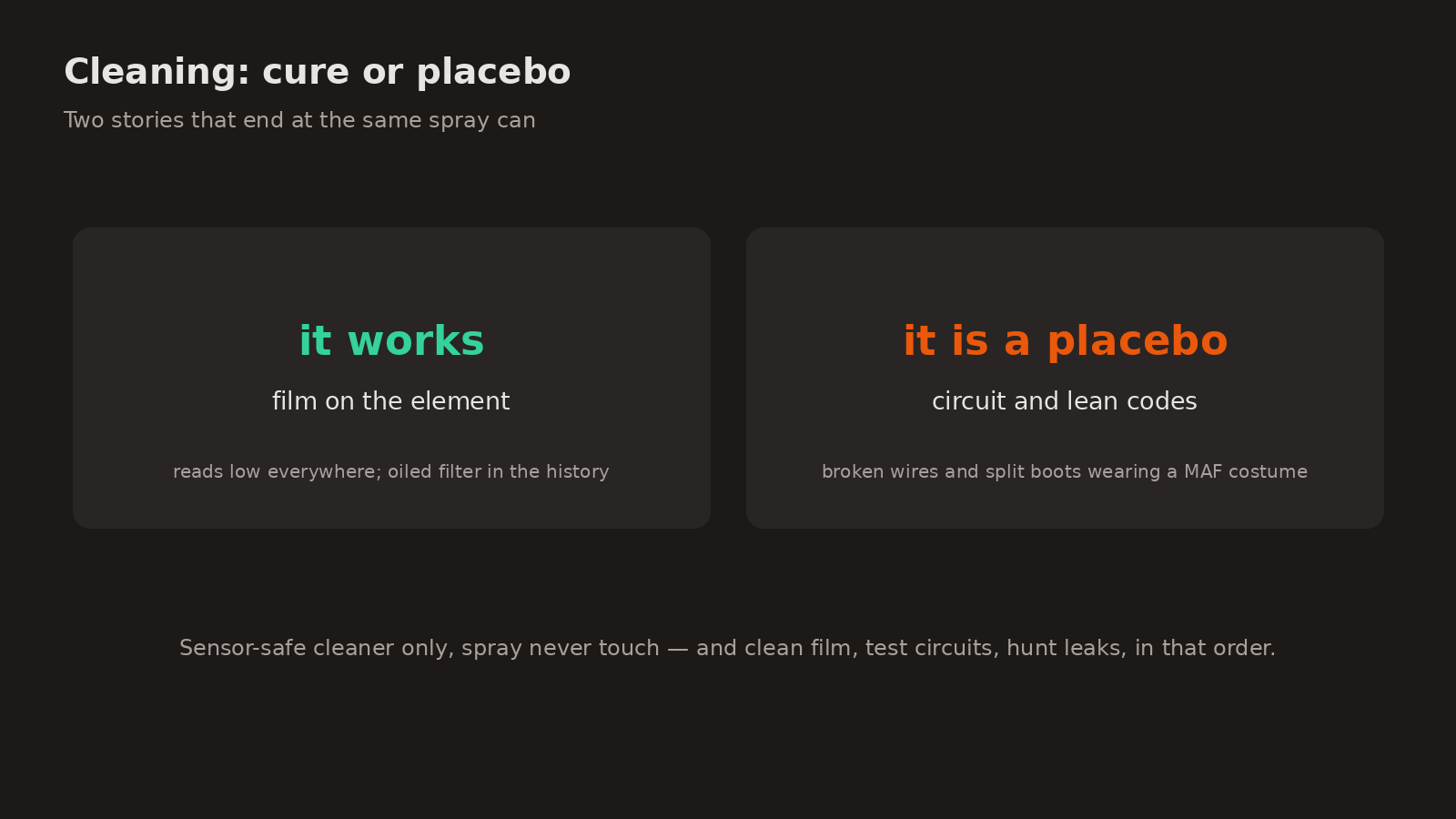
Diagram: when MAF cleaning genuinely works — an oil film on the sensing element — versus the circuit faults and vacuum leaks it cannot touch.
Информация, а не инструкция
CarGeek — это справочник, а не руководство по ремонту. Его страницы составлены по открытым источникам и по опыту других людей, но не по сервисной документации производителя, поэтому для вашего конкретного автомобиля они могут быть неверными или неполными. Часть описанного связана с реальной опасностью: высокое напряжение, топливо под давлением, накопленная энергия, горячие и движущиеся детали.
Всё, по чему вы собираетесь действовать, сначала проверьте с человеком, имеющим техническую подготовку, по собственной процедуре производителя для вашего автомобиля. Ничто здесь не заменяет эту процедуру.