Cleaning a MAF: when it works and when it is a placebo
When it genuinely works: the sensing element has a film on it. The classic source is an over-oiled aftermarket air filter — the oil migrates, coats the hot element, and the sensor under-reads everywhere. The signature is a MAF reading low across the range (grams per second clearly below roughly one per litre of displacement at hot idle, and a weak peak at full throttle) on an engine whose filter history includes oil. Cleaning removes the film and the readings recover. That is the whole success story, and it is common enough to be worth the ten minutes.
How to do it without buying a new sensor anyway: sensor-safe MAF cleaner only — not carb cleaner, not brake cleaner, both of which attack the element's coating. Spray, never touch; the wires and films in there do not survive cotton buds. Let it dry fully before refitting.
When it is a placebo: circuit codes (signal low, signal high, no signal) are electrical faults — no amount of cleaning fixes a broken wire or a dead supply. Lean codes whose trims point at unmetered air are boot-and-PCV problems wearing a MAF costume. And a sensor that reads plausibly at idle and proportionally through the range is doing its job; cleaning it changes nothing but confidence.
Clean film, test circuits, hunt leaks — in that order, for those symptoms respectively.
Bijlagen
-
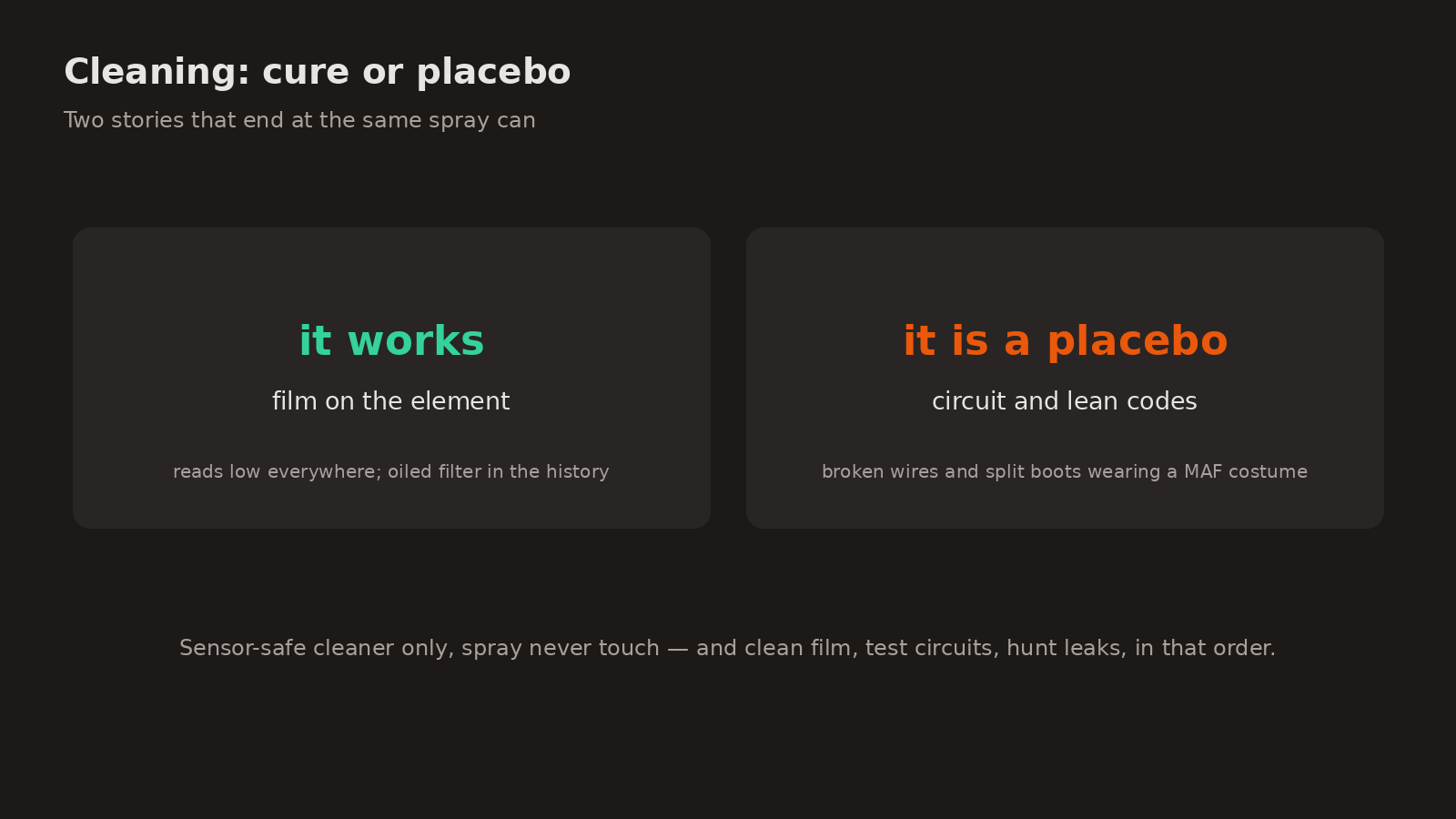
Diagram: when MAF cleaning genuinely works — an oil film on the sensing element — versus the circuit faults and vacuum leaks it cannot touch.
Informatie, geen instructie
CarGeek is een naslagwerk, geen werkplaatshandboek. De pagina's zijn geschreven op basis van openbare bronnen en van wat anderen hebben ondervonden, nooit op basis van de servicedocumentatie van de fabrikant zelf, dus ze kunnen onjuist of onvolledig zijn voor jouw specifieke voertuig. Een deel van wat erin staat brengt echt gevaar met zich mee: hoogspanning, brandstof onder druk, opgeslagen energie en hete of bewegende delen.
Laat alles waarnaar je wilt handelen eerst controleren door iemand met een technische opleiding, aan de hand van de eigen procedure van de fabrikant voor jouw voertuig. Niets hier vervangt die procedure.