Cleaning a MAF: when it works and when it is a placebo
When it genuinely works: the sensing element has a film on it. The classic source is an over-oiled aftermarket air filter — the oil migrates, coats the hot element, and the sensor under-reads everywhere. The signature is a MAF reading low across the range (grams per second clearly below roughly one per litre of displacement at hot idle, and a weak peak at full throttle) on an engine whose filter history includes oil. Cleaning removes the film and the readings recover. That is the whole success story, and it is common enough to be worth the ten minutes.
How to do it without buying a new sensor anyway: sensor-safe MAF cleaner only — not carb cleaner, not brake cleaner, both of which attack the element's coating. Spray, never touch; the wires and films in there do not survive cotton buds. Let it dry fully before refitting.
When it is a placebo: circuit codes (signal low, signal high, no signal) are electrical faults — no amount of cleaning fixes a broken wire or a dead supply. Lean codes whose trims point at unmetered air are boot-and-PCV problems wearing a MAF costume. And a sensor that reads plausibly at idle and proportionally through the range is doing its job; cleaning it changes nothing but confidence.
Clean film, test circuits, hunt leaks — in that order, for those symptoms respectively.
Anexos
-
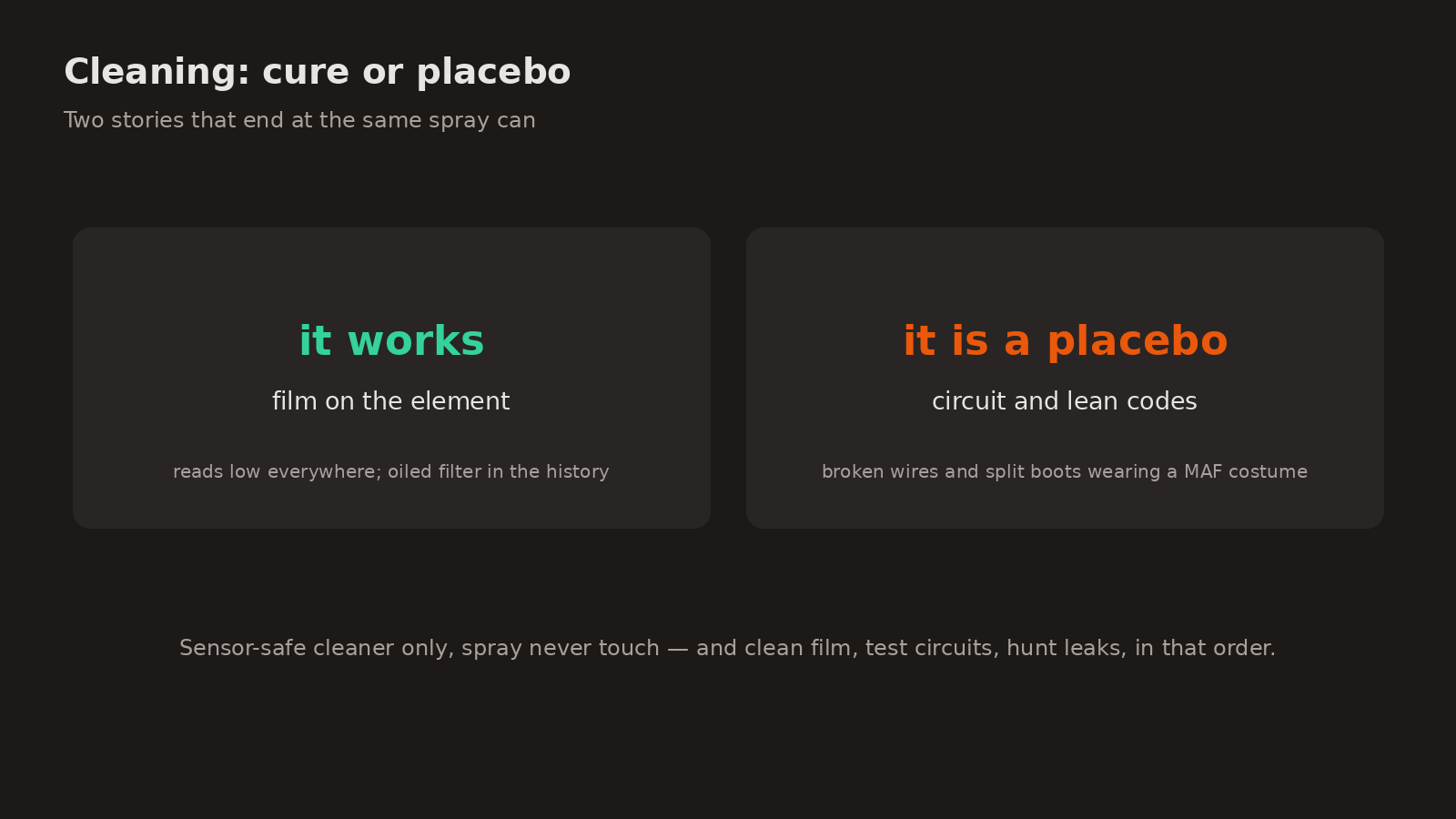
Diagram: when MAF cleaning genuinely works — an oil film on the sensing element — versus the circuit faults and vacuum leaks it cannot touch.
Informação, não instrução
O CarGeek é uma referência, não um manual de serviço. Suas páginas são escritas a partir de fontes públicas e do que outras pessoas constataram, nunca a partir da documentação de serviço do fabricante, de modo que podem estar erradas ou incompletas para o seu veículo específico. Parte do que descrevem envolve risco real: alta tensão, combustível sob pressão, energia acumulada e peças quentes ou em movimento.
Antes de agir com base em qualquer orientação, peça a verificação de uma pessoa com formação técnica, seguindo o procedimento do próprio fabricante para o seu veículo. Nada aqui substitui esse procedimento.