Vehicle
Hyundai i30
The European-market compact hatch, mechanically an Elantra. Sold as Elantra GT in North America.
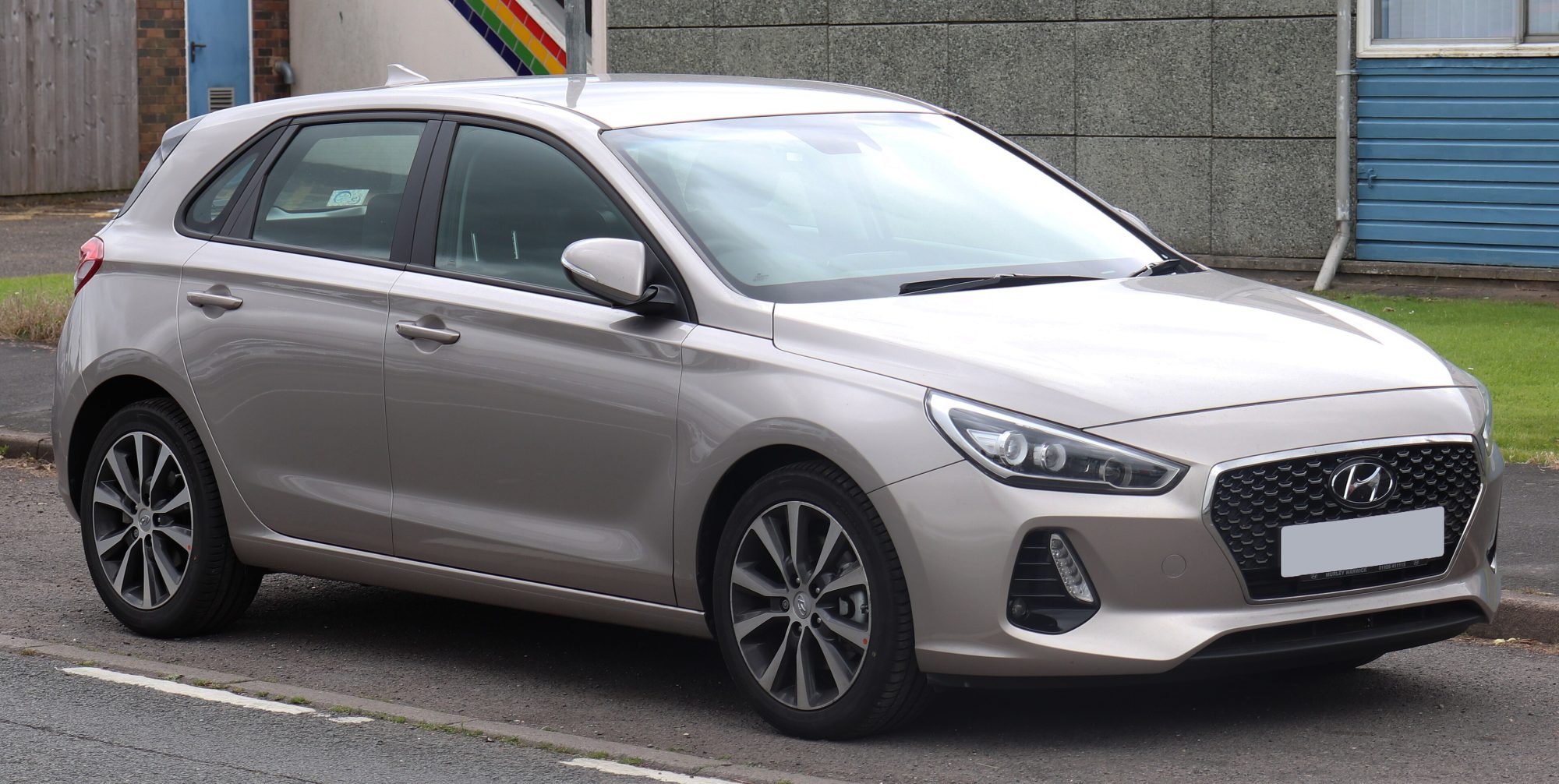

Generations
-
FD 2007–2012
The first i30; conventional petrol and the U-series diesel.
- Body styles
- Hatchback · Estate
- Platform
- Hyundai FD
- Engines
-
- 1.4 Gamma — petrol · 80 kW (107 hp) · 137 Nm (101 lb-ft)
- 1.6 Gamma — petrol · 90–93 kW (121–125 hp) · 154 Nm (114 lb-ft)
- 2.0 Beta — petrol · 105 kW (141 hp) · 186 Nm (137 lb-ft)
- 1.6 CRDi — diesel · 66–94 kW (89–126 hp) · 235–260 Nm (173–192 lb-ft)
- 2.0 CRDi — diesel · 103 kW (138 hp) · 305 Nm (225 lb-ft)
- Transmissions
- 5-speed manual · 6-speed manual · 4-speed automatic
- Drivetrain
- Front-wheel drive
-
GD 2011–2017
Gamma direct injection and a dual-clutch option.
- Body styles
- Hatchback · Estate
- Platform
- Hyundai-Kia J5 platform
- Engines
-
- 1.4 MPI — petrol · 73 kW (98 hp) · 137 Nm (101 lb-ft)
- 1.6 GDI — petrol · 99 kW (133 hp) · 164 Nm (121 lb-ft)
- 1.6 CRDi — diesel · 66–100 kW (89–134 hp)
- 1.6 turbo — petrol · 88–137 kW (118–184 hp) · 265 Nm (195 lb-ft)
- 1.8 — petrol
- 2.0 — petrol · 202 kW (271 hp)
- 1.4 — diesel · 66 kW (89 hp) · 220 Nm (162 lb-ft)
- Transmissions
- 6-speed manual · 6-speed automatic · 7-speed dual-clutch · 6-speed Shiftronic automatic
- Drivetrain
- Front-wheel drive
-
PD 2016–present
Smartstream engines with mild hybrid on the diesels.
- CRDi (badge, not an engine)
- Gamma
- Nu 2.0 L
- Smartstream G (1.0–3.5)
- T-GDi (badge, not an engine)
- U-family (CRDi, 1.5 and 1.7)
- Body styles
- Hatchback · Estate · Fastback
- Platform
- Hyundai-Kia K2 platform
- Engines
-
- 1.0 T-GDI — petrol · 88 kW (118 hp) · 171 Nm (126 lb-ft)
- 1.4 T-GDI — petrol · 103 kW (138 hp) · 242 Nm (178 lb-ft)
- 1.5 T-GDI — mild hybrid · 103–118 kW (138–158 hp) · 253 Nm (187 lb-ft)
- 1.6 CRDi — diesel · 70–122 kW (94–164 hp) · 280–300 Nm (207–221 lb-ft)
- 1.4 — petrol · 73 kW (98 hp) · 134 Nm (99 lb-ft)
- 1.6 — petrol · 88–137 kW (118–184 hp)
- 1.6 turbo — petrol · 88–137 kW (118–184 hp)
- 2.0 — petrol
- 2.0 turbo — petrol · 184–206 kW (247–276 hp) · 353–392 Nm (260–289 lb-ft)
- Transmissions
- 6-speed manual · 7-speed dual-clutch · 6-Speed automatic · 7/8-Speed DCT
- Drivetrain
- Front-wheel drive
CAN data
Bus databases covering this vehicle, mirrored from the open-source opendbc project.
Service information
Information, not instruction
CarGeek is a reference, not a service manual. Its pages are written from public sources and from what other people have found, never from a manufacturer's own service information, so they can be wrong or incomplete for your particular vehicle. Some of what they describe carries real risk: high voltage, fuel under pressure, stored energy, hot and moving parts.
Have anything you intend to act on checked by a trained person against the manufacturer's own procedure for your vehicle. Nothing here replaces that procedure.
Posted about the Hyundai i30
Be the first to write this up
Nothing posted about this yet. Whatever you found is worth writing down — even a dead end saves someone the same afternoon.
What makes one worth reading:
- The car — make, model, year and engine. The same fault behaves differently on each.
- What you measured, not only what you replaced.
- What actually fixed it — or that nothing did, which is worth knowing too.
Sign in or create an account to add what you found about Hyundai i30.