Vehicle
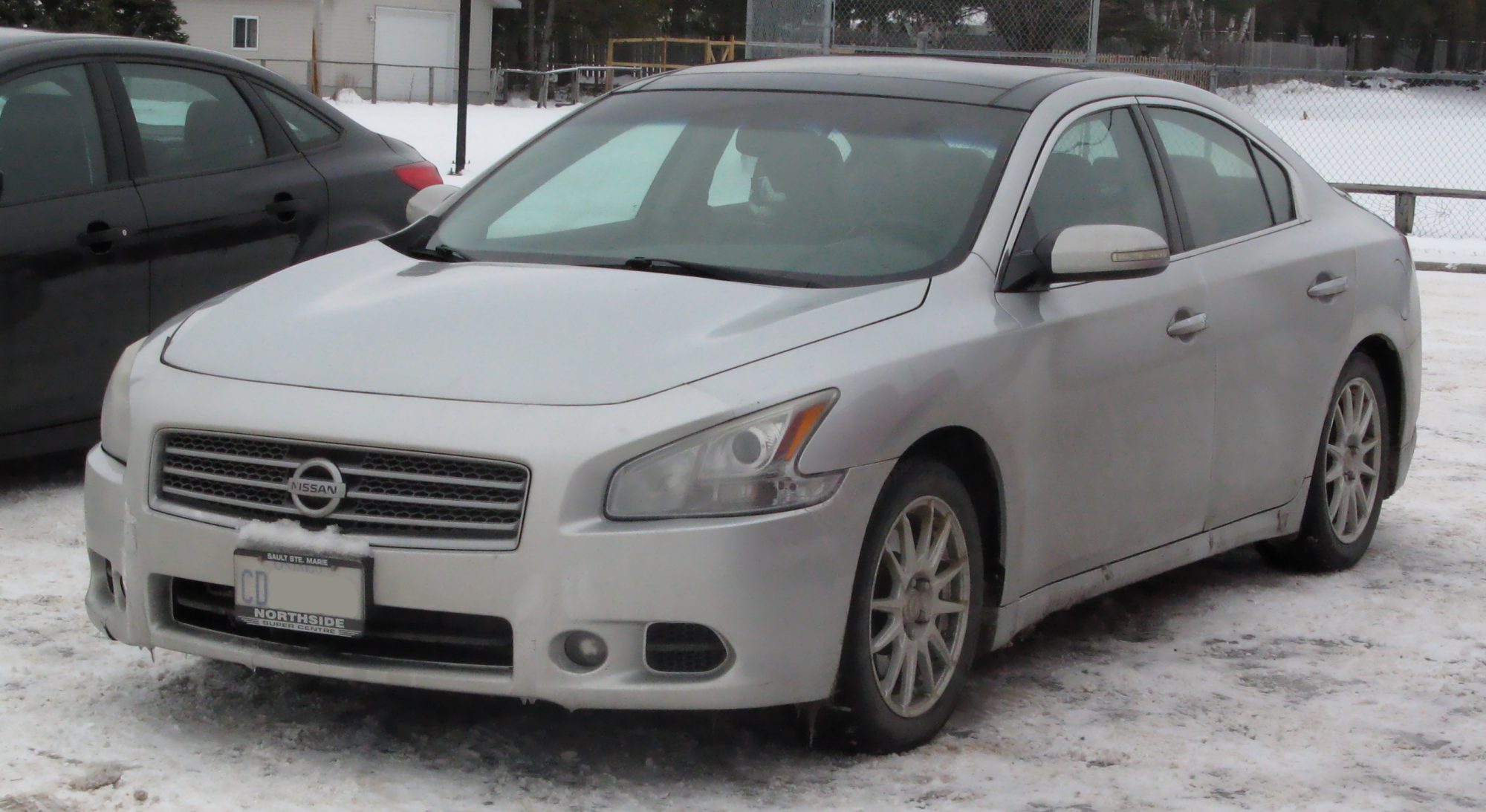
Nissan Maxima
The large front-drive saloon, and for most of its life a VQ V6 car — which makes it a useful reference point, because the VQ35 and VQ30 appear across half the Nissan range and their faults travel with them. The recurring ones are the intake-manifold runner control on VQ35DE engines, whose actuator and butterflies stick and set runner-position codes; catalyst efficiency codes driven by the well-documented precatalyst substrate breaking up and being drawn back into the engine; and, from 2007, a CVT whose fluid temperature and ratio-monitoring codes are the first sign of wear rather than a slipping complaint. Anything read about the Altima's CVT applies here.

Generations
-
910 and U11 1981–1988
The rear-drive 910 and then the first front-drive U11 — a change of layout inside one nameplate, and the L24E straight-six of the earliest cars is a different family entirely.
- RE4F02A / RE4F03A / RE4F04A 4-speed automatic
- RE4R03A / RL4R01A / 3N71 automatic
- RS5F32 / RS5F50 / RS5F91 5-speed manual
- Body styles
- Sedan · Estate
- Platform
- Nissan 910 and U11
- Engines
-
- 2.4 straight-six — L24E · petrol
- 2.8 straight-six diesel — LD28 · diesel
- 3.0 V6 — VG30E · petrol · 110–133 kW (148–178 hp) · 235–260 Nm (173–192 lb-ft)
- 2.0 turbo V6 — VG20E · petrol
- Transmissions
- 5-speed RS5F50A manual · 4-speed RL4F02A automatic · 3-speed 3N71 automatic · 4-speed L4N71B automatic
- Drivetrain
- Rear-wheel drive · Front-wheel drive
-
J30 1988–1994
The 4DSC years, on a trailing-arm independent rear end the A32 gave up. Most run the single-cam VG30E; the twin-cam VE30DE was the 1992-1994 SE alone and is the only Maxima ever fitted with it, so parts lookups that assume a VG will be wrong on one.
- Body styles
- Sedan
- Platform
- Nissan FF-L
- Engines
-
- 3.0 V6 — VG30E · petrol · 110–133 kW (148–178 hp) · 235–260 Nm (173–192 lb-ft)
- 3.0 V6 — VE30DE · petrol · 142 kW (190 hp) · SE, 1992–1994
- 2.0 turbo straight-six — RB20DET · petrol · A31 Cefiro (LA31/LCA31/LNA31), rear-wheel drive
- Transmissions
- 5-speed manual · 4-speed automatic
- Drivetrain
- Front-wheel drive
-
A32 1994–1999
The first VQ Maxima, and where the family story this page keeps returning to begins — intake-manifold runner control and precatalyst breakup are both VQ traits rather than Maxima ones. Sold as the Cefiro in Japan and the QX in Europe, which is where the smaller V6s come from.
- Body styles
- Sedan
- Platform
- Nissan FF-L
- Engines
-
- 2.0 V6 — VQ20DE · petrol · Cefiro and QX
- 2.5 V6 — VQ25DE · petrol · Cefiro, Japan
- 3.0 V6 — VQ30DE · petrol · 278–294 Nm (205–217 lb-ft)
- Transmissions
- 5-speed manual · 4-speed automatic
- Drivetrain
- Front-wheel drive
-
A33 1999–2003
A badge-engineered A33 Cefiro. The 3.0 gains the dual-runner VQ30DE-K, and the 2002 facelift brings the VQ35DE and a six-speed manual — so two cars wearing one badge here differ by half a litre and a gearbox.
- Body styles
- Sedan
- Platform
- Nissan FF-L
- Engines
-
- 2.0 V6 — VQ20DE · petrol · Cefiro, Japan
- 2.5 V6 — VQ25DE · petrol · Cefiro, Japan
- 2.5 V6 direct injection — VQ25DD · petrol · Neo Di; Cefiro, Japan
- 3.0 V6 — VQ30DE · petrol · 278–294 Nm (205–217 lb-ft) · VQ30DE-K from 2000
- 3.5 V6 — VQ35DE · petrol · 170–232 kW (228–311 hp) · 333–363 Nm (246–268 lb-ft) · from the 2002 facelift
- Transmissions
- 5-speed manual · 4-speed automatic · 6-speed manual
- Drivetrain
- Front-wheel drive
-
Sixth generation (A34) 2004–2008
VQ35DE with the intake-manifold runner control and precatalyst faults that define this engine family.
- Body styles
- Sedan
- Platform
- Nissan FF-L
- Engines
-
- 3.5 V6 — VQ35DE · petrol · 170–232 kW (228–311 hp) · 333–363 Nm (246–268 lb-ft)
- Transmissions
- 5-speed automatic · CVT · 6-speed manual (RS6F51A / RS6F51H) · 4/5-speed automatic
- Drivetrain
- Front-wheel drive
-
Seventh and eighth generation (A35 and A36) 2009–2023
CVT throughout; fluid temperature and ratio-monitoring codes are the first sign of transmission wear.
- Body styles
- Sedan
- Platform
- Nissan D
- Engines
-
- 3.5 V6 — VQ35DE · petrol · 170–232 kW (228–311 hp) · 333–363 Nm (246–268 lb-ft)
- 2.5 — QR25DE · petrol · 108–149 kW (145–200 hp) · 213–251 Nm (157–185 lb-ft) · China
- Transmissions
- Xtronic CVT
- Drivetrain
- Front-wheel drive
Service information
Information, not instruction
CarGeek is a reference, not a service manual. Its pages are written from public sources and from what other people have found, never from a manufacturer's own service information, so they can be wrong or incomplete for your particular vehicle. Some of what they describe carries real risk: high voltage, fuel under pressure, stored energy, hot and moving parts.
Have anything you intend to act on checked by a trained person against the manufacturer's own procedure for your vehicle. Nothing here replaces that procedure.
Posted about the Nissan Maxima
Be the first to write this up
Nothing posted about this yet. Whatever you found is worth writing down — even a dead end saves someone the same afternoon.
What makes one worth reading:
- The car — make, model, year and engine. The same fault behaves differently on each.
- What you measured, not only what you replaced.
- What actually fixed it — or that nothing did, which is worth knowing too.
Sign in or create an account to add what you found about Nissan Maxima.