Vehicle
Tata Sierra
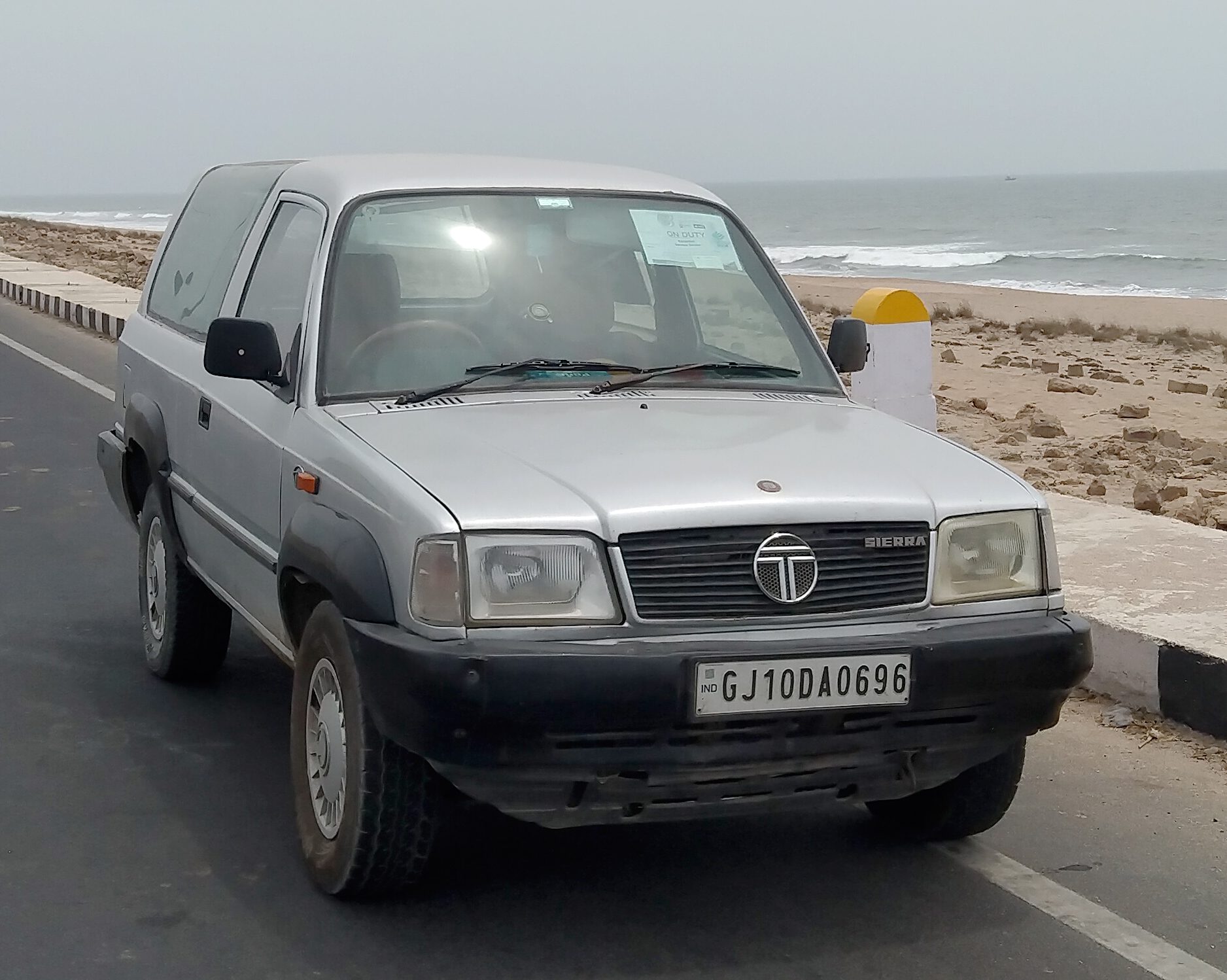
One badge on two vehicles twenty-two years apart, and nothing carries over between them. The 1991 Sierra was a three-door ladder-frame SUV with a naturally aspirated 2.0 diesel and rear-wheel drive; the 2025 Sierra is a five-door monocoque crossover with three 1.5-litre engines and front-wheel drive. A wiring diagram, a connector location or a code list found for one is describing the other vehicle entirely, so establish the model year before anything else — the name is the only thing they share.
The original was the first car designed and built in India, and it shares its underpinnings with two commercial vehicles. It sits on Tata's X2 ladder frame, the same one under the Telcoline pickup and the Sumo, and its 2.0 diesel is the engine those carry. That is genuinely useful: parts availability, service literature and fault experience for the engine and driveline are far easier to find under the commercial badges than under the Sierra's own, because far more of them were built. The engine arrived naturally aspirated and gained a turbocharger later, and the two are different diagnostic problems — a boost complaint has nowhere to go on the earlier car.
The 2025 car is a Curvv and a Nexon underneath. It uses Tata's ATLAS architecture, so the electrical architecture, module layout and most of the powertrain are shared with those two, and a procedure written for either is usually right here. Its three engines are all 1.5 litres and all different: a naturally aspirated Revotron petrol, a direct-injection turbocharged Hyperion petrol, and a turbodiesel Tata badges Kryojet on this car and Revotorq on the Curvv — the same 1,497 cc engine under two names. Reading a fuelling complaint against the wrong one of the two petrols sends the diagnosis to a different injection system: one is port-injected and the other is not.
.jpg)
Generations
-
First generation 1991–2003
Three-door SUV on the X2 ladder frame, sharing its 2.0 diesel with the Telcoline and the Sumo. Naturally aspirated first, turbocharged later.
- Body styles
- SUV
- Platform
- Tata X2
- Engines
-
- 2.0 — 483 DL · diesel · 47 kW (63 hp) · two valves per cylinder and indirect injection with a pre-chamber — nothing to interrogate electronically. Its torque is 115 Nm at 2,500 on it.wikipedia's Telcoline table, which describes this engine in the Sierra's own pickup sibling, and on nothing else. Swept across all nine versions of the Sierra article and all eight of the Telcoline's: de, ru and fr all carry the Sierra and none carries a torque, pl's article is the export name at 1,942 bytes, and fa's is excluded on its own evidence — `fa:تاتا سییرا` declares in its references that it is a translation of en.wikipedia at revision 413090439, as every Persian Tata article in this shard does, so it can never be the second source the bar wants
- 2.0 turbo — 483 DLTC · diesel · 65–67 kW (87–90 hp) · 190–200 Nm (140–148 lb-ft) · DLTC is Tata for diesel turbocharged; single-stage, from 1997, and the figure is stated as both 87 hp and 90 PS at 4,300; the torque peaks at 2,500, and the 83 × 90 mm bore and stroke is what separates this engine from the Peugeot XD88 of the same 1,948 cc, which is 88 × 80. Both axes are the same two market tunes read from the same two sources: de.wikipedia's Sierra gives 90 bhp (67 kW) at 4,500 with 190 Nm at 2,500, and it.wikipedia's table for the Telcoline — this car's own pickup sibling — gives 64 kW (87 CV) with 200 Nm at 2,500, the higher-power tune carrying the lower torque. That table lands exactly on two figures this catalogue already holds from elsewhere, the 2.2 Dicor at 103 kW and 320 Nm and the 3.0 at 52.5 kW and 225 Nm, which is what makes its cells usable here
- Transmissions
- 5-speed manual
- Drivetrain
- Rear-wheel drive · Four-wheel drive
-
Second generation 2025–present
Five-door crossover on ATLAS, sharing its architecture and engines with the Curvv and the Nexon.
- Body styles
- SUV
- Platform
- Tata ATLAS
- Engines
-
- 1.5 — REVOTRON · petrol · 78 kW (105 hp) · 145 Nm (107 lb-ft)
- 1.5 turbo petrol — HYPERION · petrol · 118 kW (158 hp) · 255 Nm (188 lb-ft) · the 1,498 cc Hyperion T-GDi in the lower of its two factory tunes — the Harrier and Safari carry the same engine at 170 PS and 280 Nm, and carhp says why in as many words: the full 170hp is reserved for Harrier and Safari with this engine. carlelo states both ratings in one sentence, 158bhp and 255Nm here against 168bhp and 280Nm there. 158 bhp and 160 PS are one figure in two units. Offered from Adventure+ upwards and, on this car, only with the six-speed torque-converter automatic where the Harrier's tune also takes a manual — en.wikipedia's infobox says the same, 6-speed AT in Diesel and Hyperion
- 1.5 Kryojet — REVOTORQ · diesel · 87 kW (116 hp) · 260–280 Nm (192–207 lb-ft) · the same 1,497 cc diesel the Curvv badges Revotorq; the higher torque is the automatic
- 63 kWh electric — electric · rear-drive, and deliberately unfigured: carwale is the only source carrying an output for it, and its own structured variant data gives this pack more power than the 75 kWh one and gives the dual-motor car the least of the three, so that column is not usable; cardekho publishes no output at all for an electric variant. en.wikipedia now covers the Sierra EV and names both packs and the rear-drive layout while stating no output for either, so the refusal rests on two sources rather than on one unusable column
- 75 kWh electric — electric · rear-drive, and unfigured for the same reason as the 63 kWh row above — 315 Nm is carried by one source alone and its power column is the unusable one, and en.wikipedia names the pack without rating it
- 75 kWh dual motor — electric · 228 kW (306 hp) · 504 Nm (372 lb-ft) · the all-wheel-drive car Tata badges QWD, and the only Sierra EV output two sources state alike. carwale's review headline says 313 in a sentence that also quotes this car's 504 Nm, so it is describing the dual-motor rather than the 75 kWh rear-drive — and 313 is the PS rendering of the same figure. Read the two as one engine in two units, not as two engines 2 kW apart. The clause this note used to end on — that the Harrier EV's identical acti.ev Plus powertrain is published at the same figure — is false and was withdrawn: cardekho's Harrier QWD variant page states 390bhp and en.wikipedia's Harrier article 390 bhp, so carwale prints one 313 PS on two cars the other two sources separate. That does not overturn this row, because en.wikipedia's 306 bhp is a statement about THIS car, but the corroboration is thinner than it reads — and cardekho publishes no output for any Sierra EV variant at all, its specs page carrying battery, range and fuel type and no Max Power row
- Transmissions
- 6-speed manual · 7-speed dual-clutch · 6-speed automatic · Single-speed reduction
- Drivetrain
- Front-wheel drive · Rear-wheel drive · All-wheel drive
Information, not instruction
CarGeek is a reference, not a service manual. Its pages are written from public sources and from what other people have found, never from a manufacturer's own service information, so they can be wrong or incomplete for your particular vehicle. Some of what they describe carries real risk: high voltage, fuel under pressure, stored energy, hot and moving parts.
Have anything you intend to act on checked by a trained person against the manufacturer's own procedure for your vehicle. Nothing here replaces that procedure.
Posted about the Tata Sierra
Be the first to write this up
Nothing posted about this yet. Whatever you found is worth writing down — even a dead end saves someone the same afternoon.
What makes one worth reading:
- The car — make, model, year and engine. The same fault behaves differently on each.
- What you measured, not only what you replaced.
- What actually fixed it — or that nothing did, which is worth knowing too.
Sign in or create an account to add what you found about Tata Sierra.