Golf Mk7 1.4 TSI running lean: the three usual doors for unmetered air
The EA211 in the Mk7 is a solid engine with a short, well-known list of places it draws air the MAF never measured. If yours is holding a lean code with trims high at idle and near normal at revs, work this list before buying sensors.
1. The PCV diaphragm, in the valve-cover module
The crankcase breather's rubber diaphragm hardens and splits, and the crankcase becomes a permanent vacuum leak. The whole unit is integrated into the valve cover on this engine.
- Quick test: pull the oil filler cap at idle. On a healthy engine the idle stumbles clearly; if almost nothing changes, the crankcase is already open to a leak somewhere.
- A faint whistle at idle that changes pitch with the cap off is the same finding by ear.
2. The turbo inlet boot
The moulded rubber elbow between the airbox pipework and the turbo inlet cracks along its folds, and the crack sits upstream of the compressor — so it pulls unmetered air in rather than blowing boost out, which is why a boost-pressure test can pass while the lean code stays.
- Flex it by hand with the engine off. Cracks gape under a thumb and close at rest.
3. The purge valve, stuck open
The EVAP purge valve is meant to open on schedule; stuck open, it feeds the intake fuel-tank vapour and unmetered air at idle.
- Listen for ticking that stops when its connector is pulled, and watch whether trims change when you clamp its hose briefly.
The order matters because it is the order of likelihood on this engine family — and all three checks together cost fifteen minutes and no parts.
Esta guía se publica bajo la licencia CC BY-SA 4.0 — libre para seguir, reutilizar y mejorar con atribución y bajo la misma licencia.
Archivos adjuntos
-
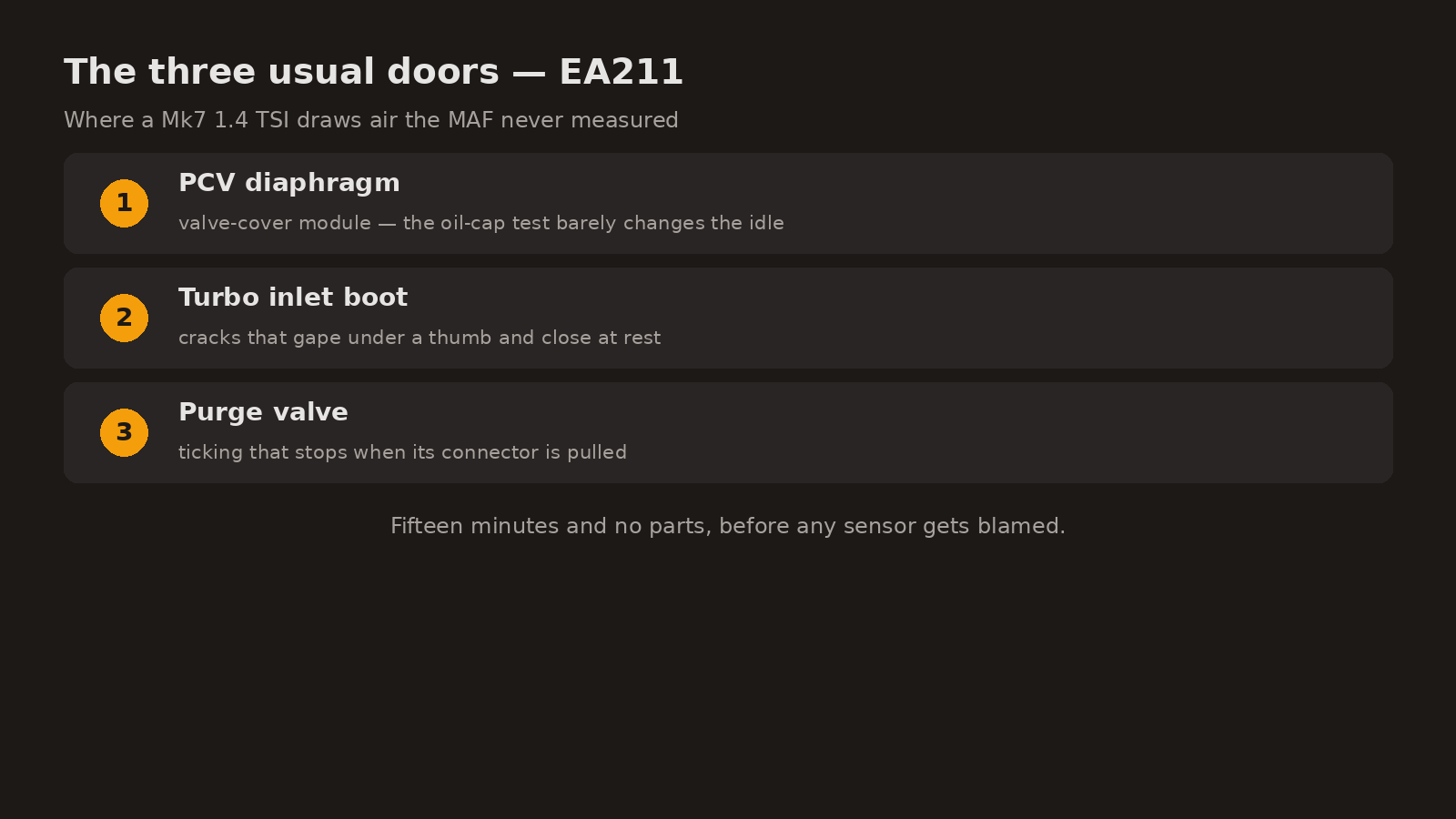
Diagram: the three usual unmetered-air entry points on the EA211 — the PCV diaphragm, the turbo inlet boot, and a stuck purge valve.
Información, no instrucciones
CarGeek es una obra de referencia, no un manual de taller. Sus páginas se escriben a partir de fuentes públicas y de lo que otras personas han comprobado, nunca a partir de la documentación de servicio del fabricante, de modo que pueden ser incorrectas o incompletas para su vehículo concreto. Parte de lo que describen entraña un riesgo real: alta tensión, combustible a presión, energía acumulada y piezas calientes o en movimiento.
Antes de actuar sobre cualquier indicación, hágala verificar por una persona con formación técnica siguiendo el procedimiento propio del fabricante para su vehículo. Nada de lo que hay aquí sustituye ese procedimiento.