Golf Mk7 1.4 TSI running lean: the three usual doors for unmetered air
The EA211 in the Mk7 is a solid engine with a short, well-known list of places it draws air the MAF never measured. If yours is holding a lean code with trims high at idle and near normal at revs, work this list before buying sensors.
1. The PCV diaphragm, in the valve-cover module
The crankcase breather's rubber diaphragm hardens and splits, and the crankcase becomes a permanent vacuum leak. The whole unit is integrated into the valve cover on this engine.
- Quick test: pull the oil filler cap at idle. On a healthy engine the idle stumbles clearly; if almost nothing changes, the crankcase is already open to a leak somewhere.
- A faint whistle at idle that changes pitch with the cap off is the same finding by ear.
2. The turbo inlet boot
The moulded rubber elbow between the airbox pipework and the turbo inlet cracks along its folds, and the crack sits upstream of the compressor — so it pulls unmetered air in rather than blowing boost out, which is why a boost-pressure test can pass while the lean code stays.
- Flex it by hand with the engine off. Cracks gape under a thumb and close at rest.
3. The purge valve, stuck open
The EVAP purge valve is meant to open on schedule; stuck open, it feeds the intake fuel-tank vapour and unmetered air at idle.
- Listen for ticking that stops when its connector is pulled, and watch whether trims change when you clamp its hose briefly.
The order matters because it is the order of likelihood on this engine family — and all three checks together cost fifteen minutes and no parts.
Este guia é publicado sob CC BY-SA 4.0 — livre para seguir, reutilizar e melhorar, com atribuição e compartilhamento pela mesma licença.
Anexos
-
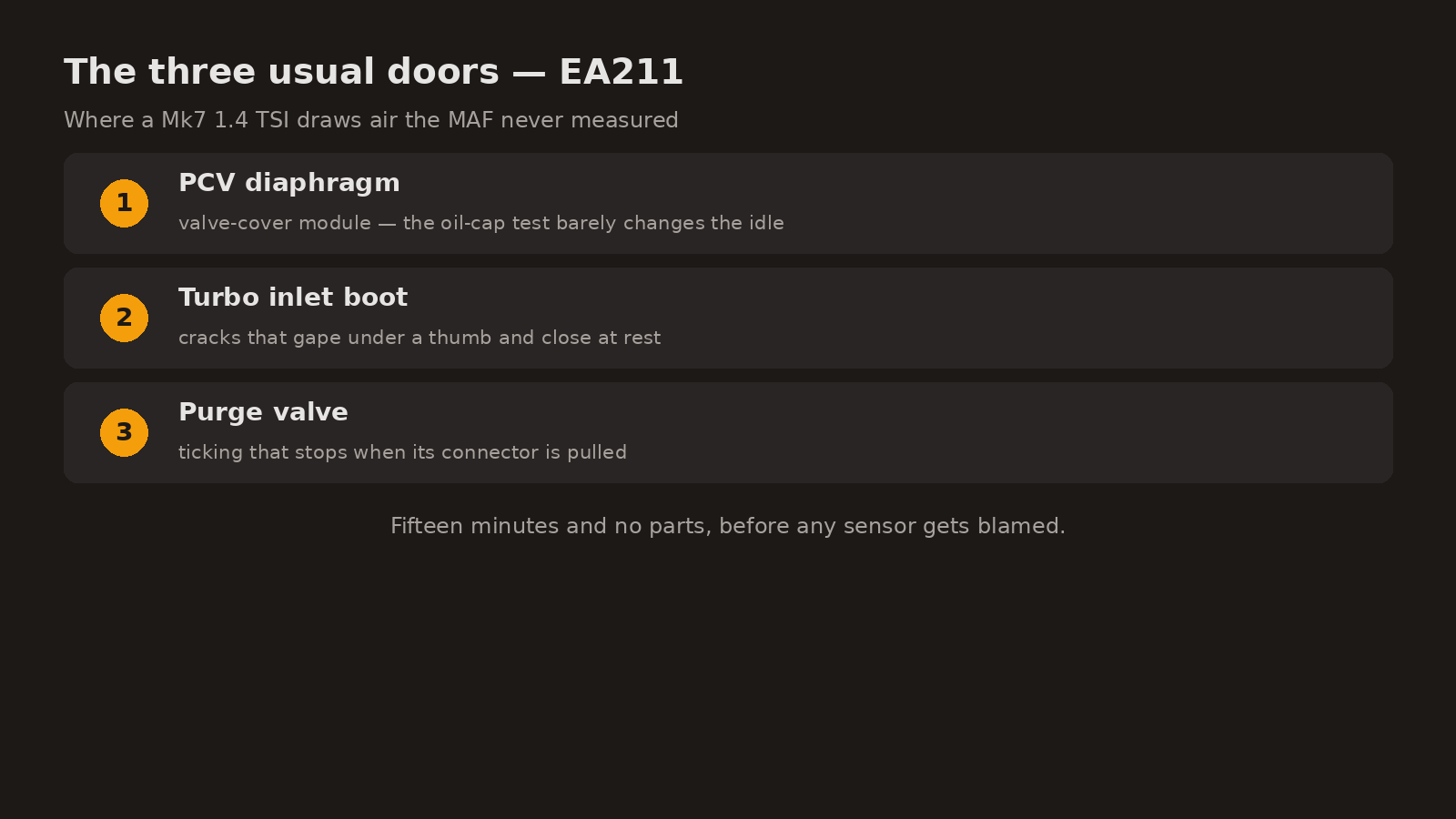
Diagram: the three usual unmetered-air entry points on the EA211 — the PCV diaphragm, the turbo inlet boot, and a stuck purge valve.
Informação, não instrução
O CarGeek é uma referência, não um manual de serviço. Suas páginas são escritas a partir de fontes públicas e do que outras pessoas constataram, nunca a partir da documentação de serviço do fabricante, de modo que podem estar erradas ou incompletas para o seu veículo específico. Parte do que descrevem envolve risco real: alta tensão, combustível sob pressão, energia acumulada e peças quentes ou em movimento.
Antes de agir com base em qualquer orientação, peça a verificação de uma pessoa com formação técnica, seguindo o procedimento do próprio fabricante para o seu veículo. Nada aqui substitui esse procedimento.