P0128 and a lukewarm heater: the stuck thermostat is costing you fuel
HO
@hhh
1 month ago
P0128 means the engine never reached the coolant temperature the thermostat is supposed to hold. The ECU waited, did the maths against ambient temperature and running time, and concluded the thermostat is stuck open. The car mostly drives fine, which is why this code gets ignored for months.
The symptoms line up once you look: the temperature gauge sitting below its usual place, a heater that is warm but never hot, a long climb to operating temperature on cold mornings.
Ignoring it has a running cost. Below regulating temperature the ECU stays in warm-up fuelling — richer mixture, raised idle — indefinitely. Fuel economy drops a real few percent, emissions rise, and on many cars the readiness monitors never complete, which matters the week of an inspection.
Verifying it is one live reading. Watch ECT from a cold start: it should climb steadily and then hold near the thermostat's rating — around 90 °C / 195 °F on most modern engines. A reading that plateaus in the seventies and dips when road speed rises is airflow cooling an engine whose thermostat will not shut.
One check before buying the thermostat: after a full overnight cold soak, ECT and intake air temperature should read within a couple of degrees of each other. If ECT is wildly off before the engine has even run, the sensor is the liar, not the thermostat.
The symptoms line up once you look: the temperature gauge sitting below its usual place, a heater that is warm but never hot, a long climb to operating temperature on cold mornings.
Ignoring it has a running cost. Below regulating temperature the ECU stays in warm-up fuelling — richer mixture, raised idle — indefinitely. Fuel economy drops a real few percent, emissions rise, and on many cars the readiness monitors never complete, which matters the week of an inspection.
Verifying it is one live reading. Watch ECT from a cold start: it should climb steadily and then hold near the thermostat's rating — around 90 °C / 195 °F on most modern engines. A reading that plateaus in the seventies and dips when road speed rises is airflow cooling an engine whose thermostat will not shut.
One check before buying the thermostat: after a full overnight cold soak, ECT and intake air temperature should read within a couple of degrees of each other. If ECT is wildly off before the engine has even run, the sensor is the liar, not the thermostat.
Attachments
-
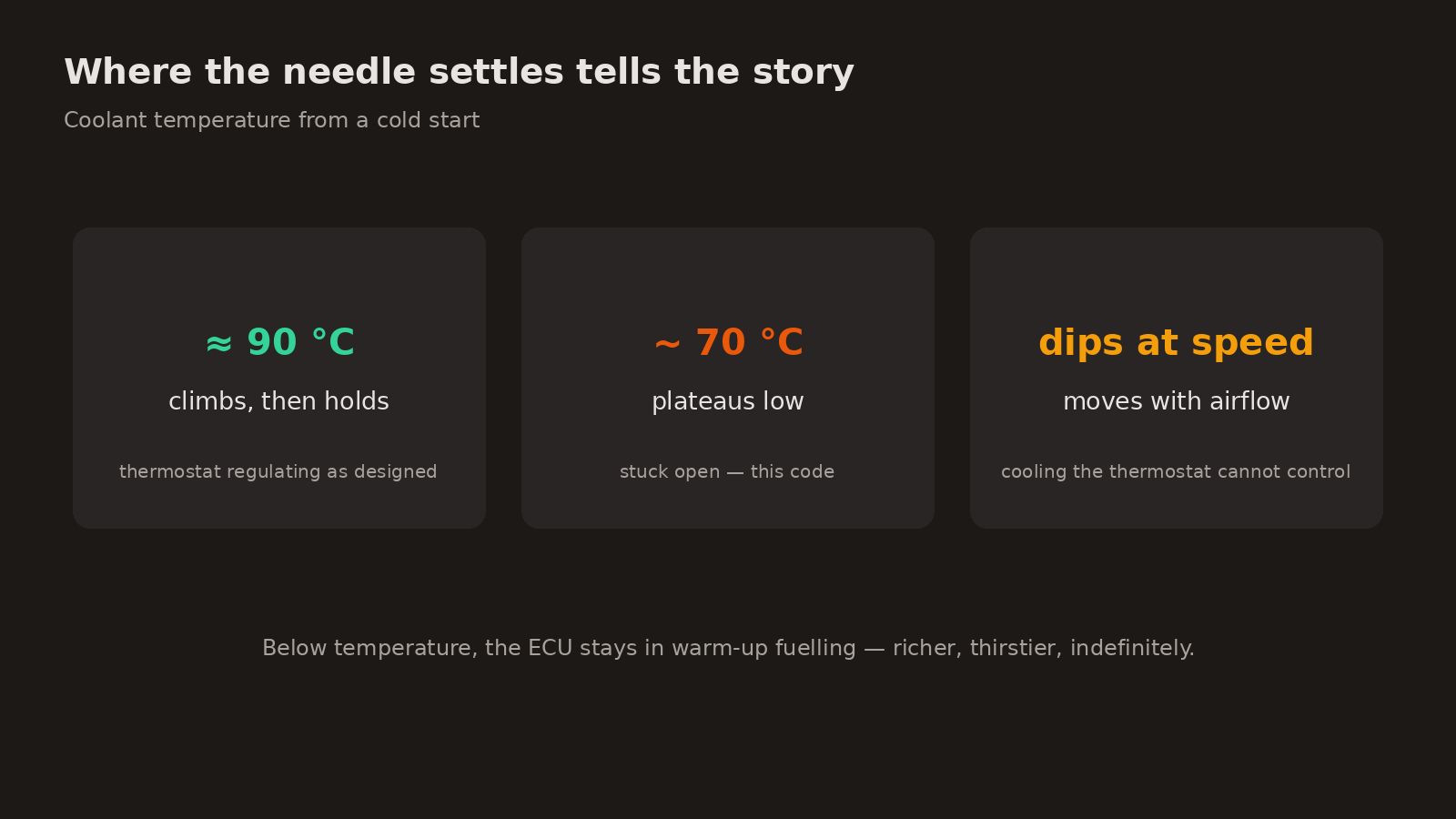
Diagram: three coolant temperature behaviours — holding near ninety degrees is healthy, plateauing near seventy or dipping with road speed is a stuck-open thermostat.
Information, not instruction
CarGeek is a reference, not a service manual. Its pages are written from public sources and from what other people have found, never from a manufacturer's own service information, so they can be wrong or incomplete for your particular vehicle. Some of what they describe carries real risk: high voltage, fuel under pressure, stored energy, hot and moving parts.
Have anything you intend to act on checked by a trained person against the manufacturer's own procedure for your vehicle. Nothing here replaces that procedure.