P0128 and a lukewarm heater: the stuck thermostat is costing you fuel
The symptoms line up once you look: the temperature gauge sitting below its usual place, a heater that is warm but never hot, a long climb to operating temperature on cold mornings.
Ignoring it has a running cost. Below regulating temperature the ECU stays in warm-up fuelling — richer mixture, raised idle — indefinitely. Fuel economy drops a real few percent, emissions rise, and on many cars the readiness monitors never complete, which matters the week of an inspection.
Verifying it is one live reading. Watch ECT from a cold start: it should climb steadily and then hold near the thermostat's rating — around 90 °C / 195 °F on most modern engines. A reading that plateaus in the seventies and dips when road speed rises is airflow cooling an engine whose thermostat will not shut.
One check before buying the thermostat: after a full overnight cold soak, ECT and intake air temperature should read within a couple of degrees of each other. If ECT is wildly off before the engine has even run, the sensor is the liar, not the thermostat.
Pièces jointes
-
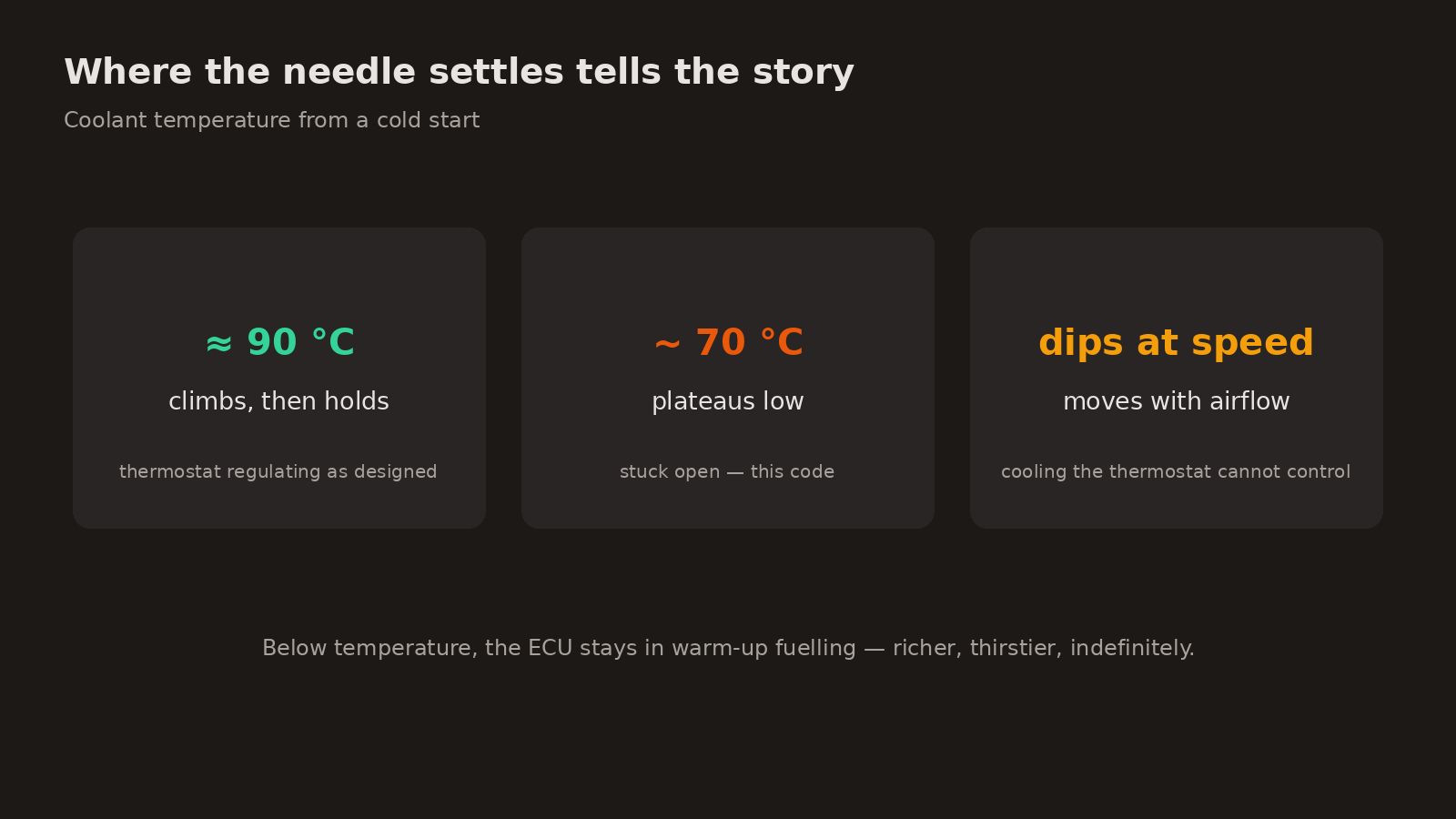
Diagram: three coolant temperature behaviours — holding near ninety degrees is healthy, plateauing near seventy or dipping with road speed is a stuck-open thermostat.
Des informations, pas des instructions
CarGeek est un ouvrage de référence, pas un manuel d'atelier. Ses pages sont rédigées à partir de sources publiques et de ce que d'autres ont constaté, jamais à partir de la documentation technique du constructeur ; elles peuvent donc être erronées ou incomplètes pour votre véhicule précis. Une partie de ce qu'elles décrivent présente un risque réel : haute tension, carburant sous pression, énergie accumulée, pièces chaudes ou en mouvement.
Avant d'agir sur quoi que ce soit, faites-le vérifier par une personne formée, en suivant la procédure du constructeur pour votre véhicule. Rien ici ne remplace cette procédure.