P0128 and a lukewarm heater: the stuck thermostat is costing you fuel
The symptoms line up once you look: the temperature gauge sitting below its usual place, a heater that is warm but never hot, a long climb to operating temperature on cold mornings.
Ignoring it has a running cost. Below regulating temperature the ECU stays in warm-up fuelling — richer mixture, raised idle — indefinitely. Fuel economy drops a real few percent, emissions rise, and on many cars the readiness monitors never complete, which matters the week of an inspection.
Verifying it is one live reading. Watch ECT from a cold start: it should climb steadily and then hold near the thermostat's rating — around 90 °C / 195 °F on most modern engines. A reading that plateaus in the seventies and dips when road speed rises is airflow cooling an engine whose thermostat will not shut.
One check before buying the thermostat: after a full overnight cold soak, ECT and intake air temperature should read within a couple of degrees of each other. If ECT is wildly off before the engine has even run, the sensor is the liar, not the thermostat.
Вложения
-
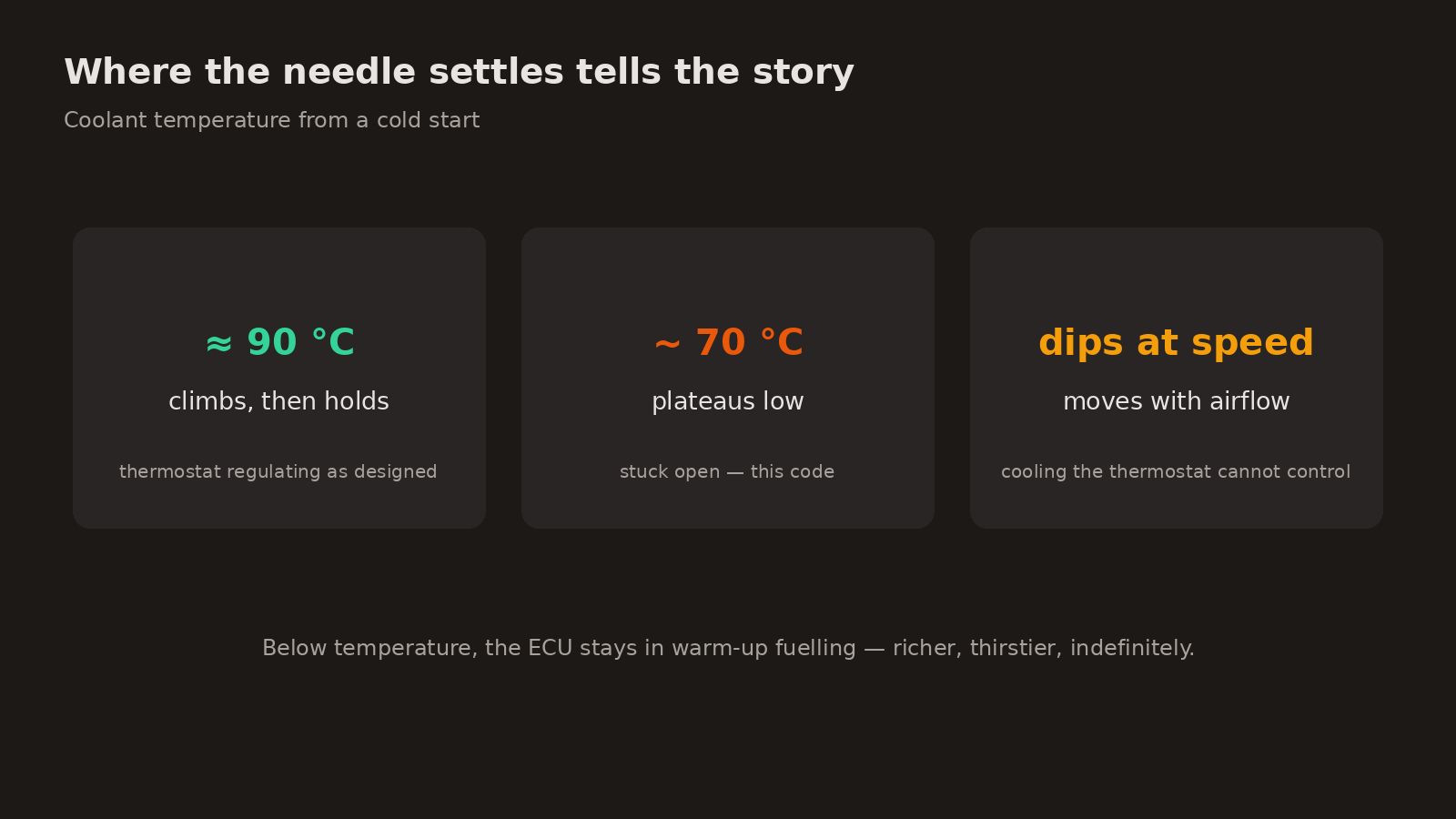
Diagram: three coolant temperature behaviours — holding near ninety degrees is healthy, plateauing near seventy or dipping with road speed is a stuck-open thermostat.
Информация, а не инструкция
CarGeek — это справочник, а не руководство по ремонту. Его страницы составлены по открытым источникам и по опыту других людей, но не по сервисной документации производителя, поэтому для вашего конкретного автомобиля они могут быть неверными или неполными. Часть описанного связана с реальной опасностью: высокое напряжение, топливо под давлением, накопленная энергия, горячие и движущиеся детали.
Всё, по чему вы собираетесь действовать, сначала проверьте с человеком, имеющим техническую подготовку, по собственной процедуре производителя для вашего автомобиля. Ничто здесь не заменяет эту процедуру.