P0128 and a lukewarm heater: the stuck thermostat is costing you fuel
The symptoms line up once you look: the temperature gauge sitting below its usual place, a heater that is warm but never hot, a long climb to operating temperature on cold mornings.
Ignoring it has a running cost. Below regulating temperature the ECU stays in warm-up fuelling — richer mixture, raised idle — indefinitely. Fuel economy drops a real few percent, emissions rise, and on many cars the readiness monitors never complete, which matters the week of an inspection.
Verifying it is one live reading. Watch ECT from a cold start: it should climb steadily and then hold near the thermostat's rating — around 90 °C / 195 °F on most modern engines. A reading that plateaus in the seventies and dips when road speed rises is airflow cooling an engine whose thermostat will not shut.
One check before buying the thermostat: after a full overnight cold soak, ECT and intake air temperature should read within a couple of degrees of each other. If ECT is wildly off before the engine has even run, the sensor is the liar, not the thermostat.
Bijlagen
-
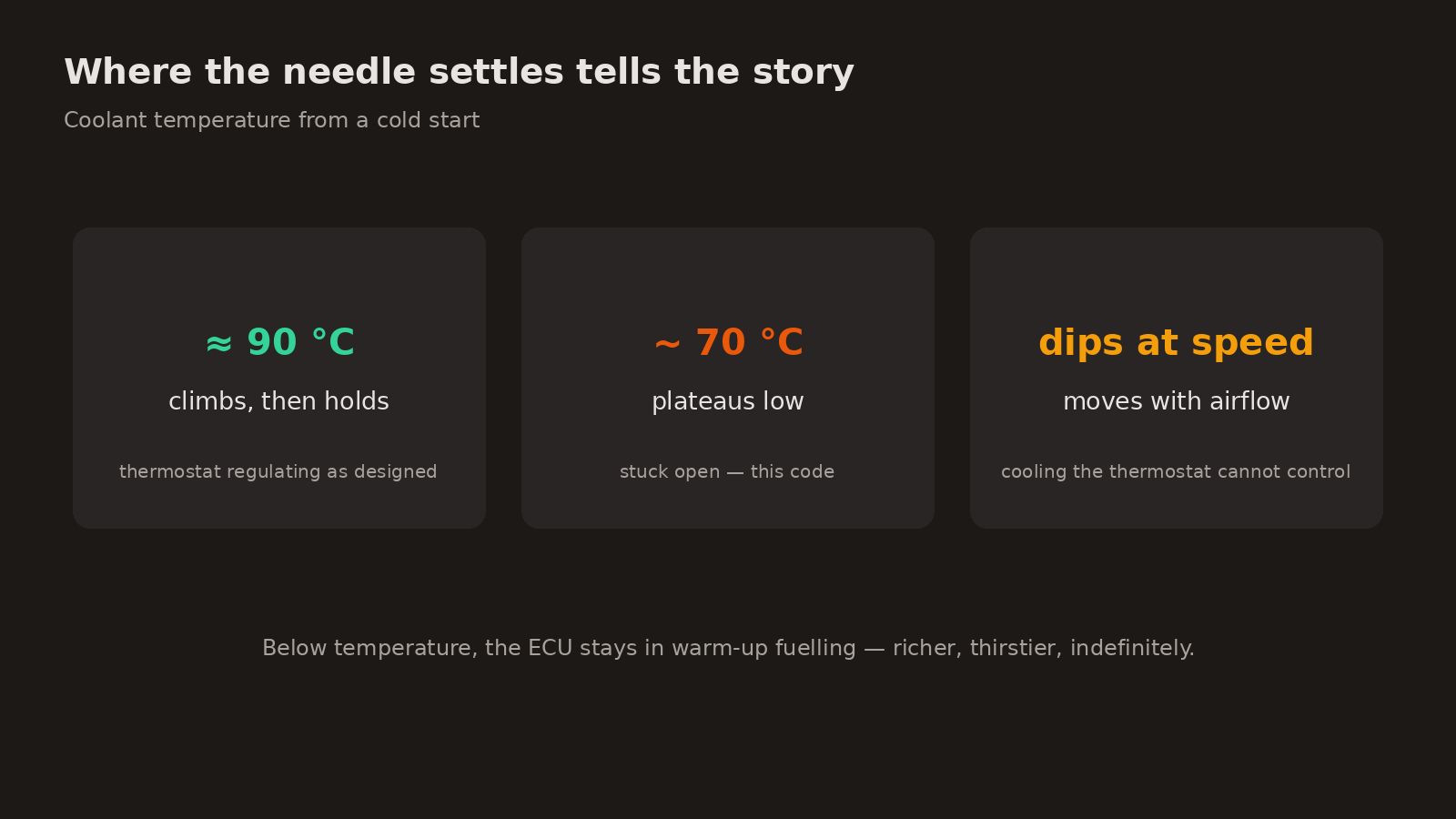
Diagram: three coolant temperature behaviours — holding near ninety degrees is healthy, plateauing near seventy or dipping with road speed is a stuck-open thermostat.
Informatie, geen instructie
CarGeek is een naslagwerk, geen werkplaatshandboek. De pagina's zijn geschreven op basis van openbare bronnen en van wat anderen hebben ondervonden, nooit op basis van de servicedocumentatie van de fabrikant zelf, dus ze kunnen onjuist of onvolledig zijn voor jouw specifieke voertuig. Een deel van wat erin staat brengt echt gevaar met zich mee: hoogspanning, brandstof onder druk, opgeslagen energie en hete of bewegende delen.
Laat alles waarnaar je wilt handelen eerst controleren door iemand met een technische opleiding, aan de hand van de eigen procedure van de fabrikant voor jouw voertuig. Niets hier vervangt die procedure.