Cranks but won't fire: the ten-minute spark–fuel–compression split
An engine that cranks strongly but never fires is missing one of three things: spark, fuel, or compression. The fastest route to a diagnosis is not finding the fault — it is finding which third of the engine the fault lives in, and that split takes about ten minutes.
Zeroth check: is it actually cranking strongly? A tired battery cranks too slowly to start while sounding almost normal. Voltage at the battery during cranking should stay above roughly 9.6 V. Below that, charge or substitute the battery before believing any other symptom.
Spark, five minutes. Pull one accessible coil or lead, fit a spare plug (or the one you just removed), ground its body against bare metal, crank: a fat blue snap is spark present. No spark on one cylinder — try another; no spark anywhere points at the shared parts: crank sensor, main ignition supply. A crank-position failure often announces itself twice here, because the rev counter typically stays dead at zero while cranking.
Fuel, three minutes. Key on: many pumps prime audibly for two seconds — silence from the tank area is a lead. On port-injected engines, the rail's test valve shows residual pressure. A sniff of the exhaust after prolonged cranking helps both ways: raw fuel smell means fuel is arriving (and spark is the suspect); bone dry means it is not. Careful with starting fluid, but a one-second whiff into the intake is decisive — fires briefly and dies means fuel delivery; no response at all pushes suspicion back to spark or compression.
Compression, two minutes for the verdict. Cranking sounds even and slightly too easy on all cylinders — fast, free-spinning — is the sound of a snapped timing belt on many engines; check belt rotation through the oil filler or the timing cover window first on any belt-driven engine. A proper gauge test comes later; the ten-minute question is only "is the engine sealed at all?"
One of the three will fail its check. Then — and only then — is it worth reading the specific codes and pages for that third of the engine, because now the search space is a handful of parts, not the whole car.
Este guia é publicado sob CC BY-SA 4.0 — livre para seguir, reutilizar e melhorar, com atribuição e compartilhamento pela mesma licença.
Anexos
-
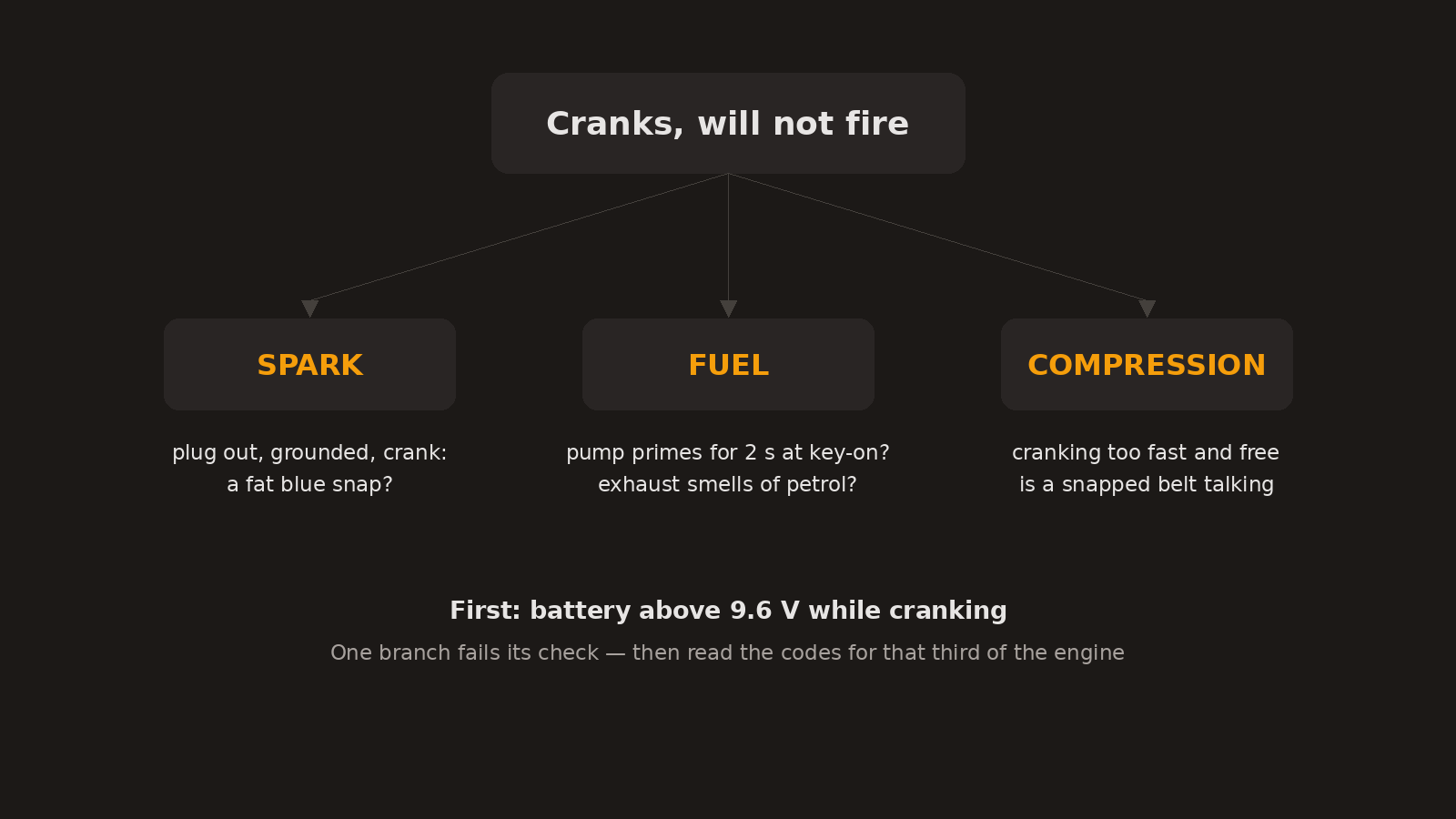
Diagram: the ten-minute split for an engine that cranks but will not fire — spark, fuel and compression as three branches, each with its quick test.
Informação, não instrução
O CarGeek é uma referência, não um manual de serviço. Suas páginas são escritas a partir de fontes públicas e do que outras pessoas constataram, nunca a partir da documentação de serviço do fabricante, de modo que podem estar erradas ou incompletas para o seu veículo específico. Parte do que descrevem envolve risco real: alta tensão, combustível sob pressão, energia acumulada e peças quentes ou em movimento.
Antes de agir com base em qualquer orientação, peça a verificação de uma pessoa com formação técnica, seguindo o procedimento do próprio fabricante para o seu veículo. Nada aqui substitui esse procedimento.