Your EV charges slower in the cold — that is protection, not a fault
Charging a lithium cell means persuading lithium into the graphite of the negative electrode. **Cold graphite accepts it slowly.** Push current in faster than the graphite will take it and the lithium plates out as metal on the surface instead of going in — which is permanent, costs capacity, and at worst grows into something that can short the cell internally.
So the car limits charging current when the pack is cold. On a rapid charger that can mean a fraction of the advertised speed until the pack has warmed up, either by preconditioning or simply by being charged for a while.
**Normal, and not worth chasing:**
- A rapid charge that starts slow and speeds up as the pack warms.
- A cold pack accepting far less than the charger's rating.
- Preconditioning running when you set a rapid charger as your navigation destination — use it. It is the single biggest thing you can do about winter charging speed, and most people never switch it on.
**Not normal, and worth a code read:**
- Charging that is slow when the pack is already *warm*.
- Charging that has become slower than the same car managed last winter.
- A session that starts and then stops by itself.
Worth knowing where the limit comes from: it is calculated from the pack's temperature. So if there genuinely is a fault, the temperature sensors are as good a place to look as the charging hardware — a sensor reading falsely cold produces a car that behaves as though it is January in June.
Anexos
-
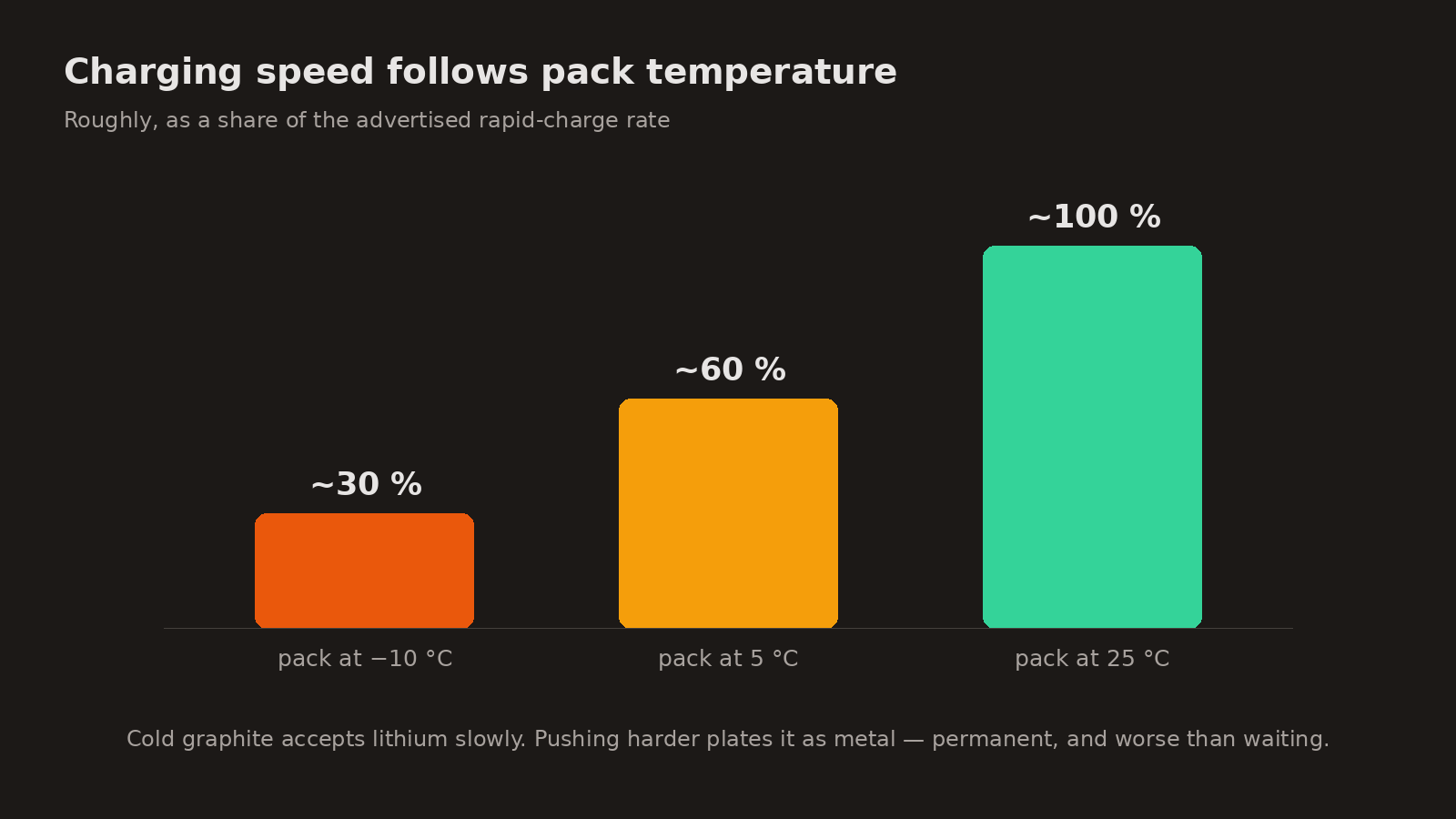
Diagram: rapid-charging speed rising with battery temperature — a cold pack charges at a fraction of the advertised rate because the cells are being protected from lithium plating.
Informação, não instrução
O CarGeek é uma referência, não um manual de serviço. Suas páginas são escritas a partir de fontes públicas e do que outras pessoas constataram, nunca a partir da documentação de serviço do fabricante, de modo que podem estar erradas ou incompletas para o seu veículo específico. Parte do que descrevem envolve risco real: alta tensão, combustível sob pressão, energia acumulada e peças quentes ou em movimento.
Antes de agir com base em qualquer orientação, peça a verificação de uma pessoa com formação técnica, seguindo o procedimento do próprio fabricante para o seu veículo. Nada aqui substitui esse procedimento.