Your EV charges slower in the cold — that is protection, not a fault
Charging a lithium cell means persuading lithium into the graphite of the negative electrode. **Cold graphite accepts it slowly.** Push current in faster than the graphite will take it and the lithium plates out as metal on the surface instead of going in — which is permanent, costs capacity, and at worst grows into something that can short the cell internally.
So the car limits charging current when the pack is cold. On a rapid charger that can mean a fraction of the advertised speed until the pack has warmed up, either by preconditioning or simply by being charged for a while.
**Normal, and not worth chasing:**
- A rapid charge that starts slow and speeds up as the pack warms.
- A cold pack accepting far less than the charger's rating.
- Preconditioning running when you set a rapid charger as your navigation destination — use it. It is the single biggest thing you can do about winter charging speed, and most people never switch it on.
**Not normal, and worth a code read:**
- Charging that is slow when the pack is already *warm*.
- Charging that has become slower than the same car managed last winter.
- A session that starts and then stops by itself.
Worth knowing where the limit comes from: it is calculated from the pack's temperature. So if there genuinely is a fault, the temperature sensors are as good a place to look as the charging hardware — a sensor reading falsely cold produces a car that behaves as though it is January in June.
Pièces jointes
-
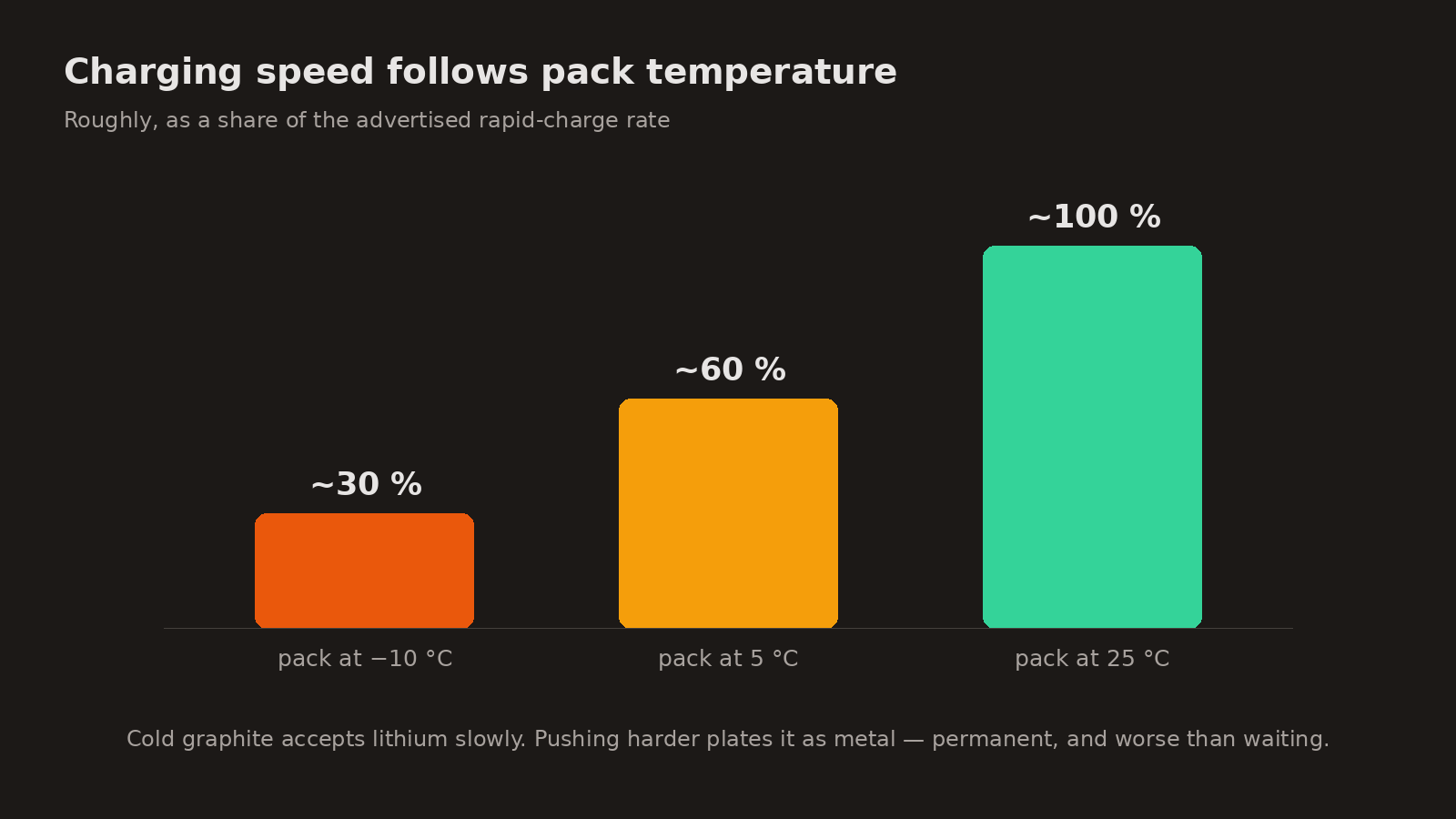
Diagram: rapid-charging speed rising with battery temperature — a cold pack charges at a fraction of the advertised rate because the cells are being protected from lithium plating.
Des informations, pas des instructions
CarGeek est un ouvrage de référence, pas un manuel d'atelier. Ses pages sont rédigées à partir de sources publiques et de ce que d'autres ont constaté, jamais à partir de la documentation technique du constructeur ; elles peuvent donc être erronées ou incomplètes pour votre véhicule précis. Une partie de ce qu'elles décrivent présente un risque réel : haute tension, carburant sous pression, énergie accumulée, pièces chaudes ou en mouvement.
Avant d'agir sur quoi que ce soit, faites-le vérifier par une personne formée, en suivant la procédure du constructeur pour votre véhicule. Rien ici ne remplace cette procédure.