Vehicle
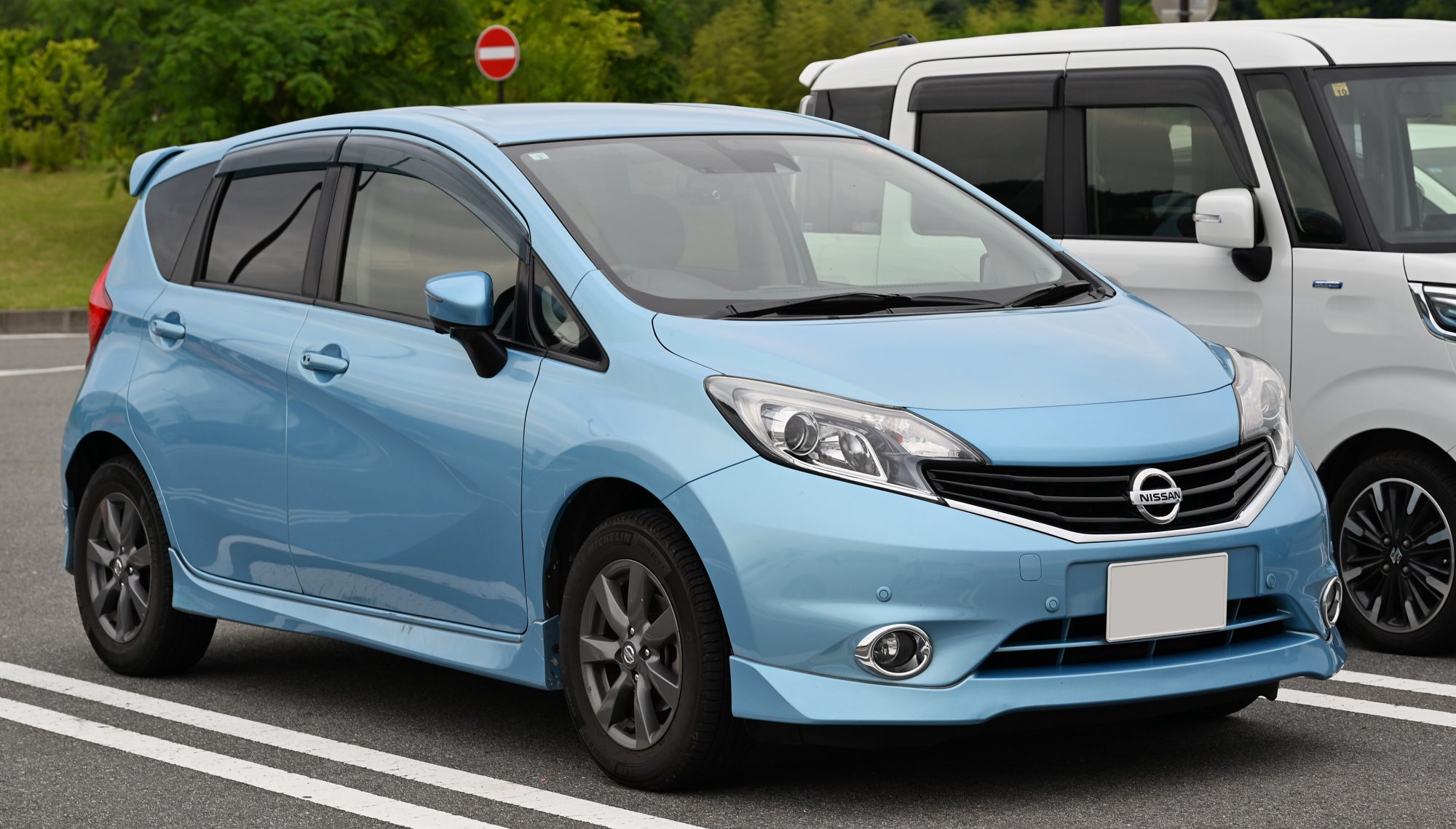
Nissan Note
The compact MPV and later hatchback, and the model that introduced e-Power — a series hybrid where the engine is a generator only and has no mechanical connection to the wheels at all. That single fact reorganises the diagnosis: engine speed does not track road speed, so a driveability complaint that would be a gearbox fault on any other car is a power-electronics question here, and the engine's own load behaviour is set by battery demand rather than by the accelerator.

Generations
-
E11 2004–2012
A conventional compact MPV on the Micra platform — the last Note before the series-hybrid era.
- Body styles
- MPV
- Platform
- Nissan B
- Engines
-
- 1.4 — CR14DE · petrol · 65 kW (87 hp)
- 1.6 — HR16DE · petrol · 81 kW (109 hp) · 153 Nm (113 lb-ft)
- 1.5 dCi — K9K · diesel · 63–66 kW (84–89 hp) · 160–260 Nm (118–192 lb-ft)
- 1.5 — HR15DE · petrol · 134–156 Nm (99–115 lb-ft)
- Transmissions
- 5-speed manual · 4-speed Jatco RE4F03A automatic · Jatco RE0F08A/JF009E CVT
- Drivetrain
- Front-wheel drive
-
E12 2012–present
Where e-Power arrives — the engine drives a generator and never the wheels, so engine speed and road speed are unrelated by design.
- Belt CVT (continuously variable) CVT
- Jatco JF015E CVT
- Single-speed reduction gear (EV drive unit) reduction
- Body styles
- Hatchback · MPV
- Platform
- Renault–Nissan V
- Engines
-
- 1.2 — HR12DE · petrol · 59–72 kW (79–97 hp)
- 1.2 supercharged — HR12DDR · petrol · 59–72 kW (79–97 hp) · 142–143 Nm (105 lb-ft)
- 1.2 e-Power — hybrid · engine drives a generator only
- 1.5 dCi — K9K · diesel · 66 kW (89 hp) · 160–260 Nm (118–192 lb-ft)
- 1.6 — HR16DE · petrol · 81 kW (109 hp) · 150–163 Nm (111–120 lb-ft)
- Transmissions
- 5-speed manual · Xtronic CVT · Single-speed reduction
- Drivetrain
- Front-wheel drive · Four-wheel drive
Service information
Information, not instruction
CarGeek is a reference, not a service manual. Its pages are written from public sources and from what other people have found, never from a manufacturer's own service information, so they can be wrong or incomplete for your particular vehicle. Some of what they describe carries real risk: high voltage, fuel under pressure, stored energy, hot and moving parts.
Have anything you intend to act on checked by a trained person against the manufacturer's own procedure for your vehicle. Nothing here replaces that procedure.
Posted about the Nissan Note
Be the first to write this up
Nothing posted about this yet. Whatever you found is worth writing down — even a dead end saves someone the same afternoon.
What makes one worth reading:
- The car — make, model, year and engine. The same fault behaves differently on each.
- What you measured, not only what you replaced.
- What actually fixed it — or that nothing did, which is worth knowing too.
Sign in or create an account to add what you found about Nissan Note.