Before you accept a battery pack quote: the question that separates a wire from a pack
This is the most expensive misdiagnosis in electric vehicles, and it turns on a distinction the car itself cannot make.
Safety first, and not as a formality. Everything below is scan-tool work through the diagnostic port, which is safe. Opening a traction pack is not: several hundred volts DC is an electrocution hazard rather than a shock hazard, and it needs training, tested insulated gloves and the right instruments. Use this to understand a quote — not to open a battery.
The problem
A battery pack is a long series string, tapped at intervals so the module can read each section's voltage separately. Those sense lines are the only thin wires in the entire high-voltage system — signal wires on small connectors, inside a sealed box that vibrates, heats and cools for the life of the car. They corrode and fret where the heavy cable and bolted terminals never do.
And a sense line gone high-resistance reports exactly the same thing as a weak cell group: a section reading low. The module has only the wire's word for it. It cannot tell them apart, and it does not claim to.
The question to ask
How was the sense wiring eliminated before the pack was condemned?
There is a real answer, and it is behavioural rather than numerical:
- A battery section has enormous electrical inertia. It changes slowly, moves with load and temperature, and stays inside what its chemistry allows.
- A faulty sense line does none of that. It steps instantly, moves when the car goes over a bump, or reports a value no cell could physically hold.
So: does the low reading change in ways a battery can? If it jumps, it is wiring. If it sags under load and recovers as things cool, it is a battery.
Three more things worth asking for
- The per-group voltages, and the spread between highest and lowest. That one number says more about the pack's remaining life than any state-of-health percentage, and it is the right thing to have on record before deciding anything.
- Whether module-level replacement is supported on this vehicle. Many designs allow a single failed section to be replaced and the pack rebalanced, at a fraction of a new pack. Some genuinely do not — but it is a question, not an assumption.
- Which variant of the code is stored. An intermittent or erratic sense code is the cheapest ending of all, because a cell group cannot change voltage that fast. That is close to proof of a connection rather than a cell.
Where to read further
P0B14 and its siblings cover the pack-level sense circuits. P0B3B onward covers the per-cell-group ones — twenty-six of them, which is what lets a fault be localised to a module rather than to a battery. P0BBD and P0BBE are the voltage-variation codes, and the spread they report is the best single predictor of how much life the pack has left.
Diese Anleitung erscheint unter CC BY-SA 4.0 — frei zum Nachmachen, Weiterverwenden und Verbessern, mit Namensnennung und Weitergabe unter gleichen Bedingungen.
Anhänge
-
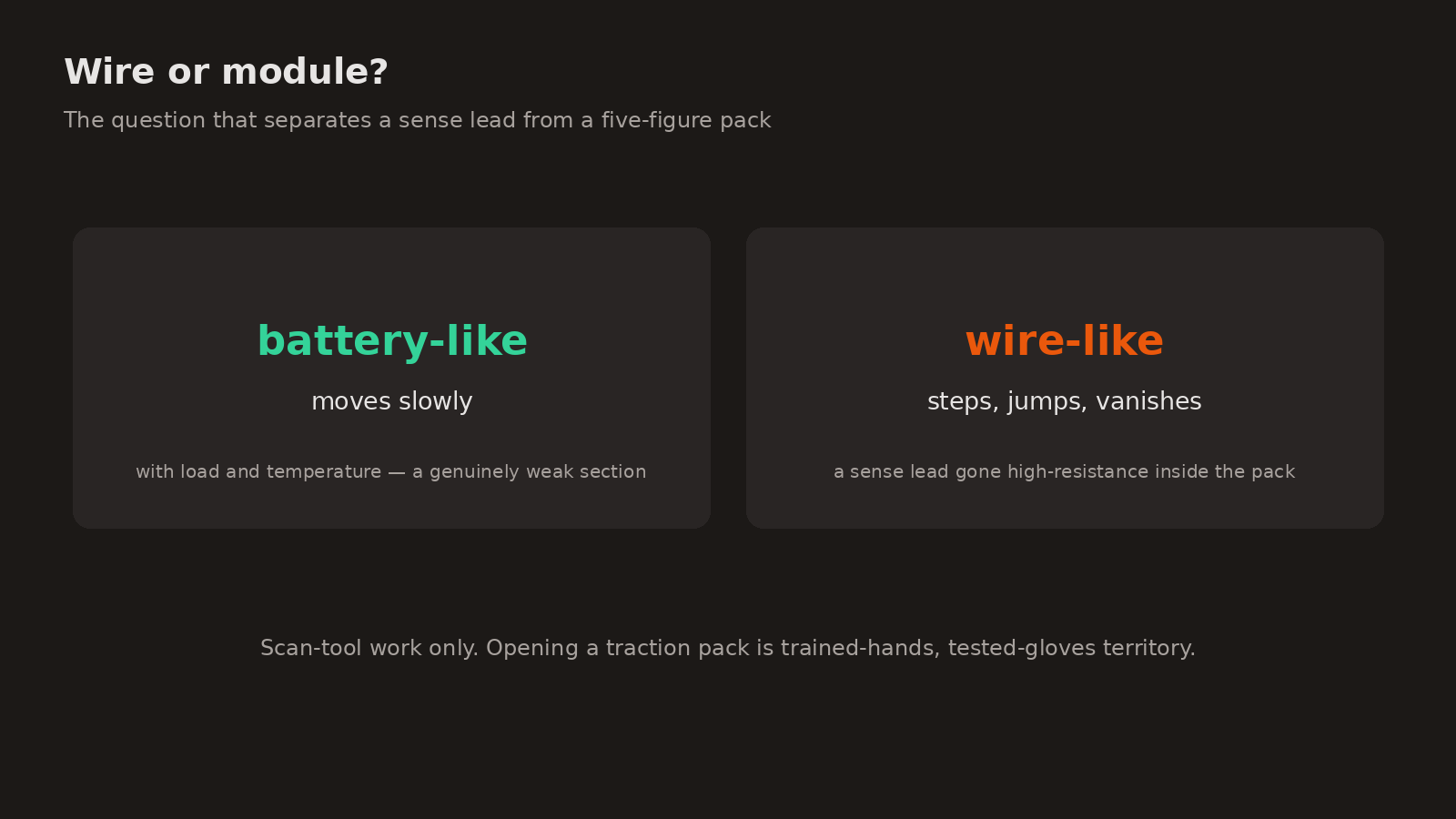
Diagram: how a genuinely weak battery section behaves versus a faulty sense wire — gradual, load-following readings against stepwise jumps.
Information, keine Handlungsanweisung
CarGeek ist ein Nachschlagewerk, kein Werkstatthandbuch. Die Seiten entstehen aus öffentlichen Quellen und aus dem, was andere festgestellt haben, nie aus den Serviceunterlagen des Herstellers; für Ihr konkretes Fahrzeug können sie daher falsch oder unvollständig sein. Ein Teil des Beschriebenen birgt echte Gefahren: Hochspannung, Kraftstoff unter Druck, gespeicherte Energie sowie heiße oder bewegte Teile.
Lassen Sie alles, wonach Sie handeln wollen, von einer fachlich geschulten Person anhand der herstellereigenen Vorgehensweise für Ihr Fahrzeug prüfen. Nichts hiervon ersetzt diese Vorgehensweise.