If the charging cable will not come out, there is almost certainly a release cord
While a car is charging, the connector is **locked into the socket on purpose.** It is not an anti-theft feature. A DC connector can be carrying hundreds of amps, and pulling one apart under load draws an arc that damages both halves and can start a fire. So the car holds the cable until the current has stopped, then releases it.
When the release actuator fails — or freezes, or jams on road salt — the cable stays in. If it is a public charger's tethered lead, you are attached to the charger.
**Things to try first, in order:**
1. End the charging session properly, from the car or the app, and check it has actually stopped rather than paused.
2. Unlock the car. On many vehicles the connector latch follows central locking, so locking and unlocking again cycles it.
3. Wait a moment after the session ends — some cars hold the latch briefly while the system de-energises.
**Then the manual release.** Almost every electric vehicle has one for exactly this situation: usually a cord or a lever, reached from inside the boot behind a trim panel, or through a hatch near the charge port. **Find yours in the handbook now.** It takes two minutes today and it is the difference between an annoyance and a recovery truck.
**What not to do is pull hard.** The latch is holding for a reason, and a damaged connector is a considerably more expensive problem than a stuck one.
In freezing weather a latch iced shut is common and is not a failure at all — warming the area releases it. P0CD1 and its neighbours are the codes for the unlock circuit itself, if one is stored.
Anhänge
-
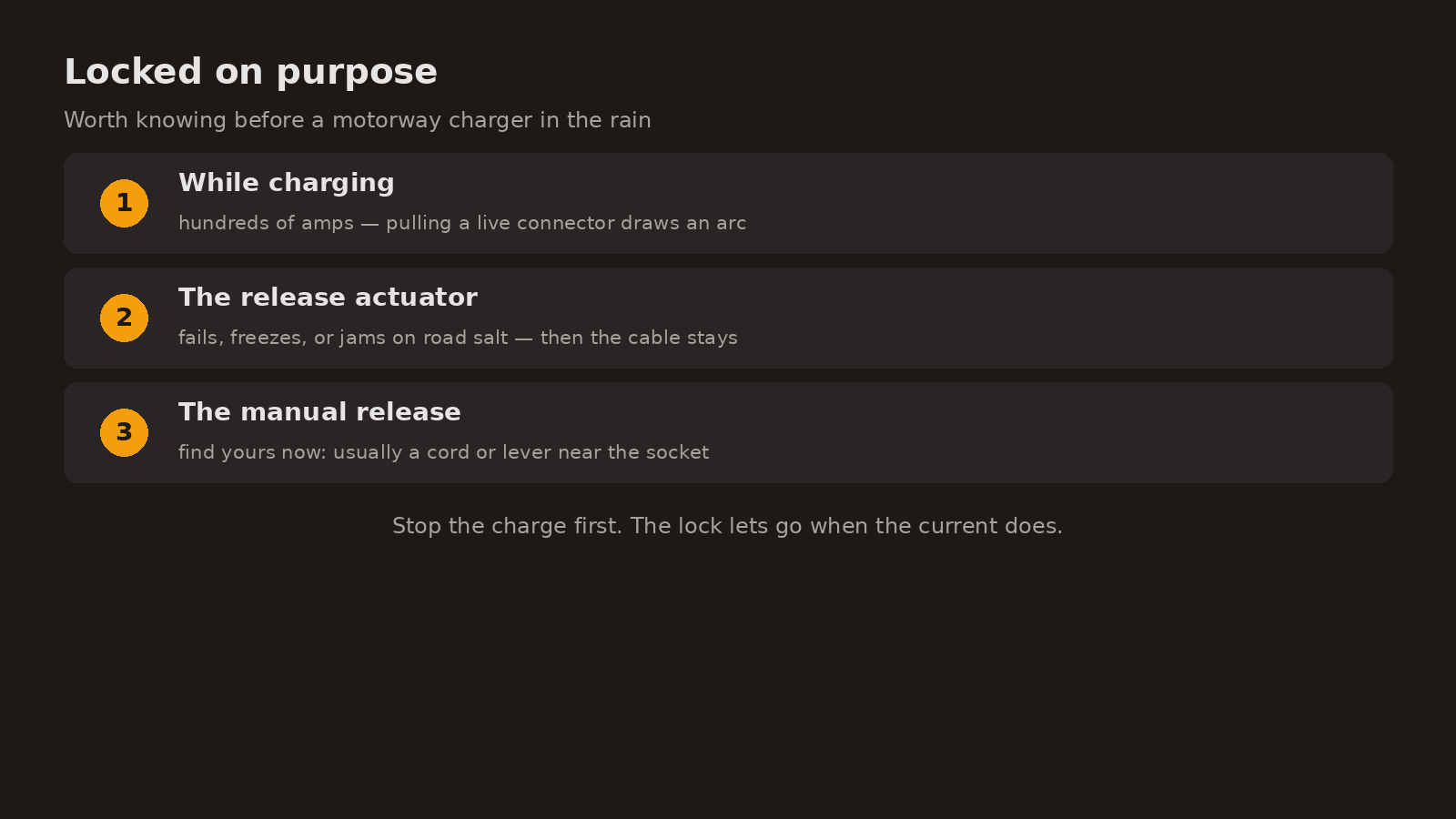
Diagram: why a charging connector locks into the car, what fails when it will not release, and the manual release worth finding before it is needed.
Information, keine Handlungsanweisung
CarGeek ist ein Nachschlagewerk, kein Werkstatthandbuch. Die Seiten entstehen aus öffentlichen Quellen und aus dem, was andere festgestellt haben, nie aus den Serviceunterlagen des Herstellers; für Ihr konkretes Fahrzeug können sie daher falsch oder unvollständig sein. Ein Teil des Beschriebenen birgt echte Gefahren: Hochspannung, Kraftstoff unter Druck, gespeicherte Energie sowie heiße oder bewegte Teile.
Lassen Sie alles, wonach Sie handeln wollen, von einer fachlich geschulten Person anhand der herstellereigenen Vorgehensweise für Ihr Fahrzeug prüfen. Nichts hiervon ersetzt diese Vorgehensweise.