The car will not charge: a ten-minute split before you blame the network
Public charging is unreliable enough that a car which will not charge gets assumed to be the network's fault. Sometimes it is. This is how to find out, in an order that halves the problem at each step.
1. Try AC and DC, and note which one fails
This is the single most useful test in the whole charging system and it costs nothing.
- AC charging — a home socket, a wallbox, a street post — goes through the car's on-board charger, which converts alternating current to direct current itself.
- DC rapid charging bypasses that unit entirely. The charge point does the conversion and feeds the pack directly.
So fails on AC, works on DC points at the on-board charger or its path. Fails on both points at something they share: the inlet, the contactors, the pack, or the control electronics. One test, and the field is halved.
2. Change the cable, then the charge point
Both are outdoor equipment handled by strangers. A tethered public cable has been dropped, driven over and rained on for years, and a charge point's own electronics drift. If the car charges somewhere else, you have your answer and it is not the car.
At home, walk the boring list too: a tripped breaker or RCD, a granny lead on a tired socket, or an extension lead that should not be in the circuit at all. Long or thin extension leads are a genuine cause — the voltage drop under sustained current is enough to abort a session.
3. Look into the socket with a torch
Beside the heavy contacts sit two small pins that decide whether charging happens at all. Bent pins, green or white deposits, standing water and debris are all visible, and all are real causes. Cable weight is what bends them: a heavy rapid lead left hanging rather than supported levers on the inlet every time the wind blows.
4. Then the codes, and the Control Pilot
If it fails everywhere, the Control Pilot is the thing to ask about. It is one pin in the connector, and it carries the entire negotiation. The charge point puts a square wave on it whose pulse width states how many amps are on offer; the car answers by pulling that line's voltage down in defined steps to say connected, then ready.
The charge point will not energise the cable until it sees a valid answer. That is what keeps a charging lead lying on a wet driveway harmless — and it is why a pilot fault is absolute. No charger anywhere will work, which reads exactly like the network being broken and is not.
The useful part is that the whole exchange is measurable. A technician can see which voltage level the car is presenting and whether the station's signal is arriving, and that single observation separates the car is not asking from the station is not offering.
P0CF3 to P0CF7 are the pilot circuit codes. P0CF8 onward covers the switch that is the car's own side of the conversation — worth knowing apart, because the pilot codes point at the inlet and its wiring while the switch codes point inside the vehicle.
Diese Anleitung erscheint unter CC BY-SA 4.0 — frei zum Nachmachen, Weiterverwenden und Verbessern, mit Namensnennung und Weitergabe unter gleichen Bedingungen.
Anhänge
-
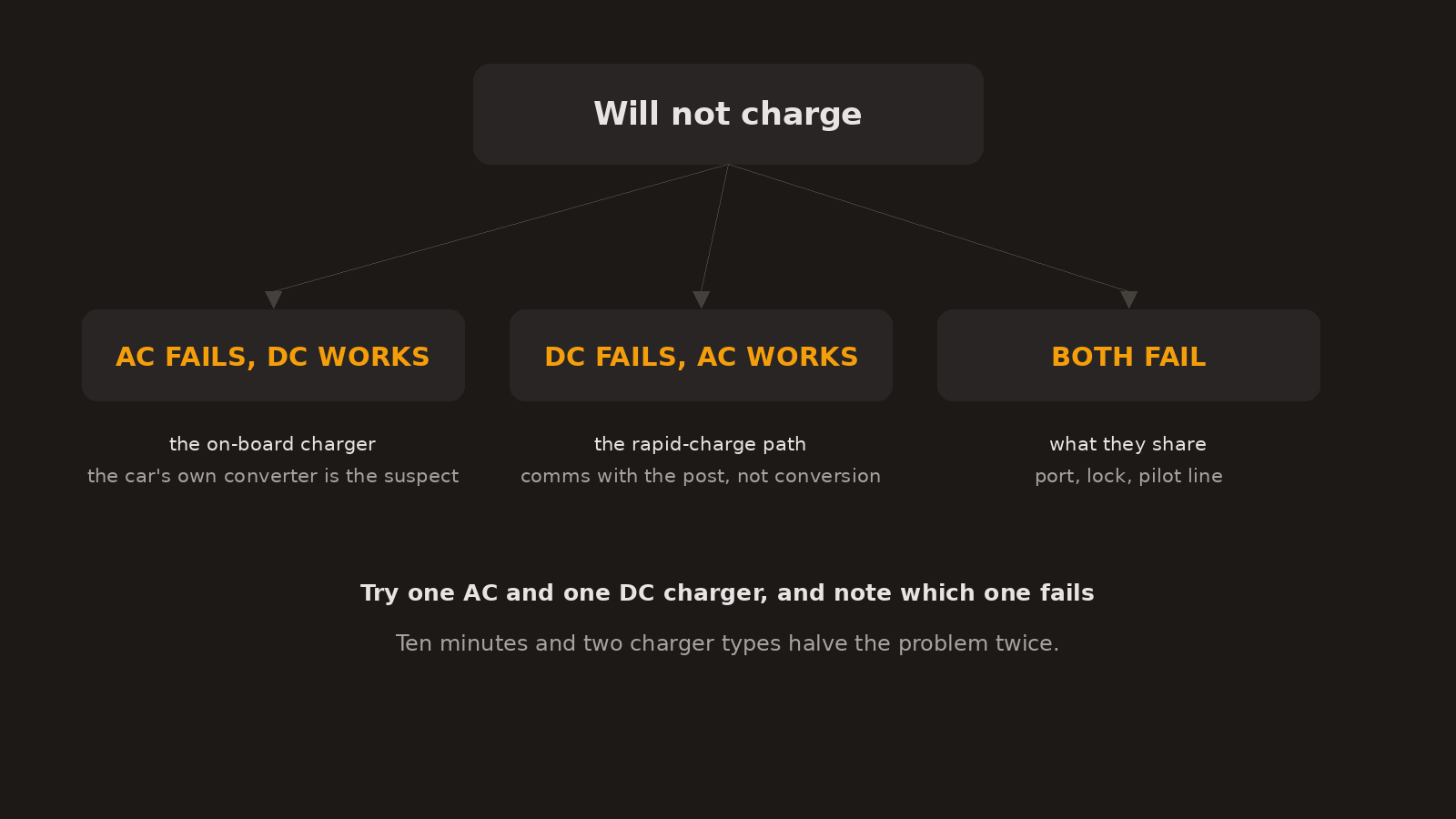
Diagram: the AC-versus-DC split for a car that will not charge — which side fails points at the on-board charger, the rapid-charge path, or what both share.
Information, keine Handlungsanweisung
CarGeek ist ein Nachschlagewerk, kein Werkstatthandbuch. Die Seiten entstehen aus öffentlichen Quellen und aus dem, was andere festgestellt haben, nie aus den Serviceunterlagen des Herstellers; für Ihr konkretes Fahrzeug können sie daher falsch oder unvollständig sein. Ein Teil des Beschriebenen birgt echte Gefahren: Hochspannung, Kraftstoff unter Druck, gespeicherte Energie sowie heiße oder bewegte Teile.
Lassen Sie alles, wonach Sie handeln wollen, von einer fachlich geschulten Person anhand der herstellereigenen Vorgehensweise für Ihr Fahrzeug prüfen. Nichts hiervon ersetzt diese Vorgehensweise.