CarGeek is new. Here is what it is, and what posting here gets you
If it looks quiet in here, that is because you are early — the community layer opened this month. What you are standing on, though, took longer:
- 1,920 trouble codes, every one authored and cross-checked against two independent sources before publishing — including the full hybrid block that most references skip. No scraped filler; five codes that failed verification were retracted rather than left to mislead.
- A browse layer that works the way diagnosis works: by symptom when there is no scanner, by cause when there is a suspicion, by component, by system, by vehicle — plus CAN bus databases mirrored from open source, and a manual index that points at the official sources instead of hosting bootlegs.
- A community layer built for evidence, not applause. A confirmed here means "I had this fault and this fix worked" — it ranks content and earns standing. Disagreement is a first-class reaction, because wrong diagnostic advice deserves pushback. Reputation is computed from what your posts did for people, never assigned.
What posting gets you: your write-up attaches to the code's own page, where every future search for that code lands. Good write-ups collect confirmations; confirmations build a public track record that follows your name. If you fix cars for a living, that track record is a portfolio nobody can fake — because on this site, nobody's is.
What we promise back: no fake activity, ever — every account here is a real person or clearly labelled as ours. Moderation with written reasons and a working appeal. Your deleted content is actually recoverable by you, and your photos are stripped of location data on upload.
The reference is free to read, no account needed. The community starts with whoever shows up first. That could be you — and founding member is a title that only exists for a little while.
Ce guide est publié sous licence CC BY-SA 4.0 — libre de suivre, réutiliser et améliorer, avec attribution et partage dans les mêmes conditions.
Pièces jointes
-
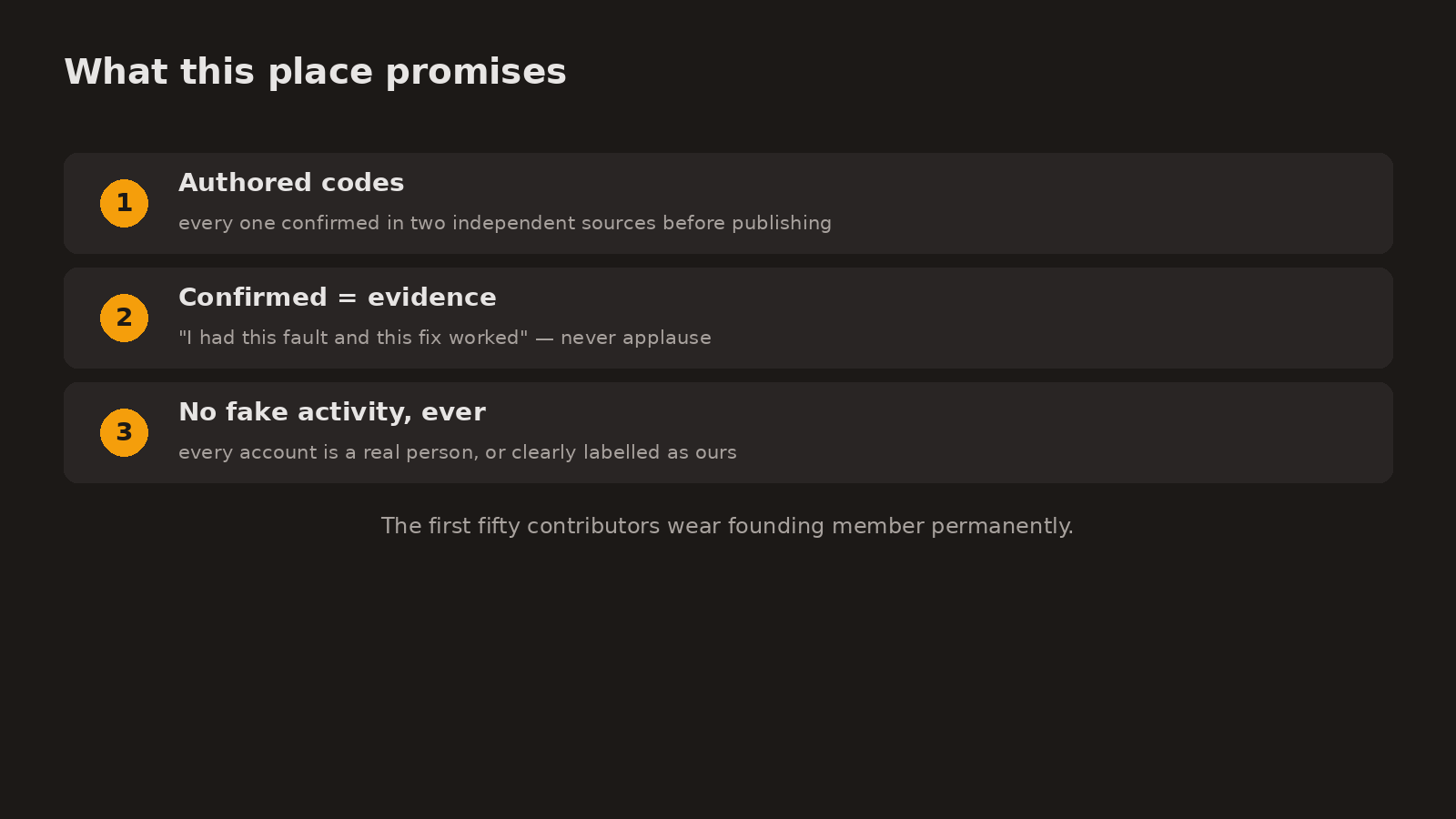
Diagram: the three promises CarGeek makes — an authored two-source corpus, confirmations as evidence, and no fabricated activity.
Des informations, pas des instructions
CarGeek est un ouvrage de référence, pas un manuel d'atelier. Ses pages sont rédigées à partir de sources publiques et de ce que d'autres ont constaté, jamais à partir de la documentation technique du constructeur ; elles peuvent donc être erronées ou incomplètes pour votre véhicule précis. Une partie de ce qu'elles décrivent présente un risque réel : haute tension, carburant sous pression, énergie accumulée, pièces chaudes ou en mouvement.
Avant d'agir sur quoi que ce soit, faites-le vérifier par une personne formée, en suivant la procédure du constructeur pour votre véhicule. Rien ici ne remplace cette procédure.