P0335 and the engine that dies hot and restarts after lunch
That heat-soak pattern is nearly diagnostic by itself. These are mostly inductive sensors, and a winding that has cracked with age goes open-circuit as it heats and expands, then reconnects as it cools. The classic sequence: dies in traffic on a hot day, cranks uselessly for twenty minutes, starts like nothing happened once the fan has been off for a while. If that is your story, this sensor is the prime suspect even before you read the code.
Testing has a trap: a resistance check with the sensor cold and the engine cold will often pass, because the failure only exists hot. If you can, measure at the moment of failure — or heat the sensor gently with a heat gun while watching resistance. A scope showing the AC signal while cranking is the honest test; a healthy inductive sensor makes a clean sine-like pattern with a gap for the missing tooth.
While it is out, look at the tip. These sensors are magnetic, and they collect metal dust off the reluctor ring. A tip wearing a beard of swarf can corrupt the signal — and is also telling you something is shedding metal in there.
Вложения
-
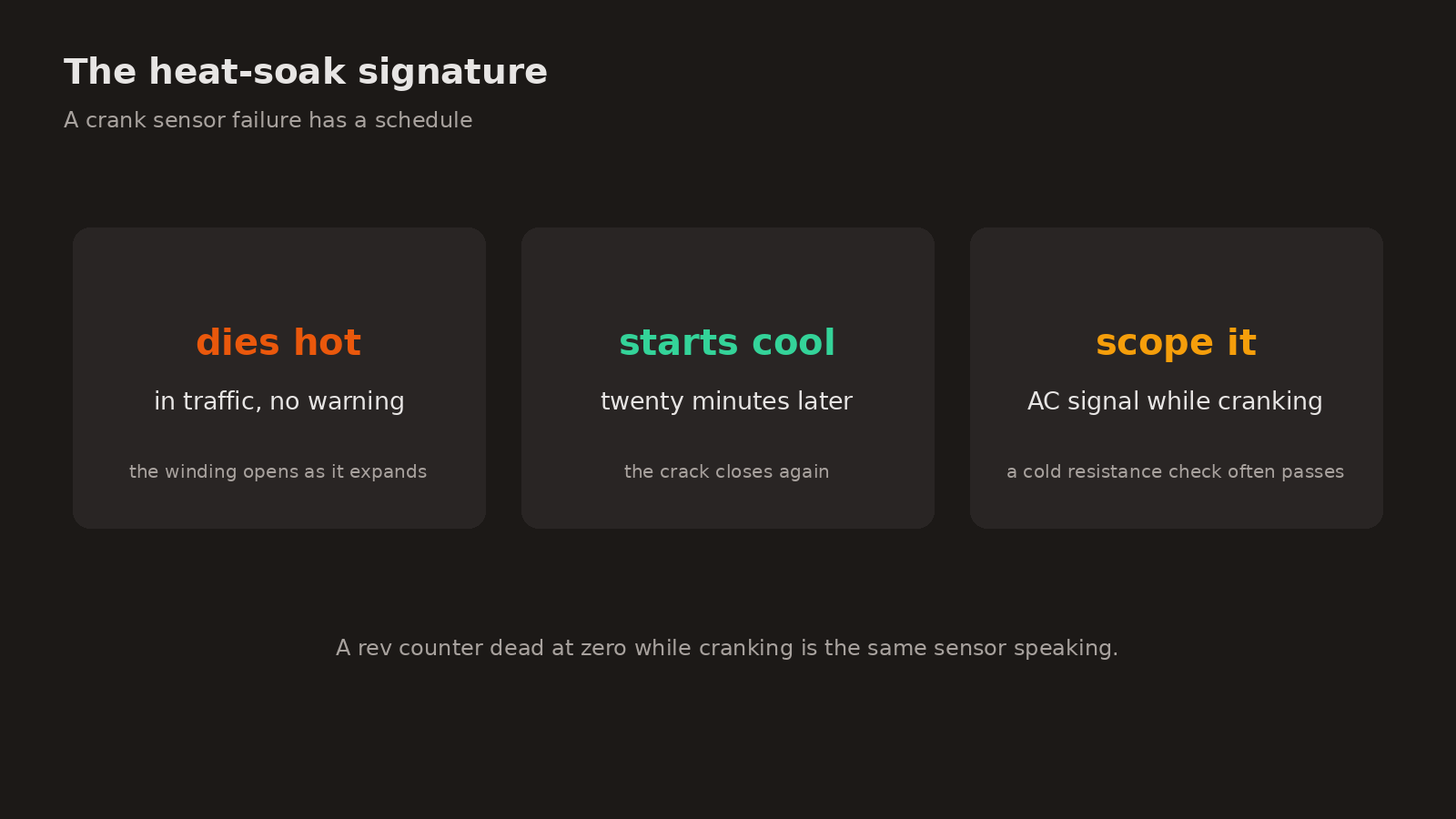
Diagram: the crankshaft position sensor's heat-soak pattern — dies hot, restarts after cooling, and needs testing at temperature rather than cold.
Информация, а не инструкция
CarGeek — это справочник, а не руководство по ремонту. Его страницы составлены по открытым источникам и по опыту других людей, но не по сервисной документации производителя, поэтому для вашего конкретного автомобиля они могут быть неверными или неполными. Часть описанного связана с реальной опасностью: высокое напряжение, топливо под давлением, накопленная энергия, горячие и движущиеся детали.
Всё, по чему вы собираетесь действовать, сначала проверьте с человеком, имеющим техническую подготовку, по собственной процедуре производителя для вашего автомобиля. Ничто здесь не заменяет эту процедуру.