Vehicle
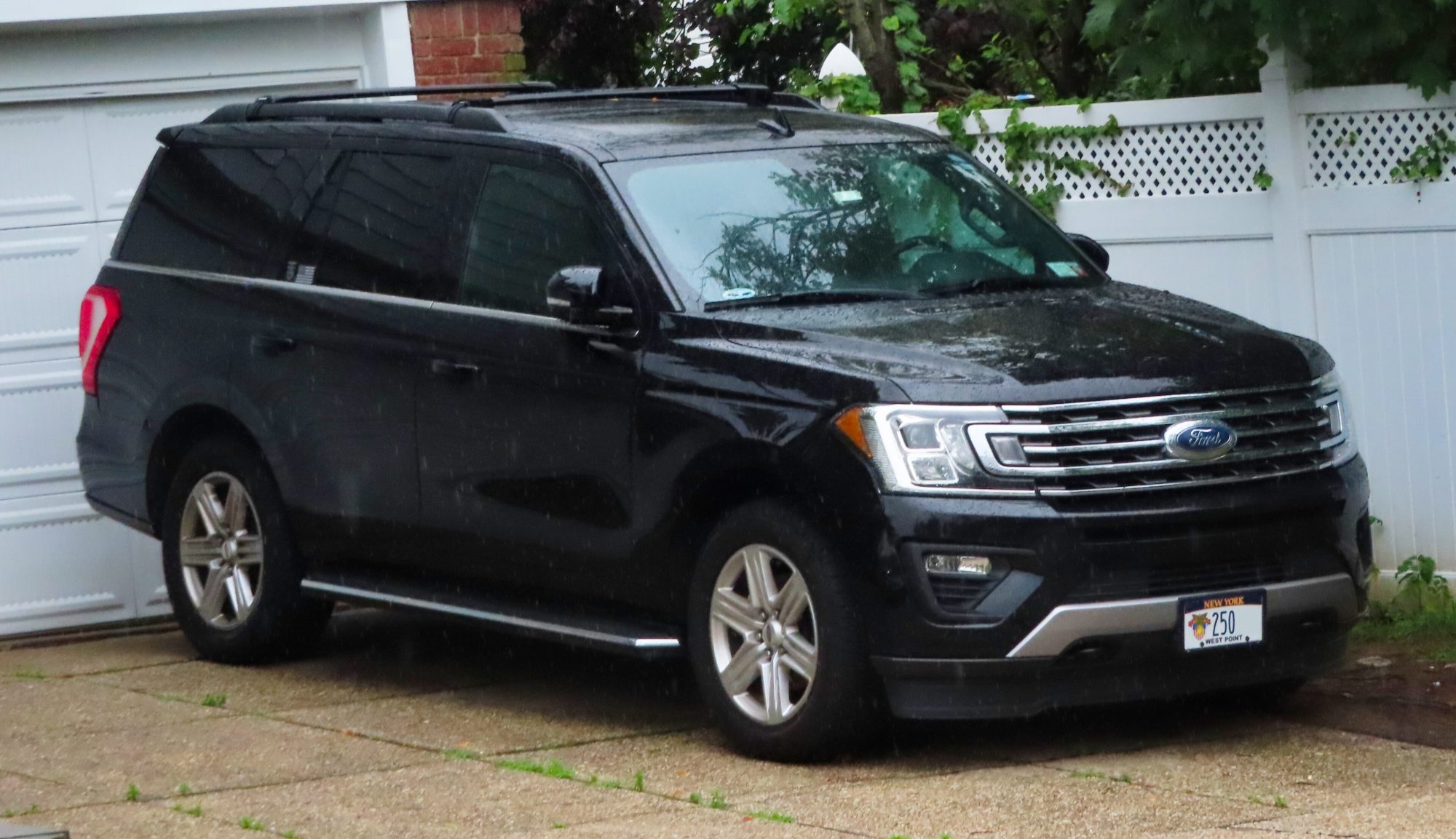
Ford Expedition
Ford's full-size body-on-frame SUV, and mechanically it is an F-150 with a wagon body — the same modular V8s to 2017, the same 3.5 EcoBoost after, and the same transmissions, so F-150 information covers most of it. Two faults are worth knowing before diagnosing one. The 5.4 Triton three-valve engines suffer cam phaser wear and spark plugs that seize and break in the head, both of which arrive as misfire and timing codes rather than as noise complaints. And from 2003 the rear suspension is air-sprung on many trims, where a leaking bag makes the compressor run continuously and sets ride-height faults that read as a sensor problem. The Lincoln Navigator is the same vehicle with different trim.

Generations
-
First generation 1997–2002
The modular Triton V8s, and the generation where the spark plugs that seize and break in the head first become a known job.
- Body styles
- SUV
- Platform
- Ford UN93
- Engines
-
- 4.6 V8 — TRITON · petrol · 160–179 kW (215–240 hp) · 393–395 Nm (290–291 lb-ft) · Triton two-valve
- 5.4 V8 — TRITON · petrol · 172–194 kW (230–260 hp) · 441–475 Nm (325–350 lb-ft) · Triton two-valve
- Transmissions
- 4-speed E4OD automatic · 4-speed 4R100 automatic · 4-speed 4R70W automatic · 2-Speed BorgWarner 4406
- Drivetrain
- Rear-wheel drive · Four-wheel drive
-
Second generation (U222) 2003–2006
Four-wheel independent suspension arrives, and with it the air springs whose leaks set ride-height codes. Two-valve 4.6 and 5.4 Tritons for 2003 and 2004, then the three-valve 5.4 with variable cam timing from 2005 — the change that brings the phaser rattle on a cold start and the two-piece spark plug that breaks off in the head.
- Body styles
- SUV
- Platform
- Ford U222
- Engines
-
- 4.6 V8 — TRITON · petrol · 173 kW (232 hp) · 395 Nm (291 lb-ft) · Triton two-valve, 2003-2004
- 5.4 V8 — TRITON · petrol · 194 kW (260 hp) · 475 Nm (350 lb-ft) · Triton two-valve, 2003-2004
- 5.4 V8 — TRITON · petrol · 224 kW (300 hp) · 495 Nm (365 lb-ft) · Triton three-valve, from 2005
- Transmissions
- 4-speed 4R70W automatic · 4-speed 4R75E automatic · 2-speed BorgWarner 4416
- Drivetrain
- Rear-wheel drive · Four-wheel drive
-
Third generation (U324) 2007–2017
The three-valve 5.4 carried over onto six speeds, flex-fuel capable from 2009, and replaced outright by the 3.5 EcoBoost for 2015 — so a late one answers to F-150 information rather than to the truck it replaced. The air suspension and its ride-height codes continue throughout.
- Body styles
- SUV
- Platform
- Ford T1
- Engines
-
- 5.4 V8 — TRITON · petrol · 224–231 kW (300–310 hp) · 495 Nm (365 lb-ft) · Triton three-valve, E85 flex fuel from 2009
- 3.5 V6 EcoBoost — petrol · 272 kW (365 hp) · 570 Nm (420 lb-ft) · from 2015
- Transmissions
- 6-speed 6R75 automatic · 6-speed 6R80 automatic · 6-speed 6R80 SelectShift automatic · 2-speed BorgWarner 4417
- Drivetrain
- Rear-wheel drive · Four-wheel drive
-
Fourth generation (U553) 2018–present
Aluminium body, 3.5 EcoBoost only, ten-speed automatic — F-150 information applies throughout.
- Body styles
- SUV
- Platform
- Ford T3
- Engines
-
- 3.5 V6 EcoBoost — petrol · 280–328 kW (375–440 hp) · 637–691 Nm (470–510 lb-ft)
- 3.5 V6 PowerBoost — hybrid
- Transmissions
- 10-speed automatic · 2-speed BorgWarner 4417
- Drivetrain
- Rear-wheel drive · Four-wheel drive
Service information
Information, not instruction
CarGeek is a reference, not a service manual. Its pages are written from public sources and from what other people have found, never from a manufacturer's own service information, so they can be wrong or incomplete for your particular vehicle. Some of what they describe carries real risk: high voltage, fuel under pressure, stored energy, hot and moving parts.
Have anything you intend to act on checked by a trained person against the manufacturer's own procedure for your vehicle. Nothing here replaces that procedure.
Posted about the Ford Expedition
Be the first to write this up
Nothing posted about this yet. Whatever you found is worth writing down — even a dead end saves someone the same afternoon.
What makes one worth reading:
- The car — make, model, year and engine. The same fault behaves differently on each.
- What you measured, not only what you replaced.
- What actually fixed it — or that nothing did, which is worth knowing too.
Sign in or create an account to add what you found about Ford Expedition.