Vehicle
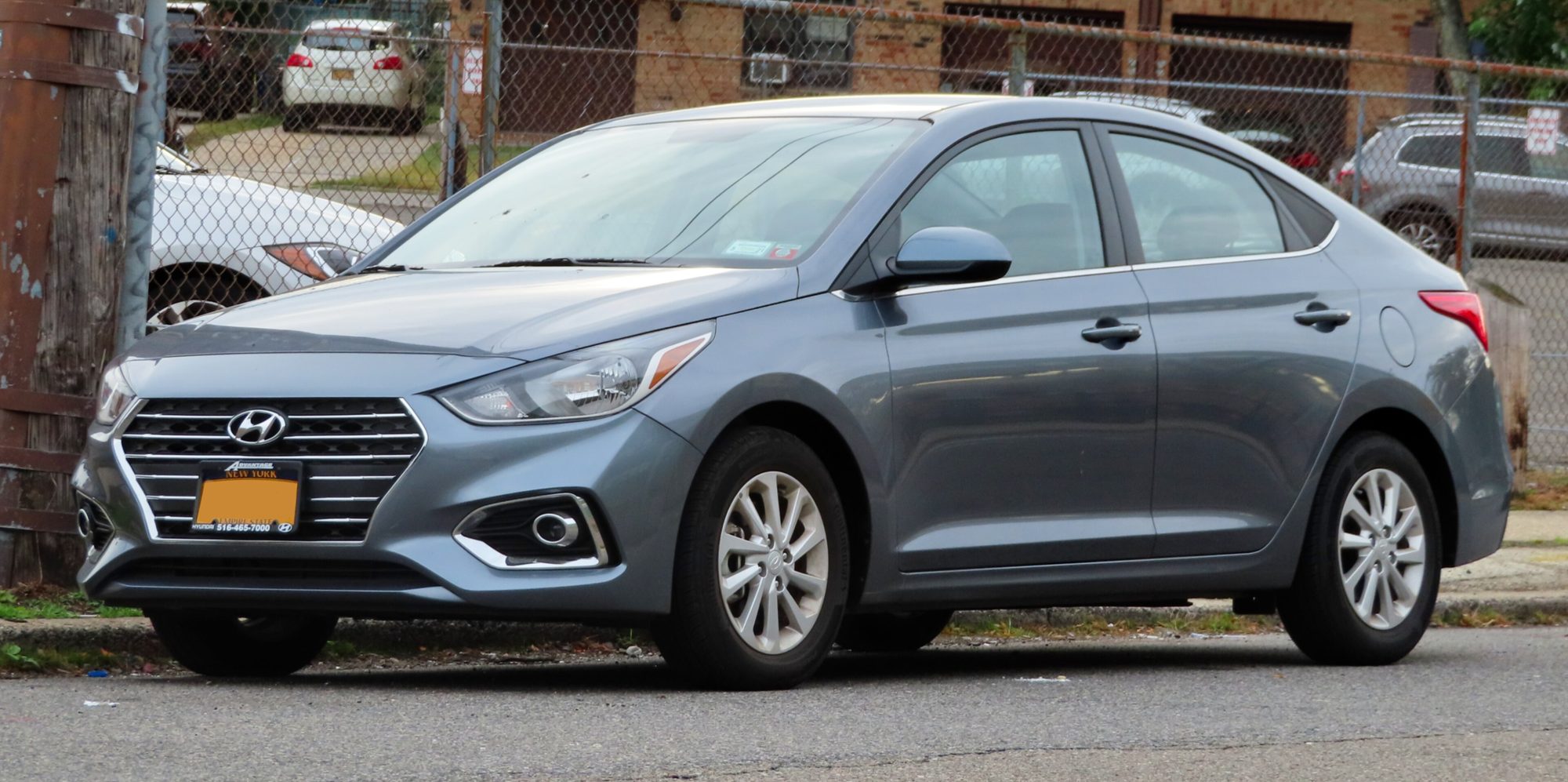
Hyundai Accent
The subcompact sold as Verna and Solaris depending on market — enormous fleets across the Middle East, Russia and Latin America, where it is often the default taxi.

Generations
-
X3 1994–1999
Alpha petrol only, in two families a reader has to tell apart: a 12-valve SOHC 1.3 and 1.5, and a 16-valve DOHC 1.5 that shares neither its power nor its cylinder head. A few export markets kept a carburettor on the 1.3, which has no injection to diagnose at all.
- Body styles
- Hatchback · Sedan
- Platform
- Hyundai Accent
- Engines
-
- 1.3 Alpha — G4EH · petrol · 44–55 kW (59–74 hp) · 105–118 Nm (77–87 lb-ft) · 12-valve SOHC, multi-point injection
- 1.3 Alpha carburettor — G4EA · petrol · 51–53 kW (68–71 hp) · 12-valve SOHC, a few export markets
- 1.5 Alpha — G4EK · petrol · 67 kW (90 hp) · 130 Nm (96 lb-ft) · 12-valve SOHC
- 1.5 II — ALPHA · petrol · 73 kW (98 hp) · 134 Nm (99 lb-ft) · 16-valve DOHC
- Transmissions
- 5-speed M5AF3 manual · 4-speed A4AF2 automatic
- Drivetrain
- Front-wheel drive
-
LC 1999–2005
The first Accent with a diesel — a 1.5 CRDi three-cylinder built under VM Motori licence — beside four Alpha petrols, and the generation where the 1.5 changes designation from G4EK to G4EB without changing size. Built on far past 2005 in India, Russia and Egypt, so the running fleet is much younger than the Korean dates suggest.
- Body styles
- Hatchback · Sedan
- Platform
- Hyundai-Kia TB
- Engines
-
- 1.3 Alpha — G4EH · petrol · 61–64 kW (82–86 hp) · 114–119 Nm (84–88 lb-ft) · 12-valve SOHC
- 1.5 Alpha — G4EB · petrol · 69 kW (92 hp) · 130 Nm (96 lb-ft) · 12-valve SOHC, to 2003
- 1.5 Alpha II — G4EC · petrol · 76 kW (102 hp) · 134 Nm (99 lb-ft) · 16-valve DOHC
- 1.6 Alpha II — G4ED · petrol · 79 kW (106 hp) · 143 Nm (105 lb-ft) · 16-valve DOHC, from 2001
- 1.5 CRDi — D3EA · diesel · 61 kW (82 hp) · 187 Nm (138 lb-ft) · three-cylinder, VM Motori licence, from 2002
- Transmissions
- 5-speed manual · 4-speed automatic
- Drivetrain
- Front-wheel drive
-
MC 2005–2011
Alpha engines; about as straightforward as a modern car gets to work through.
- Body styles
- Sedan · Hatchback
- Platform
- Hyundai MC
- Engines
-
- 1.4 Alpha — petrol · 71 kW (95 hp) · 125 Nm (92 lb-ft)
- 1.6 Alpha — petrol · 82 kW (110 hp) · 146 Nm (108 lb-ft)
- 1.5 CRDi — diesel · 81 kW (109 hp) · 235 Nm (173 lb-ft)
- Transmissions
- 5-speed manual · 4-speed automatic
- Drivetrain
- Front-wheel drive
-
RB 2010–2017
Gamma direct injection arrives, and with it the intake-carbon question.
- Body styles
- Sedan · Hatchback
- Platform
- Hyundai RB
- Engines
-
- 1.4 Gamma — petrol · 79 kW (106 hp)
- 1.6 GDi — GAMMA · petrol · 103 kW (138 hp) · 165 Nm (122 lb-ft)
- 1.1 CRDi three-cylinder — diesel
- 1.4 CRDi — diesel
- 1.6 CRDi — diesel · 94–100 kW (126–134 hp)
- Transmissions
- 5-speed manual · 4-speed automatic · 6-speed M6CF1 manual · 6-speed A6GF1 automatic · 7-speed DCT
- Drivetrain
- Front-wheel drive
-
HC 2017–present
Smartstream engines; sold under several names across markets.
- Body styles
- Sedan · Hatchback
- Platform
- Hyundai HC
- Engines
-
- 1.4 Kappa — petrol · 73 kW (98 hp) · 132 Nm (97 lb-ft)
- 1.6 GDi — GAMMA · petrol · 97 kW (130 hp) · 161 Nm (119 lb-ft)
- 1.6 Smartstream — petrol · 90 kW (121 hp) · 151 Nm (111 lb-ft)
- 1.0 turbo — petrol
- 1.4 turbo — diesel
- 1.5 turbo — diesel
- 1.6 turbo — diesel
- Transmissions
- 6-speed manual · 6-speed automatic · CVT · 7-speed DCT · C0GF1 CVT
- Drivetrain
- Front-wheel drive
-
BN7 2023–present
Sixth generation, built in India and sold there as the Verna; carries the Accent name across the Middle East, Vietnam and parts of South America. Petrol only, both engines 1.5 litres.
- Engines
-
- 1.5 Smartstream — G4FL · petrol · 85 kW (114 hp)
- 1.5 Smartstream turbo — G4LH · petrol · 118 kW (158 hp)
- Transmissions
- 6-speed manual · 7-speed DCT · CVT
- Drivetrain
- Front-wheel drive
Service information
Information, not instruction
CarGeek is a reference, not a service manual. Its pages are written from public sources and from what other people have found, never from a manufacturer's own service information, so they can be wrong or incomplete for your particular vehicle. Some of what they describe carries real risk: high voltage, fuel under pressure, stored energy, hot and moving parts.
Have anything you intend to act on checked by a trained person against the manufacturer's own procedure for your vehicle. Nothing here replaces that procedure.
Posted about the Hyundai Accent
Be the first to write this up
Nothing posted about this yet. Whatever you found is worth writing down — even a dead end saves someone the same afternoon.
What makes one worth reading:
- The car — make, model, year and engine. The same fault behaves differently on each.
- What you measured, not only what you replaced.
- What actually fixed it — or that nothing did, which is worth knowing too.
Sign in or create an account to add what you found about Hyundai Accent.