Vehicle
Mahindra Thar
The short-wheelbase off-roader descended from Mahindra's licensed Willys Jeep, and still a body-on-frame vehicle with a low-range transfer case and a live rear axle. The second generation of 2020 is where it gained modern engine management and an automatic option, so a Thar's model year decides whether it is a mechanically simple vehicle or one with a full electronic control architecture. Off-road duty means sensor and wiring damage is a first suspect rather than a last one.
The five-door Thar Roxx is a different vehicle and has its own page. It is built on the Scorpio-N's longer ladder frame rather than on this one, so parts, wiring and procedures do not transfer between the two on the strength of the shared name.
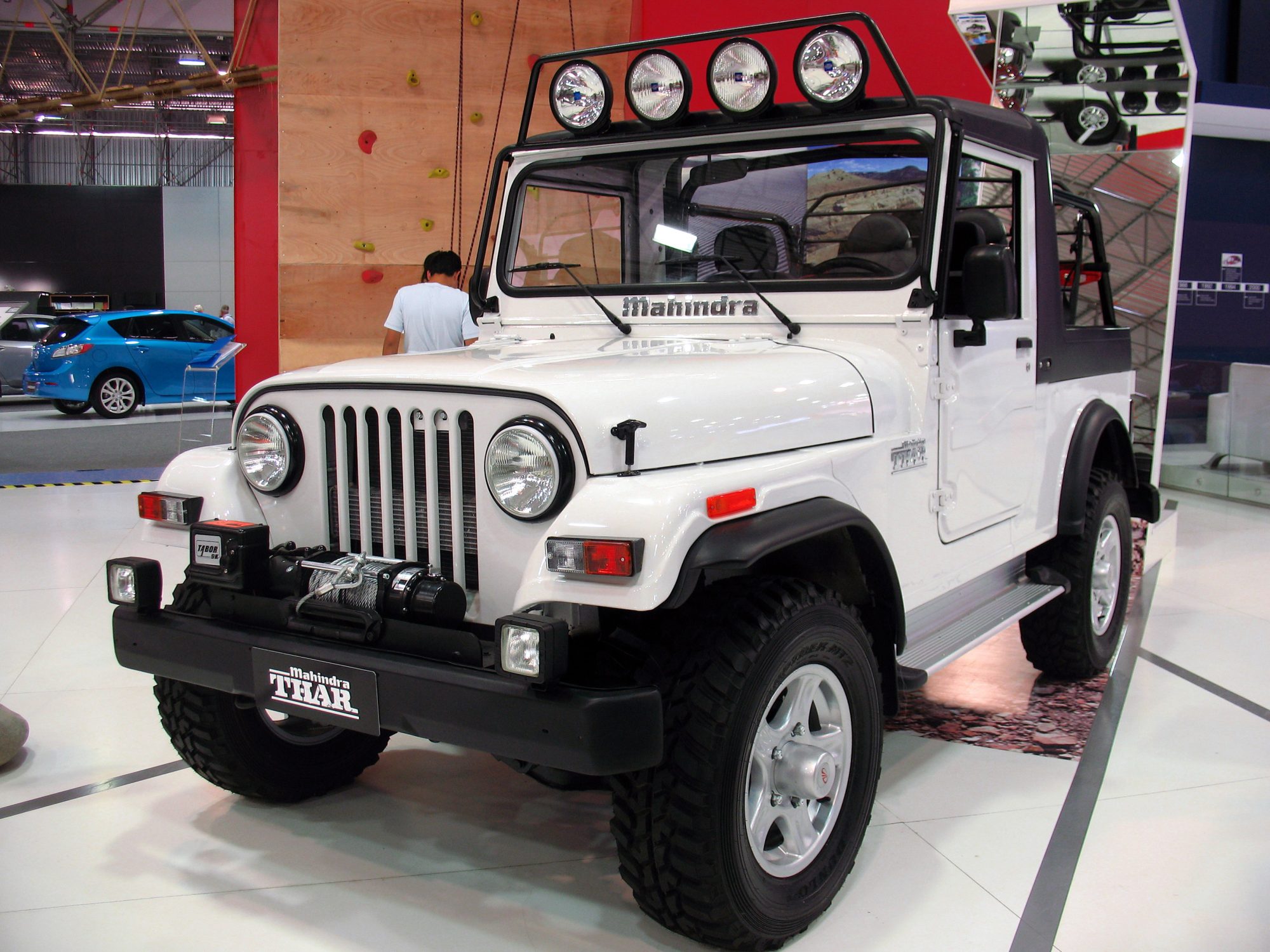
.jpg)
Generations
-
First generation 2010–2020
Mechanically simple, descended from the licensed Willys — a low-range transfer case, a live rear axle and very little electronics.
- Body styles
- SUV
- Platform
- Mahindra CL
- Engines
-
- 2.5 CRDe — NEF 2.49 · diesel · 78 kW (105 hp) · 247 Nm (182 lb-ft) · the short-stroke 2,498 cc NEF, not the 2,522 cc m2DiCR the CRDe badge is also used on
- 2.53 — MDI3200TC · diesel · 47 kW (63 hp) · 176 Nm (130 lb-ft) · 2,522 cc — the DI, sold as DI 2WD and DI 4WD; the CRDe above is a different block
- Transmissions
- 5-speed manual
- Drivetrain
- Part-time four-wheel drive with low range
-
Second generation 2020–present
Modern engine management and an automatic option arrive — the point where a Thar stops being a mechanically simple vehicle.
- Body styles
- SUV
- Platform
- Mahindra body-on-frame
- Engines
-
- 2.0 turbo — MSTALLION · petrol · 112 kW (150 hp) · 300–320 Nm (221–236 lb-ft)
- 2.2 mHawk — 4D22 · diesel · 97 kW (130 hp) · 300 Nm (221 lb-ft)
- 1.5 diesel — 4D15 · diesel · 87 kW (117 hp) · 300 Nm (221 lb-ft)
- Transmissions
- 6-speed manual · 6-speed automatic
- Drivetrain
- Rear-wheel drive · Part-time four-wheel drive with low range
Information, not instruction
CarGeek is a reference, not a service manual. Its pages are written from public sources and from what other people have found, never from a manufacturer's own service information, so they can be wrong or incomplete for your particular vehicle. Some of what they describe carries real risk: high voltage, fuel under pressure, stored energy, hot and moving parts.
Have anything you intend to act on checked by a trained person against the manufacturer's own procedure for your vehicle. Nothing here replaces that procedure.
Posted about the Mahindra Thar
Be the first to write this up
Nothing posted about this yet. Whatever you found is worth writing down — even a dead end saves someone the same afternoon.
What makes one worth reading:
- The car — make, model, year and engine. The same fault behaves differently on each.
- What you measured, not only what you replaced.
- What actually fixed it — or that nothing did, which is worth knowing too.
Sign in or create an account to add what you found about Mahindra Thar.