Vehicle
Mazda BT-50
The pickup, and three different parent vehicles across three generations — which makes establishing the year the entire first step, because none of the three shares parts with the others. To 2011 it is a Ford Ranger of the old shape; from 2011 it is a Ford Ranger T6; from 2020 it is an Isuzu D-Max. So a BT-50 wants Ford documentation or Isuzu documentation depending on nothing but its age, and Mazda's own material is the thinnest of the three.
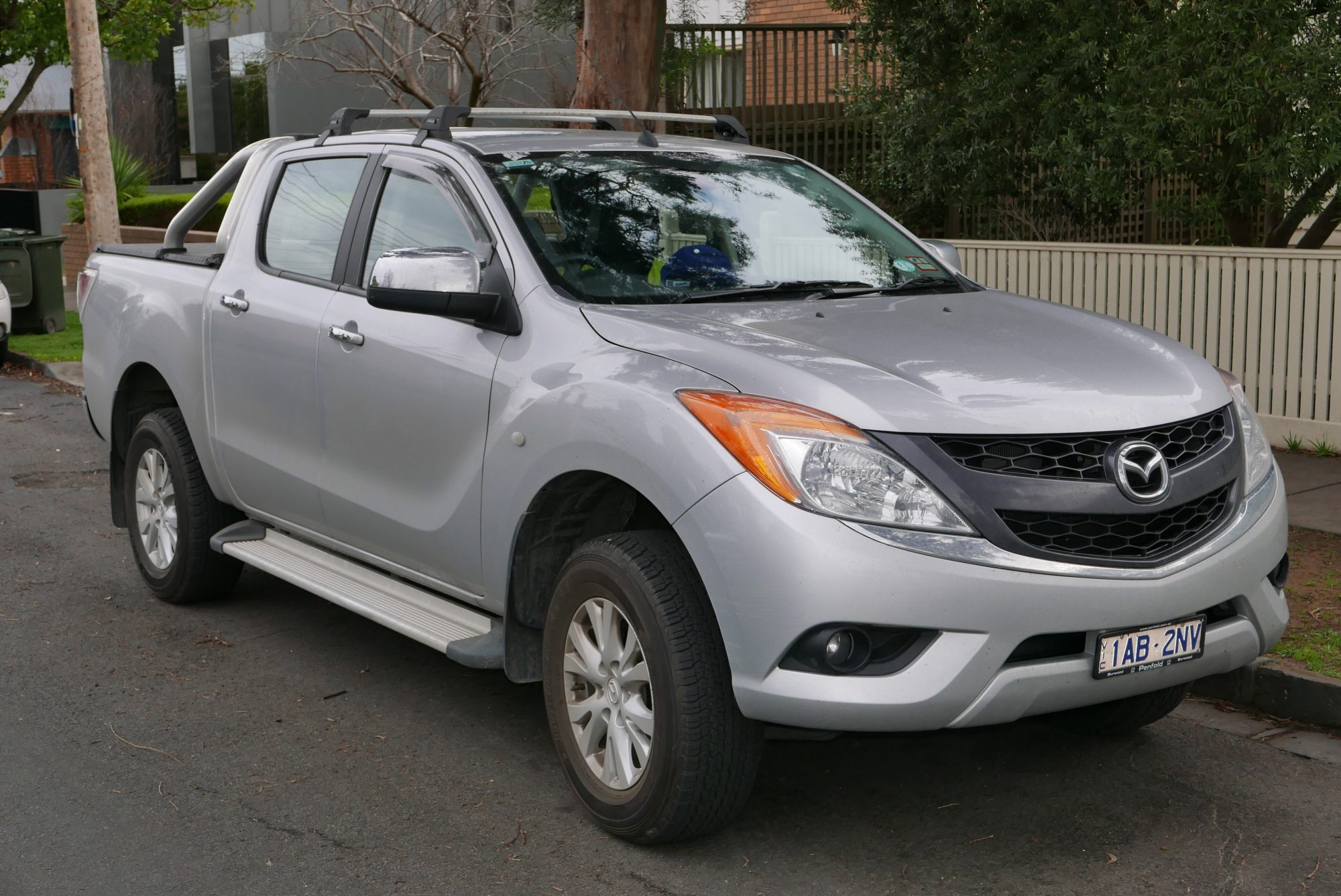
_XTR_4WD_4-door_utility_(2015-07-24)_01.jpg)
Generations
-
UN 2006–2011
A Ford Ranger of the pre-T6 shape — Ford information applies and Mazda's is the thinner source.
- Body styles
- Pickup
- Platform
- Ford Ranger
- Engines
-
- 2.5 MZR-CD — diesel · 105 kW (141 hp) · 330 Nm (243 lb-ft)
- 3.0 MZR-CD — diesel
- 2.6 petrol — petrol
- Transmissions
- 5-speed automatic · 5-speed M5OD manual
- Drivetrain
- Rear-wheel drive · Part-time four-wheel drive with low range
-
UR 2011–2020
A Ford Ranger T6 with the five-cylinder Duratorq — the same vehicle as the Ranger of those years in every mechanical respect.
- Body styles
- Pickup
- Platform
- Ford T6
- Engines
-
- 2.2 Duratorq — diesel
- 3.2 five-cylinder — DURATORQ · diesel
- Transmissions
- 6-speed manual · 6-speed automatic
- Drivetrain
- Rear-wheel drive · Part-time four-wheel drive with low range
-
TF 2020–present
An Isuzu D-Max — the parentage changes completely, so Ford information stops applying and Isuzu's starts.
- Body styles
- Pickup
- Platform
- Isuzu RG
- Engines
-
- 1.9 diesel — RZ4E-TC · diesel · 110 kW (148 hp) · 350 Nm (258 lb-ft) · Isuzu RZ4E
- 3.0 diesel — 4JJ3-TCX · diesel · 140 kW (188 hp) · 450 Nm (332 lb-ft) · Isuzu 4JJ3
- 2.2 — RZ4F-TC · diesel · 120 kW (161 hp) · 400 Nm (295 lb-ft)
- Transmissions
- 6-speed Aisin AE6 manual · 6-speed AW TB60-LS automatic
- Drivetrain
- Rear-wheel drive · Part-time four-wheel drive with low range
Information, not instruction
CarGeek is a reference, not a service manual. Its pages are written from public sources and from what other people have found, never from a manufacturer's own service information, so they can be wrong or incomplete for your particular vehicle. Some of what they describe carries real risk: high voltage, fuel under pressure, stored energy, hot and moving parts.
Have anything you intend to act on checked by a trained person against the manufacturer's own procedure for your vehicle. Nothing here replaces that procedure.
Posted about the Mazda BT-50
Be the first to write this up
Nothing posted about this yet. Whatever you found is worth writing down — even a dead end saves someone the same afternoon.
What makes one worth reading:
- The car — make, model, year and engine. The same fault behaves differently on each.
- What you measured, not only what you replaced.
- What actually fixed it — or that nothing did, which is worth knowing too.
Sign in or create an account to add what you found about Mazda BT-50.