Vehicle
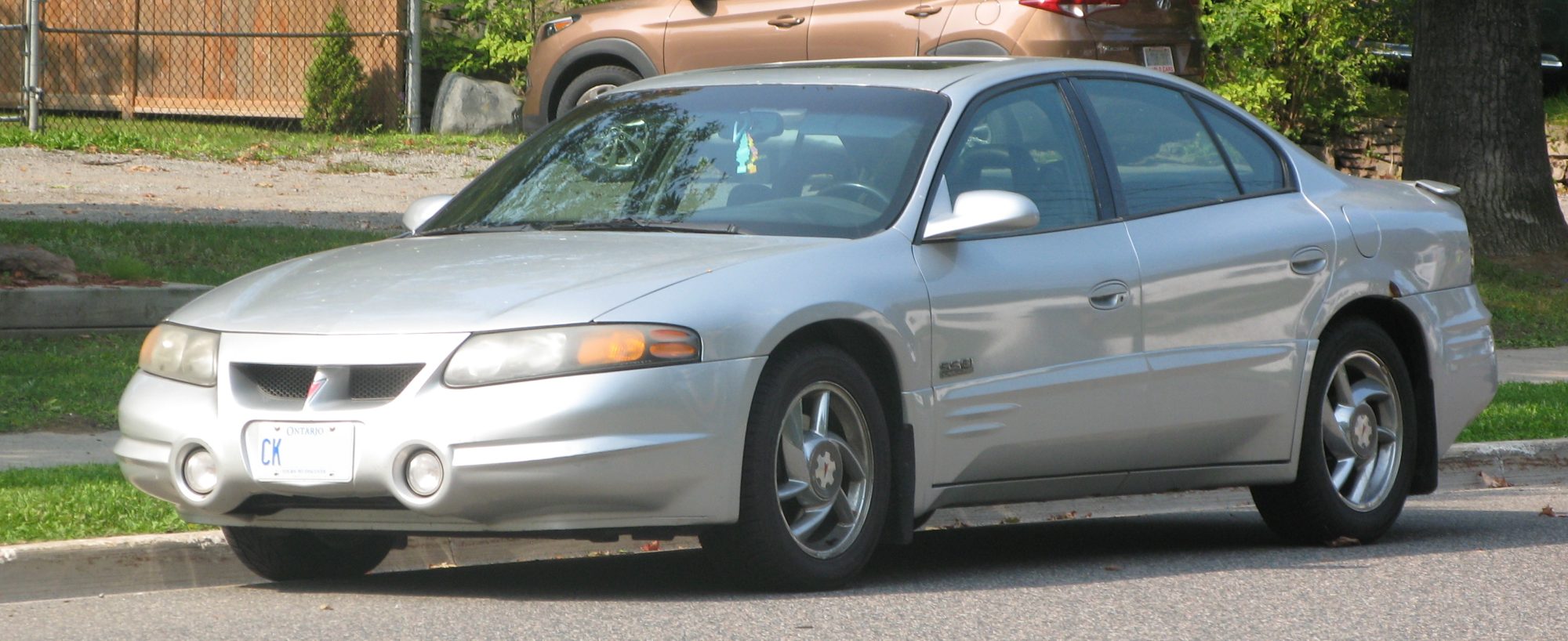
Pontiac Bonneville
The large front-drive saloon, and for most of its later life a 3.8 Series II V6 car — which makes it a useful reference point, because that engine appears across half of GM's front-drive range and carries the same fault everywhere. The upper intake manifold gasket degrades and leaks coolant internally, producing misfires, lean codes and a slowly disappearing coolant level with no visible leak; it is the first thing to check on any 3.8 rather than the last. The supercharged SSEi adds an Eaton blower whose coupling and bearings are a separate wear item, and the 4T65E transaxle behind both is where the remaining complaints live.

Generations
-
Sixth and seventh generation 1981–1991
The downsized G-body and then the first H-body car; the 3.8 V6 arrives here and brings its intake gasket story with it.
- Body styles
- Sedan · Coupé · Estate
- Platform
- GM G-body and H-body
- Engines
-
- 3.8 V6 — petrol · 111–126 kW (149–169 hp)
- 5.0 V8 — petrol
- 4.1 V6 — petrol
- Transmissions
- 3-speed THM200 automatic · 4-speed 200-4R automatic · 4-speed THM440T4 automatic
- Drivetrain
- Rear-wheel drive · Front-wheel drive
-
Eighth generation 1992–1999
3.8 Series I and II, supercharged on the SSEi; the upper intake manifold gasket leaking coolant internally is the defining fault.
- Body styles
- Sedan
- Platform
- GM H-body
- Engines
-
- 3.8 V6 — L36 · petrol · 153 kW (205 hp) · 312 Nm (230 lb-ft) · Series II 3800
- 3.8 supercharged V6 — petrol · L67, SSEi
- 3.8 V6 — L27 · petrol
- Transmissions
- 4-speed automatic
- Drivetrain
- Front-wheel drive
-
Ninth generation 2000–2005
Adds the 4.6 Northstar on the GXP, whose head-bolt threads pulling from the alloy block is a different fault entirely from the 3.8's gasket.
- Body styles
- Sedan
- Platform
- GM G-body
- Engines
-
- 3.8 V6 — L36 · petrol · 312 Nm (230 lb-ft) · Series II L36
- 3.8 supercharged V6 — L67 · petrol · 380 Nm (280 lb-ft) · L67, SSEi
- 4.6 V8 — LD8 · petrol · 205 kW (275 hp) · 407 Nm (300 lb-ft) · Northstar, GXP
- Transmissions
- 4-speed 4T65-E automatic · 4-speed 4T65E-HD automatic · 4-speed 4T80-E automatic
- Drivetrain
- Front-wheel drive
Information, not instruction
CarGeek is a reference, not a service manual. Its pages are written from public sources and from what other people have found, never from a manufacturer's own service information, so they can be wrong or incomplete for your particular vehicle. Some of what they describe carries real risk: high voltage, fuel under pressure, stored energy, hot and moving parts.
Have anything you intend to act on checked by a trained person against the manufacturer's own procedure for your vehicle. Nothing here replaces that procedure.
Posted about the Pontiac Bonneville
Be the first to write this up
Nothing posted about this yet. Whatever you found is worth writing down — even a dead end saves someone the same afternoon.
What makes one worth reading:
- The car — make, model, year and engine. The same fault behaves differently on each.
- What you measured, not only what you replaced.
- What actually fixed it — or that nothing did, which is worth knowing too.
Sign in or create an account to add what you found about Pontiac Bonneville.