Vehicle
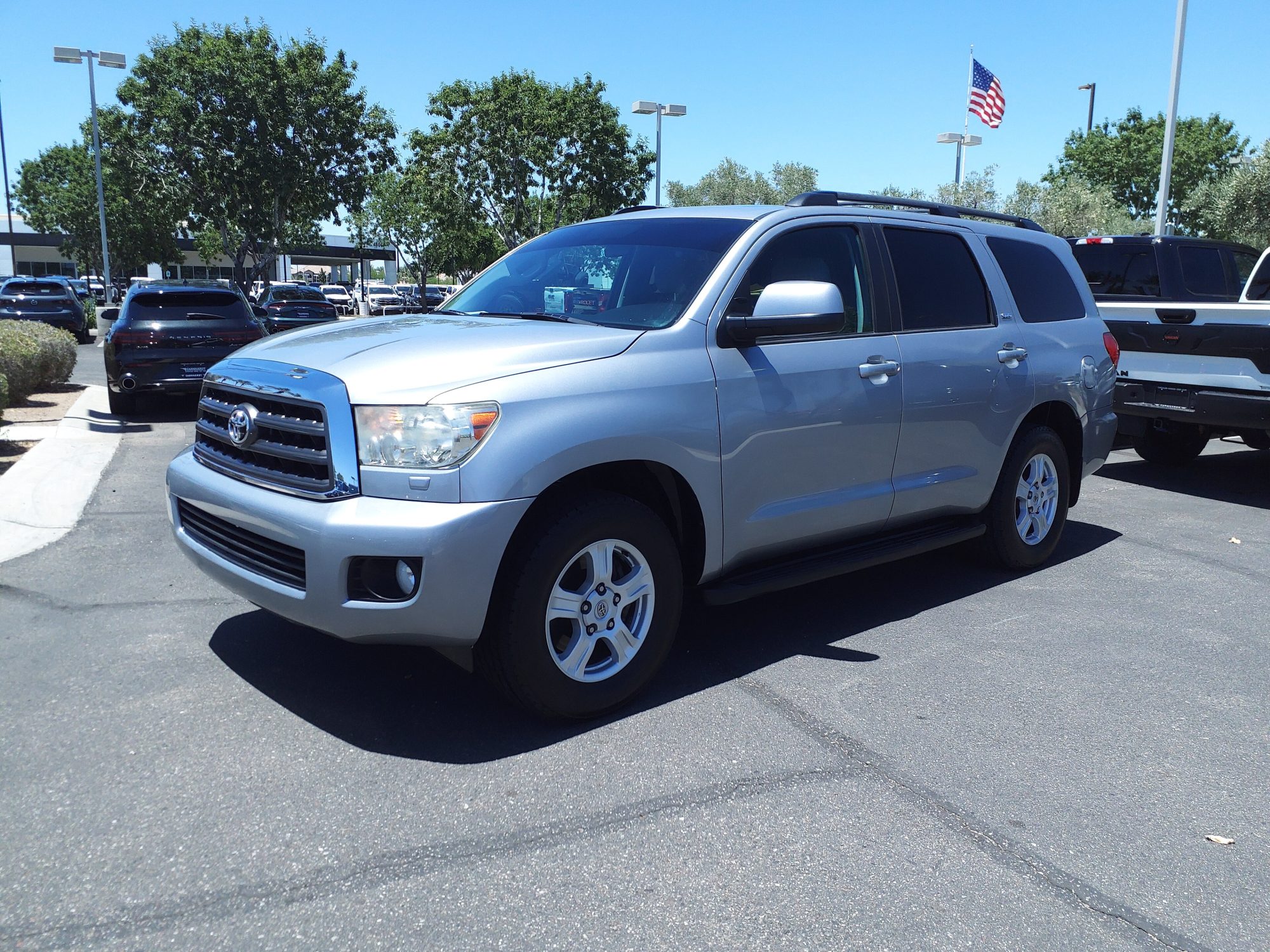
Toyota Sequoia
The full-size body-on-frame SUV built on the Tundra's chassis, which is where its information lives — anything true of a Tundra of the same year is almost certainly true of the Sequoia. The 4.7 and 5.7 V8s are durable, and the faults that bring one in are usually elsewhere: the secondary air injection system on 2005-2012 cars is the well-known one, where the pump and its changeover valves corrode and set a family of air-injection codes on cold start that will not clear without replacing the assembly. The 2023-on car drops the V8 entirely for a twin-turbo V6 hybrid, which changes the entire thermal and boost picture and shares nothing with the older diagnosis.

Generations
-
XK30 2000–2007
The first Sequoia on the Tundra's chassis, with the 4.7 2UZ-FE and the secondary air injection faults that define the era.
- Body styles
- SUV
- Platform
- Toyota XK30
- Engines
-
- 4.7 V8 — 2UZ-FE · petrol · 170–212 kW (228–284 hp) · 410–448 Nm (302–330 lb-ft)
- Transmissions
- 4-speed automatic · 5-speed automatic
- Drivetrain
- Rear-wheel drive · Four-wheel drive
-
Second generation (XK60) 2008–2022
Tundra chassis with the 4.7 and 5.7 V8s; secondary air injection pump and valve corrosion is the recurring cold-start fault.
- Body styles
- SUV
- Platform
- Toyota XK60
- Engines
-
- 4.7 V8 — 2UZ-FE · petrol · 170–212 kW (228–284 hp) · 410–448 Nm (302–330 lb-ft)
- 5.7 V8 — 3UR-FE · petrol · 284 kW (381 hp) · 544 Nm (401 lb-ft)
- 4.6 V8 — 1UR-FE · petrol · 221–255 kW (296–342 hp) · 439–460 Nm (324–339 lb-ft) · UPK60/65; 2010–2012
- 5.7 V8 — 3UR-FBE · petrol · USK65
- Transmissions
- 5-speed automatic · 6-speed automatic
- Drivetrain
- Rear-wheel drive · Four-wheel drive
-
Third generation (XK80) 2023–present
TNGA-F with the i-FORCE MAX twin-turbo V6 hybrid — no V8, and a completely different boost and cooling architecture.
- Body styles
- SUV
- Platform
- Toyota TNGA-F
- Engines
-
- 3.4 twin-turbo V6 i-FORCE MAX — V35A-FTS · hybrid · 549–650 Nm (405–479 lb-ft)
- Transmissions
- 10-speed automatic
- Drivetrain
- Rear-wheel drive · Four-wheel drive
Service information
Information, not instruction
CarGeek is a reference, not a service manual. Its pages are written from public sources and from what other people have found, never from a manufacturer's own service information, so they can be wrong or incomplete for your particular vehicle. Some of what they describe carries real risk: high voltage, fuel under pressure, stored energy, hot and moving parts.
Have anything you intend to act on checked by a trained person against the manufacturer's own procedure for your vehicle. Nothing here replaces that procedure.
Posted about the Toyota Sequoia
Be the first to write this up
Nothing posted about this yet. Whatever you found is worth writing down — even a dead end saves someone the same afternoon.
What makes one worth reading:
- The car — make, model, year and engine. The same fault behaves differently on each.
- What you measured, not only what you replaced.
- What actually fixed it — or that nothing did, which is worth knowing too.
Sign in or create an account to add what you found about Toyota Sequoia.