P0500: check where your car gets its speed from before buying a sensor
The symptoms around the code are the clue. Speedometer dead too? On cars where the cluster reads the same sensor, that points at the sensor or its wiring. Speedo fine but P0500 stored? The cluster may be fed separately — now suspect the wiring between modules, or the message not arriving over the network rather than the sensor itself.
The knock-on effects are why this code should not wait: automatic gearboxes shift by road speed, so a missing signal produces harsh or late shifts that feel like a transmission problem; cruise control disables itself; some ABS/ESP systems degrade.
With a scanner: watch the vehicle speed PID against a GPS app while someone else drives. Reading zero while moving confirms the signal is missing at the ECU. On older cars with a gearbox-mounted sensor, check the sensor's drive gear too — plastic teeth strip, and a stripped gear takes out a brand-new sensor's reading exactly as thoroughly as a dead one.
Pièces jointes
-
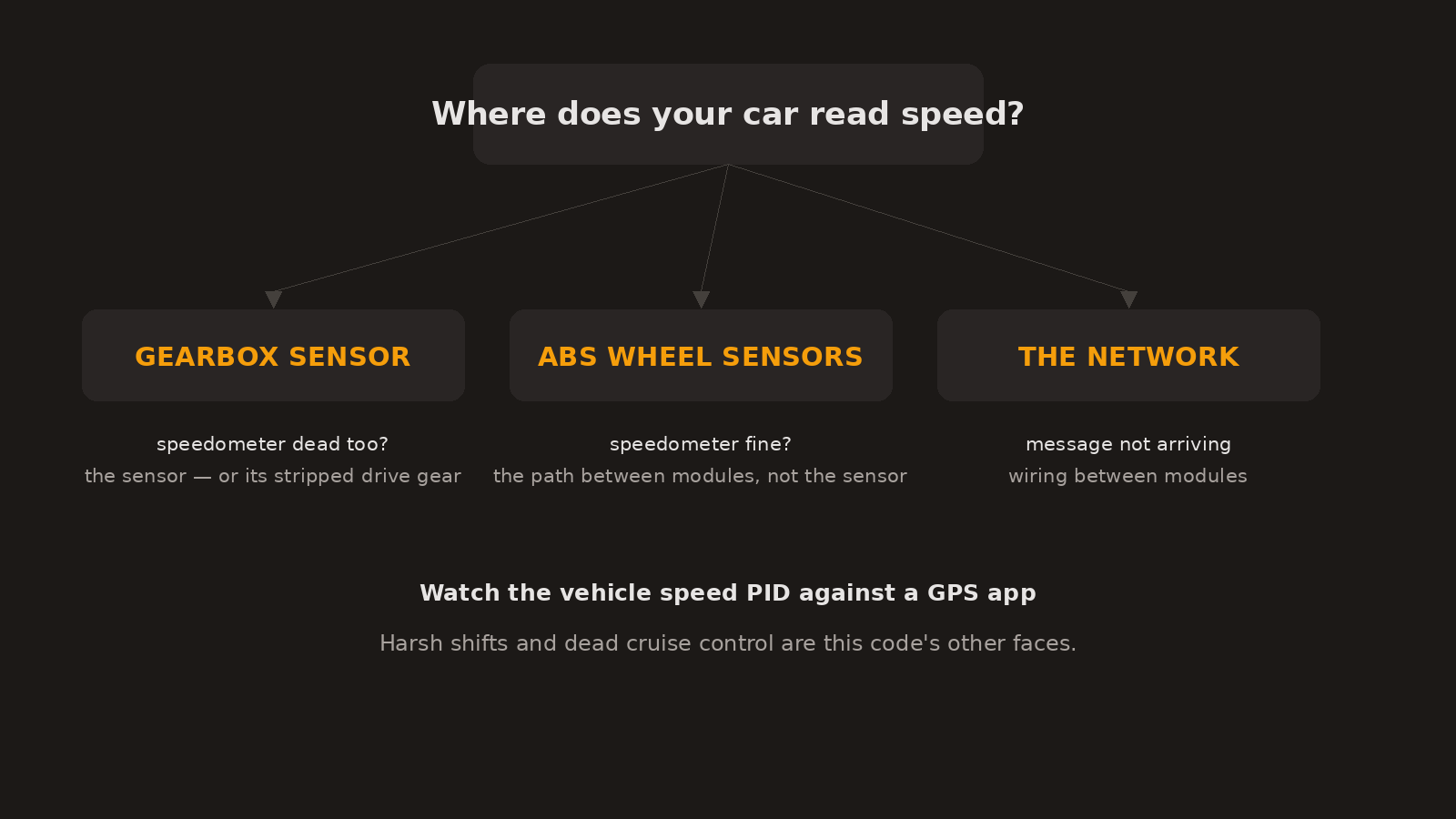
Diagram: the three places a car reads road speed from — a gearbox output sensor, the ABS wheel sensors, or the network between modules — and the symptom that points at each.
Des informations, pas des instructions
CarGeek est un ouvrage de référence, pas un manuel d'atelier. Ses pages sont rédigées à partir de sources publiques et de ce que d'autres ont constaté, jamais à partir de la documentation technique du constructeur ; elles peuvent donc être erronées ou incomplètes pour votre véhicule précis. Une partie de ce qu'elles décrivent présente un risque réel : haute tension, carburant sous pression, énergie accumulée, pièces chaudes ou en mouvement.
Avant d'agir sur quoi que ce soit, faites-le vérifier par une personne formée, en suivant la procédure du constructeur pour votre véhicule. Rien ici ne remplace cette procédure.