On an electric car, a 12 V battery that keeps dying is a charging fault
HO
@hhh
1 month ago
An electric car still has a 12-volt battery, and it still runs the lights, the computers, the pumps and the door locks. What it does not have is an alternator. **The DC/DC converter does that job** — stepping the traction pack's several hundred volts down to the twelve or so everything else expects.
Which produces a failure that catches almost everybody. When the converter stops charging properly — derated for temperature, or faulted outright — the 12 V battery is drained instead of filled. Lights dim, modules start reporting nonsense, and eventually the car will not power on at all. **It looks exactly like a dead 12 V battery, so a 12 V battery gets fitted, and the new one flattens too.** A perfectly healthy traction pack sits underneath the whole time.
**The measurement that settles it takes two minutes.** With the car powered on and ready to drive, put a meter across the 12 V battery terminals. You should see roughly 13.5 to 14.5 volts — the same as a running petrol car. **Twelve-point-something, with the car switched on, means it is not being charged**, and that is the converter's side of the fence rather than the battery's.
Two codes describe that side directly: P0C38 for the converter's temperature sensing, and P0CA2 for the step-down conversion underperforming. But you do not need a code to apply the rule.
The rule: on an electrified car, replace a 12 V battery once. **If the second one goes flat, stop buying batteries.**
Which produces a failure that catches almost everybody. When the converter stops charging properly — derated for temperature, or faulted outright — the 12 V battery is drained instead of filled. Lights dim, modules start reporting nonsense, and eventually the car will not power on at all. **It looks exactly like a dead 12 V battery, so a 12 V battery gets fitted, and the new one flattens too.** A perfectly healthy traction pack sits underneath the whole time.
**The measurement that settles it takes two minutes.** With the car powered on and ready to drive, put a meter across the 12 V battery terminals. You should see roughly 13.5 to 14.5 volts — the same as a running petrol car. **Twelve-point-something, with the car switched on, means it is not being charged**, and that is the converter's side of the fence rather than the battery's.
Two codes describe that side directly: P0C38 for the converter's temperature sensing, and P0CA2 for the step-down conversion underperforming. But you do not need a code to apply the rule.
The rule: on an electrified car, replace a 12 V battery once. **If the second one goes flat, stop buying batteries.**
Attachments
-
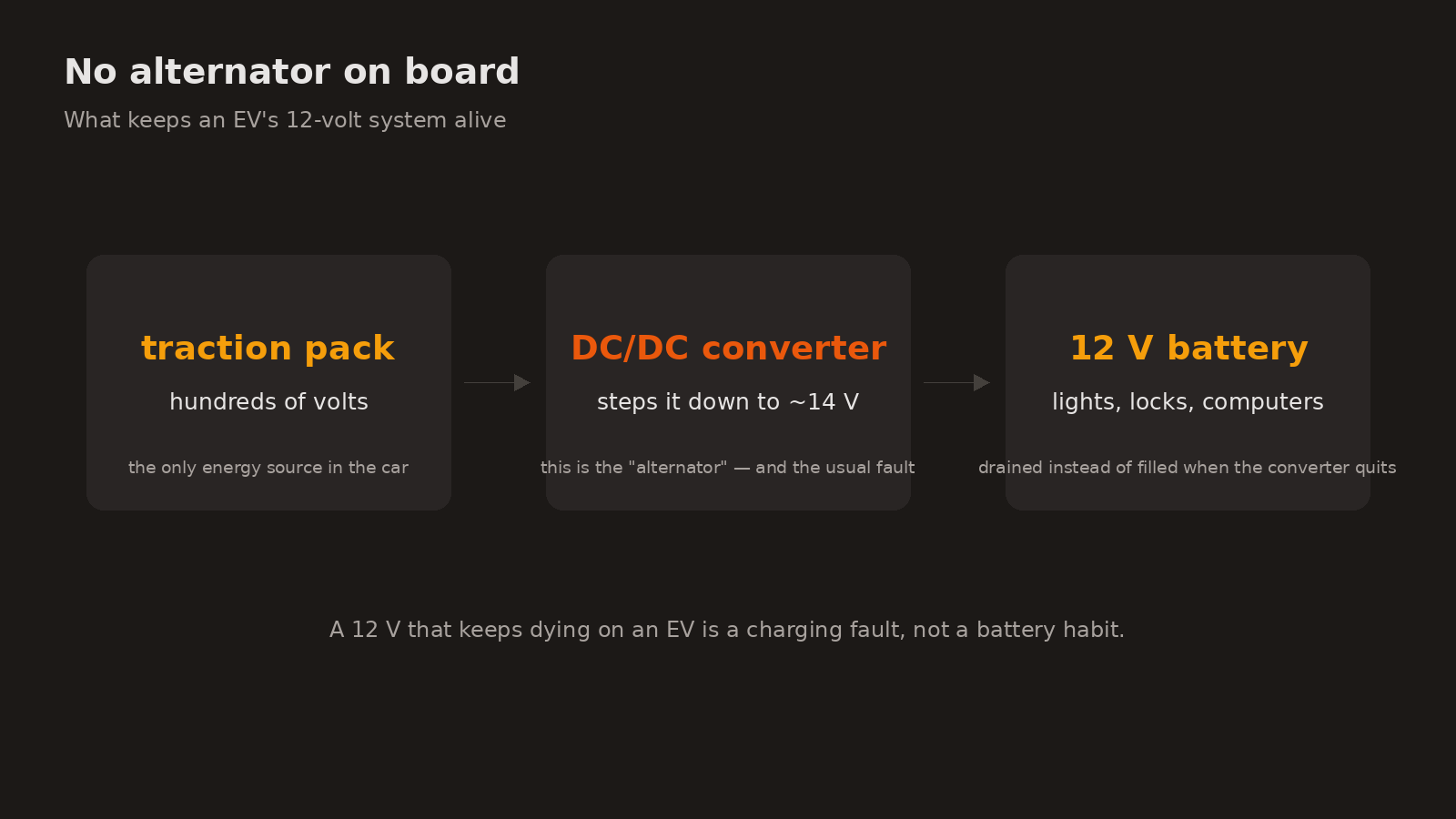
Diagram: the EV twelve-volt chain — traction pack to DC/DC converter to the small battery — and why a failing converter drains it.
Information, not instruction
CarGeek is a reference, not a service manual. Its pages are written from public sources and from what other people have found, never from a manufacturer's own service information, so they can be wrong or incomplete for your particular vehicle. Some of what they describe carries real risk: high voltage, fuel under pressure, stored energy, hot and moving parts.
Have anything you intend to act on checked by a trained person against the manufacturer's own procedure for your vehicle. Nothing here replaces that procedure.