On an electric car, a 12 V battery that keeps dying is a charging fault
Which produces a failure that catches almost everybody. When the converter stops charging properly — derated for temperature, or faulted outright — the 12 V battery is drained instead of filled. Lights dim, modules start reporting nonsense, and eventually the car will not power on at all. **It looks exactly like a dead 12 V battery, so a 12 V battery gets fitted, and the new one flattens too.** A perfectly healthy traction pack sits underneath the whole time.
**The measurement that settles it takes two minutes.** With the car powered on and ready to drive, put a meter across the 12 V battery terminals. You should see roughly 13.5 to 14.5 volts — the same as a running petrol car. **Twelve-point-something, with the car switched on, means it is not being charged**, and that is the converter's side of the fence rather than the battery's.
Two codes describe that side directly: P0C38 for the converter's temperature sensing, and P0CA2 for the step-down conversion underperforming. But you do not need a code to apply the rule.
The rule: on an electrified car, replace a 12 V battery once. **If the second one goes flat, stop buying batteries.**
Archivos adjuntos
-
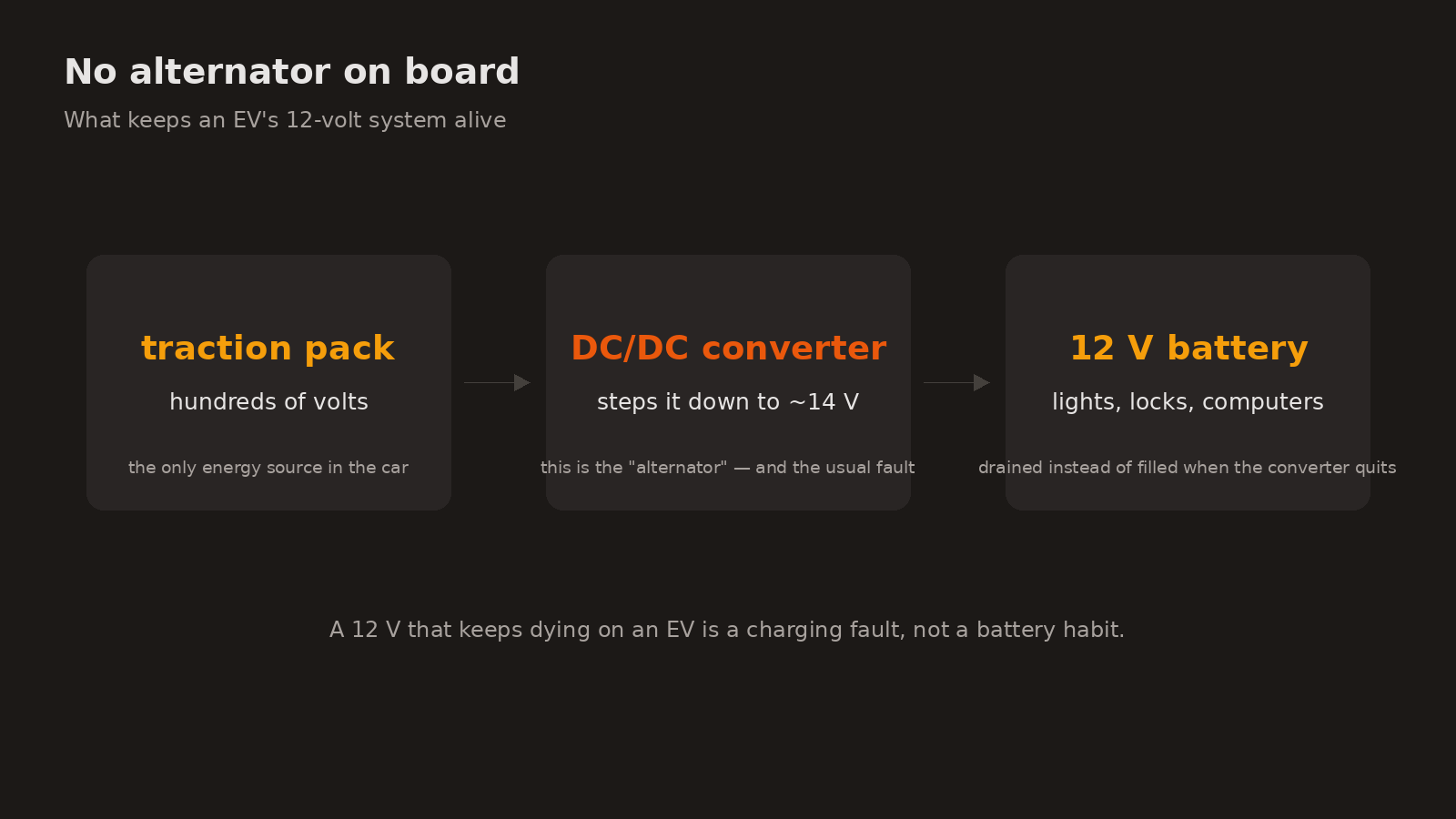
Diagram: the EV twelve-volt chain — traction pack to DC/DC converter to the small battery — and why a failing converter drains it.
Información, no instrucciones
CarGeek es una obra de referencia, no un manual de taller. Sus páginas se escriben a partir de fuentes públicas y de lo que otras personas han comprobado, nunca a partir de la documentación de servicio del fabricante, de modo que pueden ser incorrectas o incompletas para su vehículo concreto. Parte de lo que describen entraña un riesgo real: alta tensión, combustible a presión, energía acumulada y piezas calientes o en movimiento.
Antes de actuar sobre cualquier indicación, hágala verificar por una persona con formación técnica siguiendo el procedimiento propio del fabricante para su vehículo. Nada de lo que hay aquí sustituye ese procedimiento.