نکته
کد خطا P0C38
On an electric car, a 12 V battery that keeps dying is a charging fault
HO
@hhh
1 ماه پیش
An electric car still has a 12-volt battery, and it still runs the lights, the computers, the pumps and the door locks. What it does not have is an alternator. **The DC/DC converter does that job** — stepping the traction pack's several hundred volts down to the twelve or so everything else expects.
Which produces a failure that catches almost everybody. When the converter stops charging properly — derated for temperature, or faulted outright — the 12 V battery is drained instead of filled. Lights dim, modules start reporting nonsense, and eventually the car will not power on at all. **It looks exactly like a dead 12 V battery, so a 12 V battery gets fitted, and the new one flattens too.** A perfectly healthy traction pack sits underneath the whole time.
**The measurement that settles it takes two minutes.** With the car powered on and ready to drive, put a meter across the 12 V battery terminals. You should see roughly 13.5 to 14.5 volts — the same as a running petrol car. **Twelve-point-something, with the car switched on, means it is not being charged**, and that is the converter's side of the fence rather than the battery's.
Two codes describe that side directly: P0C38 for the converter's temperature sensing, and P0CA2 for the step-down conversion underperforming. But you do not need a code to apply the rule.
The rule: on an electrified car, replace a 12 V battery once. **If the second one goes flat, stop buying batteries.**
Which produces a failure that catches almost everybody. When the converter stops charging properly — derated for temperature, or faulted outright — the 12 V battery is drained instead of filled. Lights dim, modules start reporting nonsense, and eventually the car will not power on at all. **It looks exactly like a dead 12 V battery, so a 12 V battery gets fitted, and the new one flattens too.** A perfectly healthy traction pack sits underneath the whole time.
**The measurement that settles it takes two minutes.** With the car powered on and ready to drive, put a meter across the 12 V battery terminals. You should see roughly 13.5 to 14.5 volts — the same as a running petrol car. **Twelve-point-something, with the car switched on, means it is not being charged**, and that is the converter's side of the fence rather than the battery's.
Two codes describe that side directly: P0C38 for the converter's temperature sensing, and P0CA2 for the step-down conversion underperforming. But you do not need a code to apply the rule.
The rule: on an electrified car, replace a 12 V battery once. **If the second one goes flat, stop buying batteries.**
پیوستها
-
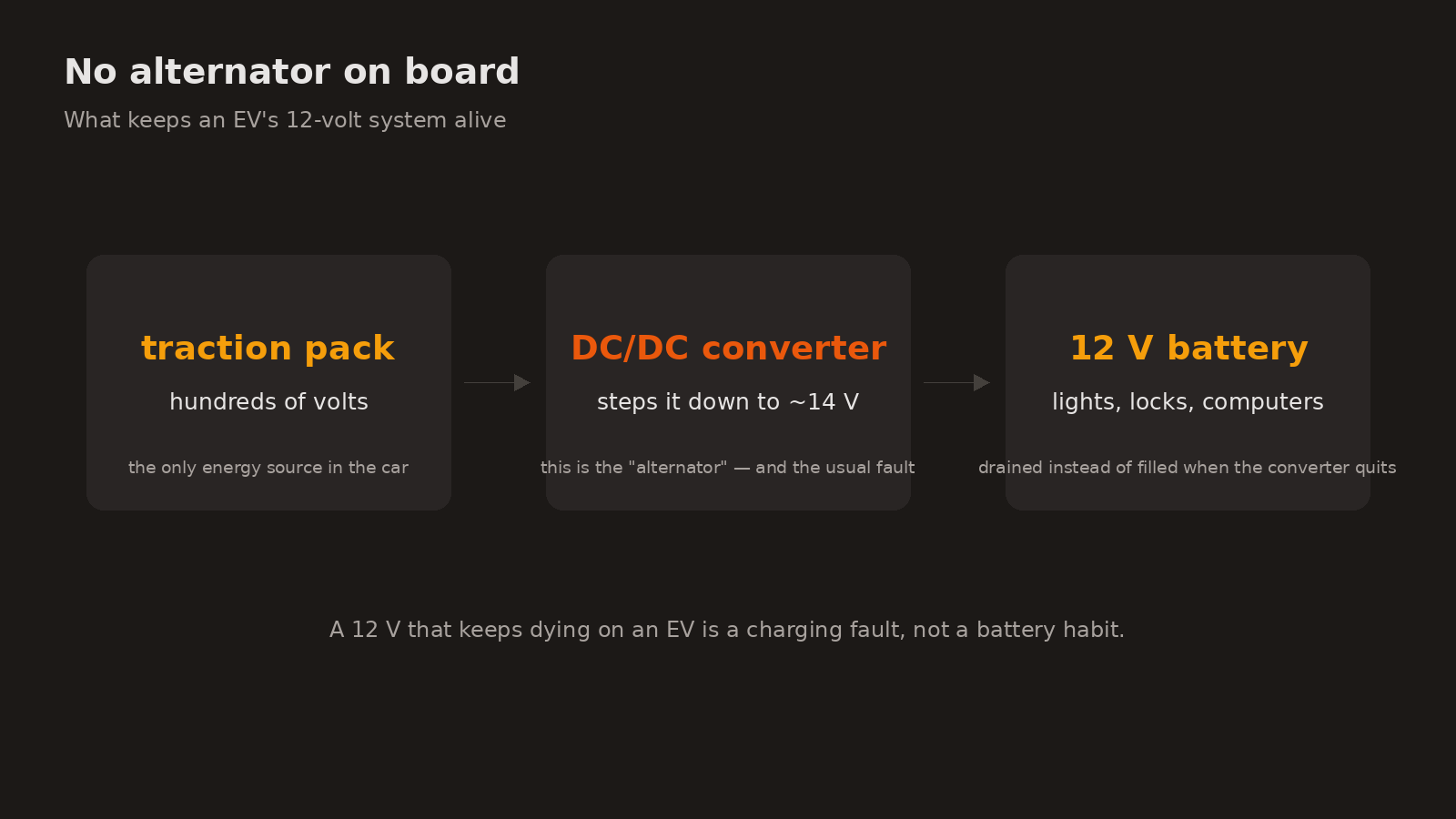
Diagram: the EV twelve-volt chain — traction pack to DC/DC converter to the small battery — and why a failing converter drains it.
اطلاعات است، نه دستورالعمل
سایت CarGeek یک مرجع است، نه دفترچه تعمیرگاهی. صفحههای آن از منابع عمومی و از آنچه دیگران تجربه کردهاند نوشته میشود، نه از مستندات سرویس خودِ سازنده؛ بنابراین ممکن است برای خودروی خاص شما نادرست یا ناقص باشد. بخشی از آنچه شرح داده میشود خطر واقعی دارد: ولتاژ بالا، سوخت تحت فشار، انرژی ذخیرهشده و قطعات داغ یا متحرک.
هر چیزی را که میخواهید بر اساس آن اقدام کنید، نخست فردی آموزشدیده بر پایه دستورالعمل خودِ سازنده برای خودروی شما بررسی کند. هیچچیز در اینجا جایگزین آن دستورالعمل نیست.