On an electric car, a 12 V battery that keeps dying is a charging fault
Which produces a failure that catches almost everybody. When the converter stops charging properly — derated for temperature, or faulted outright — the 12 V battery is drained instead of filled. Lights dim, modules start reporting nonsense, and eventually the car will not power on at all. **It looks exactly like a dead 12 V battery, so a 12 V battery gets fitted, and the new one flattens too.** A perfectly healthy traction pack sits underneath the whole time.
**The measurement that settles it takes two minutes.** With the car powered on and ready to drive, put a meter across the 12 V battery terminals. You should see roughly 13.5 to 14.5 volts — the same as a running petrol car. **Twelve-point-something, with the car switched on, means it is not being charged**, and that is the converter's side of the fence rather than the battery's.
Two codes describe that side directly: P0C38 for the converter's temperature sensing, and P0CA2 for the step-down conversion underperforming. But you do not need a code to apply the rule.
The rule: on an electrified car, replace a 12 V battery once. **If the second one goes flat, stop buying batteries.**
Anhänge
-
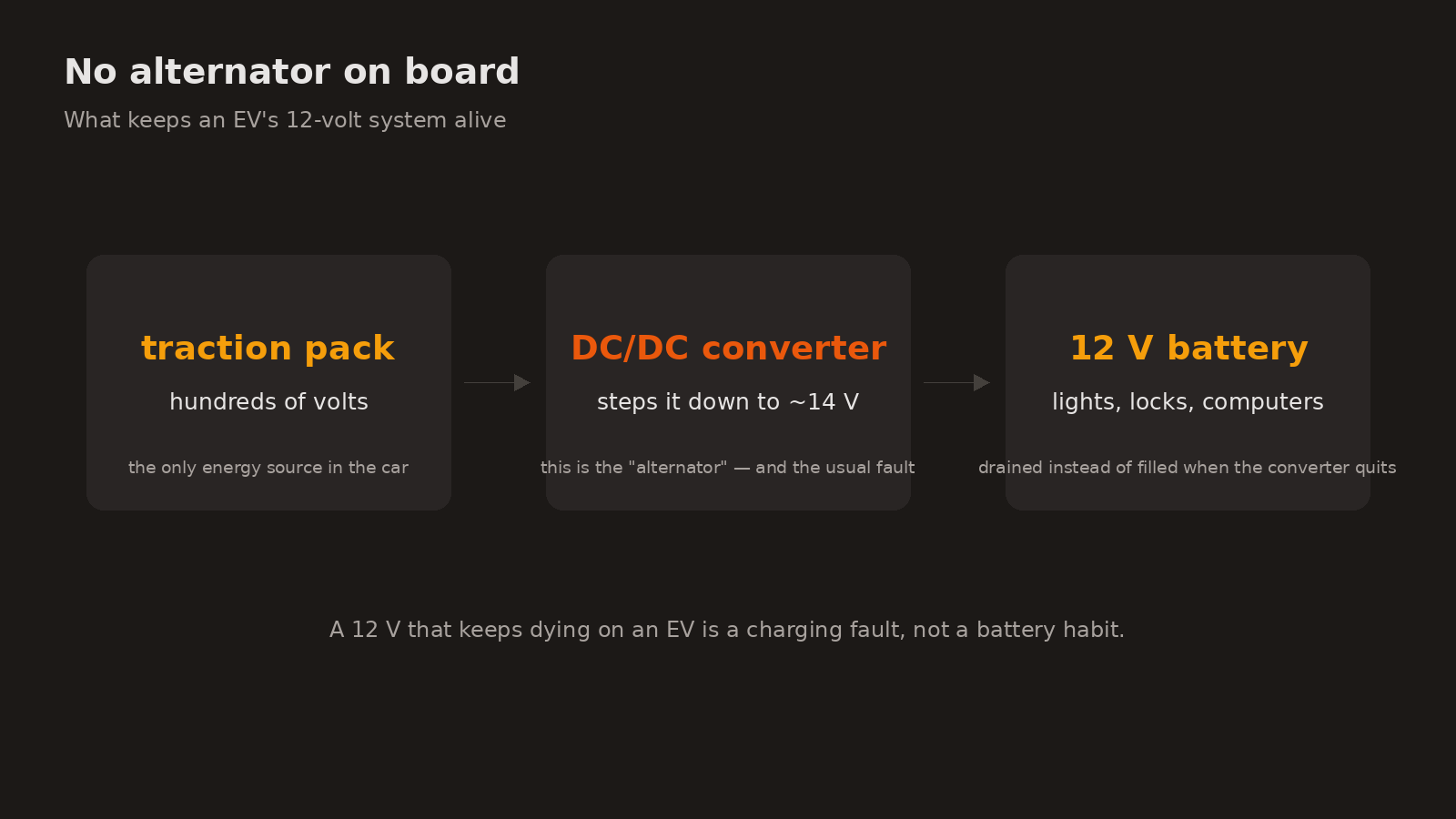
Diagram: the EV twelve-volt chain — traction pack to DC/DC converter to the small battery — and why a failing converter drains it.
Information, keine Handlungsanweisung
CarGeek ist ein Nachschlagewerk, kein Werkstatthandbuch. Die Seiten entstehen aus öffentlichen Quellen und aus dem, was andere festgestellt haben, nie aus den Serviceunterlagen des Herstellers; für Ihr konkretes Fahrzeug können sie daher falsch oder unvollständig sein. Ein Teil des Beschriebenen birgt echte Gefahren: Hochspannung, Kraftstoff unter Druck, gespeicherte Energie sowie heiße oder bewegte Teile.
Lassen Sie alles, wonach Sie handeln wollen, von einer fachlich geschulten Person anhand der herstellereigenen Vorgehensweise für Ihr Fahrzeug prüfen. Nichts hiervon ersetzt diese Vorgehensweise.